3 months ago
164
3 months ago
164
When Phil Lord and Christopher Miller were starting out in Hollywood – long before they became a popcorn-flick industry unto themselves with The Lego Movie, the Jump Street films, the Spider-Verse franchise and their latest, Project Hail Mary – the duo found themselves summoned before a panel at the formidable Directors Guild of America (DGA). Lord and Miller wanted to be credited, as they would be for the rest of their career, as co-directors, and that was something the DGA – which, as Miller puts it, prefers “one set of hands on the steering wheel” – was uneasy about. In order to get approval, the pair would have to plead their case to some very famous peers.
“It was like a Senate hearing,” says Miller, his eyes widening at the memory. “Steven Spielberg and Jon Favreau and all these people asking questions like: ‘All right, but what happens if one of you gets sick? What are you gonna do?’ It was … interesting.”
Fortunately, justices Spielberg and Favreau ruled in the duo’s favour. Meeting Lord and Miller in a London hotel suite, it’s hard to imagine the verdict going any other way. Professionally, they come as a pair. Speak to the duo for more than a few minutes and its clear that they operate on a wavelength shared with few others. They don’t finish each other’s sentences as much as finish each other’s ideas; a mind-meld forged when the Miami-born Lord and Miller, who is from near Seattle, met as undergraduates at the Ivy League Dartmouth college.
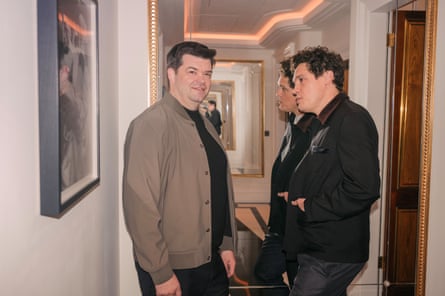
The pair’s inseparability can be confusing for the rest of us. In a truly mortifying moment, I greet the duo by calling Miller (science-geek haircut, stocky, shyly smiling) “Phil”, and Lord (think Adam Brody but with a slight shock of Eraserhead hair) “Chris”, something they thankfully laugh off. It’s evidently not the first time they’ve been mixed up: they joke that, on sets in their early jobs, they considered wearing name tags. While Lord is keen to point out there are “slight differences and areas of interest between us”, as a directing duo, they operate as a single unit. “Like any good partnership, every once in a while the polarities flip and one of us winds up compensating for the other.”
On screen, their shared taste, sensibility and humour has translated into a distinctive style of film-making, full of surreal humour, wild tonal shifts and dizzying visual invention. Whether they’ve directed something, or quietly overseen things via their hugely successful Lord Miller Productions, you can usually tell you’re watching one of their movies within minutes of it starting, from the sheer flurry of colour and imagination being flung at you from the screen. Even the strictures of the studio system don’t deter them: their animated Spider-Verse films rejected the thudding functionality of most superhero movies in favour of a kaleidoscopic, multidimensional head trip; almost a full decade before Greta Gerwig’s Barbie, they were smuggling consumer satire and weirdo comedy skits into the product-placement fest that was The Lego Movie.

Lord and Miller’s latest is another big swing: a deep-space adventure for the age of climate collapse. Adapted from Andy Weir’s hard science novel, Project Hail Mary stars Ryan Gosling as Dr Ryland Grace, a high school science teacher who wakes up to find himself the only surviving occupant of a spaceship parked in some distant galaxy, with no real memory of how he got there.
Through flashbacks, we learn that Grace was recruited by Sandra Hüller’s steely government agent for a mission to stop a parasitic microbe from blotting out the sun and every other star in the universe. Only one star, it seems, is immune to this nasty space virus and Grace has been given a one-way ticket on a rocket ship to find out why; there’s only enough fuel to take samples from the star, send them back and then – gulp – slowly expire in deep space. With the rest of the crew already dead, Grace must complete the mission on his own, a task that will require him to make contact with, and work alongside, an actual alien.
The film is far less doomy than that “space suicide mission” synopsis suggests – a winningly geeky sci-fi concoction that mixes together The Martian (another adaptation of an Andy Weir novel) with Close Encounters of the Third Kind, although there’s a lot of Lord’s and Miller’s own particular filmic formula stirred in there, too. After optioning the rights to the book, Gosling sought the pair out, sending them The Martian screenwriter Drew Goddard’s manuscript for the film. Is it common for one of the most famous actors in the world to stick a script in the post?
“The short answer is: no. That’s not common,” laughs Lord. Miller Jumps in: “But we had known Ryan for over a decade. We’d occasionally have breakfast with him and talk about working together someday, so he made it happen.”
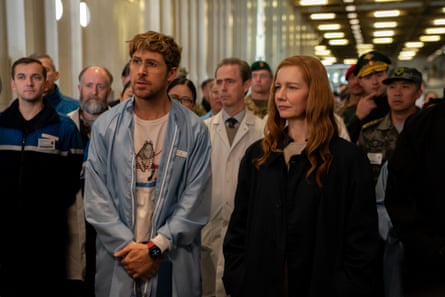
Once Lord and Miller read the script, “it was a pretty easy yes”, says Miller. Immediately, they say, they could picture Gosling in the role, utilising what Miller calls “that big, old-school movie star stuff” that he believes Gosling shares with greats like Tom Hanks or Jimmy Stewart. “You’ve seen him be funny in a movie,” says Lord. “You’ve seen him break your heart in a movie. This is a movie where he gets to deploy all of his talents.”
He certainly needs them. For large swathes of the film, Gosling’s only on-screen partner is a scuttling, labrador-sized alien his character has named Rocky. Given that Rocky communicates only in singsong chirrups and lacks any Disney-ish anthropomorphised features, it is one of the film’s biggest achievements that his relationship with Grace is genuinely affecting. Much of that is down to Gosling, whose “great magic trick is that, like Warren Beatty or Robert Redford, he’s a handsome movie star who is able to elevate the other characters in the scene above him”, says Lord – but it’s also thanks to the spirit of can-do collaboration promoted by the film. Watching Grace and Rocky problem-solve together, despite the fact that, as Miller notes, they “don’t look the same, or speak the same language or breathe the same air”, is genuinely stirring.

Like The Lego Movie, which Lord and Miller described at the time as “an anti-totalitarian film for children”, Project Hail Mary has smuggled a utopian message into a mass-entertainment product. Here, says Miller, it’s “the idea that communication and empathy can help you solve what seem like impossible problems”. This is hardly a firebrand notion, but at a moment when international cooperation over the climate crisis – or, well, anything – seems a nonstarter, there’s something almost revolutionary about it. “It might seem like wish-casting. But I don’t think it is,” Lord maintains.
It’s a spirit of collaboration Lord and Miller spotted while making Project Hail Mary, their VFX teams working alongside puppeteers to create Rocky – and something lacking in Hollywood’s current bete noire, artificial intelligence, which Miller says can only “regurgitate the average of things that have come before it”. AI, the pair note, could never conjure up any of the film’s happy quirks and accidents: the jumper Gosling demanded he wear in tribute to a fox he encountered while locked out of his London flat at midnight, say; or the scene where Hüller’s character belts out a karaoke rendition of Harry Styles’s Sign of the Times, included on the spot after Gosling and the crew noticed her terrific singing voice between setups.
Happy accidents are something Lord and Miller lean into. To them, even setbacks have positives attached. There’s a great segment in a screenwriting masterclass they gave to Bafta in 2017, where they outline the many failures they’ve experienced and what they taught them. It’s quite the list: they were sacked, rehired and almost sacked again on their first movie, the buoyant animated comedy Cloudy With a Chance of Meatballs; their 2002 MTV show Clone High – a very funny cartoon sitcom about a group of teenage clones (Cleopatra, Abraham Lincoln, Joan of Arc) – was cancelled after a mass hunger-strike in New Delhi over the depiction of one of its characters, a hard-partying frat-boy Gandhi known as G-Man. (The show was revived in 2023, minus the Gandhi character.)

Even more high-profile was the incident three months after that masterclass, when the pair were sacked from the Star Wars prequel movie Solo over creative differences. (Ron Howard took over directing duties for the film, which would lose more than $100m at the box office.) Nearly a decade, and a string of global hits, on from the Solo debacle, I wonder if the pair think it would happen the same way today. Surely Lord and Miller are too big and too bankable to be treated in that way now? They aren’t so sure. “It can happen anywhere. It can happen to anybody,” says Miller. “Talk to any film-makers who are a generation ahead of us – they all have war stories,” adds Lord.
All you can do in that situation, then, is take your licks and move on. The pair, both big basketball fans, follow the old sports credo that there are only two options: winning and learning. “You get to be like: OK, I got some reps in. And now, on the next one, I’m going to bring that knowledge with me,” says Miller. “It becomes a chip on your shoulder that makes you play, aggressively,” adds Lord, a hint of steeliness in his voice.
Besides, bouncing back is far easier to do when you have a co-director to do it with. “It’s nice having a person with you in the foxhole,” says Miller. “Whatever is coming down the pipe, you can look at each other and, if you both think it, then you’re like: OK, I feel confident in my point of view.” Surely that’s an ethos that Spielberg, Favreau and the rest of the DGA could get on board with.