2 months ago
90
2 months ago
90
Californians are frustrated and underwhelmed as they head to the polls to cast their ballots in Tuesday’s primary election, where voters will eliminate all but two candidates in the volatile race for governor, the messy battle for Los Angeles mayor and a series of high-stakes congressional contests.
In the marquee race to succeed term-limited Democratic governor Gavin Newsom a trio of new surveys shows Democrat Xavier Becerra pulling slightly ahead as progressive Tom Steyer and Republican Steve Hilton scrap for the second-place spot to advance in the state’s nonpartisan primary. Meanwhile, voters in Los Angeles remain divided over whether to stand by embattled mayor Karen Bass or to elevate her challengers.
At the federal level, voters will set the stage for a November showdown in the state’s newly redrawn congressional districts, choosing their candidates for November in a series of House races that are poised to play an outsized and potentially decisive role in the fight for power in Washington.
Under California’s quirky nonpartisan primary system, all candidates regardless of party appear on the same ballot and only the top two vote-getters advance to November.
The turbulence surrounding Tuesday’s primary contests have created a political environment unlike any the Golden state has seen in years, according to longtime political observers. California Democrats hold a roughly two-to-one advantage over Republicans in voter registration. In 2024, Donald Trump lost the state by more than 20 percentage points, and no Republican has won statewide office since governor Arnold Schwarzenegger’s 2006 re-election.
Yet this year, Democratic officials are confronting competing demands from their voters who want them to do more to address the crippling cost-of-living crisis and to take a harder line against the Trump administration.
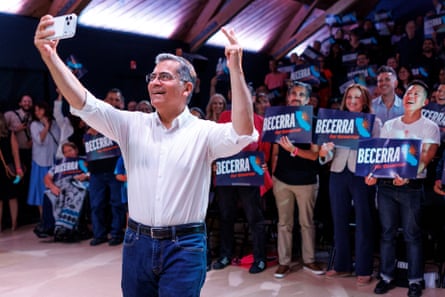
“About half of Californians feel that the state is going in the wrong direction,” said Mark Baldassare, the survey director at the nonpartisan Public Policy Institute of California (PPIC). But, he said, their dissatisfaction with the state of affairs in California is “overshadowed by a greater unhappiness about the state of the nation right now”.
Three-quarters of Californians say the nation is headed in the wrong direction, according to the latest PPIC survey, the highest share since 2003, when pollsters first asked the question, while only about 30% of likely voters approve of Trump’s job performance.
Concerns that the Trump administration might attempt to interfere in the state’s elections have alarmed Democratic voters, already worried that Republican redistricting efforts would push congressional control out of reach.
Yet with the president’s approval rating falling and inflation rising, amid an unpopular war with Iran, and historical trends favoring the party out of power, Democrats nationally enter the midterm elections with considerable strength, tipped to win control of the House and potentially retake the Senate.
One ballot, no consensus candidate
In what political observers describe as the most topsy-turvy governor’s race in modern California history, a final spate of pre-election day polling suggests three candidates have emerged from an enormous field of 61 hopefuls.
The PPIC survey released last week found Becerra, the former US health and human services secretary, leading the race with 23%, followed by Hilton, the British-born former Fox News personality who has been endorsed by Trump, with 20%, and Steyer, the billionaire environmental activist who is the choice of progressives, with 15%. Republican Riverside county sheriff Chad Bianco and former US congresswoman Katie Porter also reached doubled digits. The Berkeley IGS Poll, released on Friday, similarly put Becerra, Hilton and Steyer at the front of the pack.
And the final Emerson College Polling California survey, released on Saturday, found Becerra with a growing lead – 28% – trailed closely by Steyer and Hilton, who were in a statistical tie.
Becerra’s unexpected rise – leapfrogging from the back of the pack to putative frontrunner – followed the rapid implosion of Democratic congressman Eric Swalwell’s campaign for governor amid sexual assault and harassment allegations that he has denied.

The mud-slinging has intensified as the candidates barnstormed the state in the final days before the primary, trying to ensure their place in the top two. Becerra has said he is the only candidate with the experience to solve California’s most intractable problems, while Steyer made the case that he is the only one with solutions big and bold enough to bring about the kind of structural change voters say they want.
“We are not going to let a billionaire or Trump’s handpicked candidate take over this state,” Becerra said at a rally in Long Beach on Sunday.
Delivering his closing argument in downtown Los Angeles on Sunday, Steyer said the choice was “actually very simple”. “It comes down to this,” he said. “Do you want a California for corporations, or a California for Californians?”
Hilton, meanwhile, has blamed the state’s woes on 16 years of what he calls “failed” Democratic governance and has argued that it is time for a change in political leadership.
Fears among Democrats that two Republicans could squeak through to the November general election – a possibility pollsters and political observers say is increasingly remote – has led many voters to hold on to their ballots in a strategic effort to ensure at least one Democrat advances. Voting experts and election officials are preparing for an influx of last-minute absentee ballots, which means it could take time before the preliminary results are known. As of Monday, only 16% of all ballots have been submitted, according to the voter data firm Political Data Inc.

Discontent with the status quo is shaping the race for mayor of the US’s second-biggest city.
In Los Angeles, Bass, the incumbent Democrat, is trying to overcome voter frustration about persistent homelessness, affordability, and her handling of last year’s devastating fires. Opposition to Bass has splintered among her leading challengers: progressive LA councilmember Nithya Raman, and reality TV star Spencer Pratt, a victim of the Palisades fire whose bombastic social media-driven campaign has attracted attention far beyond the city limits.
A UC Berkeley poll found a nail-bitingly close race among likely voters, with Bass at 26%, Raman at 25% and Pratt at 22%.
Democrats’ battle for the House could hinge on California
The battle for California’s 52 congressional districts may carry the biggest national consequences. Democrats need only a handful of seats to reclaim the House for the final two years of Trump’s second term, and a handful of the state’s contests are among the most competitive in the nation.
Approved overwhelmingly by voters last year, Proposition 50 allowed California to redraw its congressional lines in response to a broader redistricting war sparked by Republican efforts in other states. The redrawn districts created as many as five new opportunities for Democrats, while scrambling the political calculations for several Republican incumbents, including congressman Kevin Kiley, who left the party and registered as an independent as he faces a tough re-election, and late congressman Doug LaMalfa, whose death earlier this year set off a fierce contest to succeed him in his newly redrawn district.
Tuesday’s primary contests will not determine whether Democrats were successful in their redrawing, but they will bring into focus the head-to-head matchups in November.
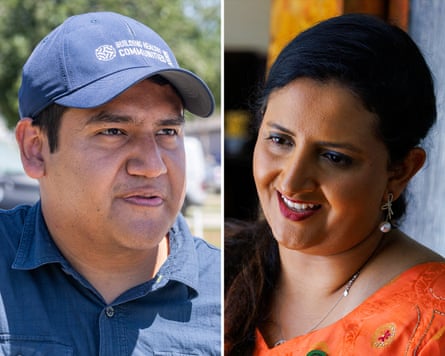
One of the most closely watched House races will take place in the central valley, where Republican congressman David Valadao is defending his seat, which now leans slightly Democratic. The Democrats vying to replace him represent the ideological span of the party, with Bernie Sanders-endorsed political newcomer Randy Villegas facing off against Jasmeet Bains, a moderate state assembly member who is running with the backing of the Democratic Congressional Campaign Committee. The district remains one of Democrats’ top pickup opportunities.
The redistricting fight has also produced a contentious Republican-on-Republican showdown in Orange county, where longtime GOP congressman Ken Calvert and fellow Republican congresswoman Young Kim have been drawn into the same reconfigured 40th district, setting up a bitter battle to advance.
The opportunity to flip as many as five Republican-held House seats in California has become all the more crucial for Democrats following a US supreme court decision undermining the Voting Rights Act. The ruling last month has had a cascading effect as Republican-led states across the south race to redraw their maps, unraveling majority-Black districts.
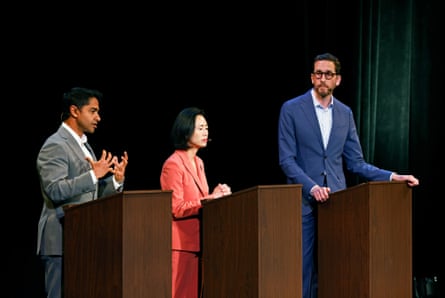
In progressive San Francisco, the bruising race to succeed retiring former House speaker Nancy Pelosi has become a fulcrum for the many internal fights animating the party – on ideology, economic populism, how to take on Trump and whether Israel committed a genocide in Gaza. Amid the turmoil, Pelosi has endorsed Connie Chan, a San Francisco supervisor, who is running against Scott Wiener, a Democratic state senator known for championing legislation to ramp up housing production and enshrining LGBTQ+ rights, and Saikat Chakrabarti, a former tech executive who served as Congresswoman Alexandria Ocasio-Cortez’s first chief of staff.
Though California is expected to remain firmly Democratic and deeply resistant to Trump, the elections on Tuesday may serve as an early barometer for the party amid the noisy debate over how it moves forward.
“If it’s a Xavier Becerra and a Karen Bass, it says a lot about the establishment – and maybe our politics haven’t shifted as much as we thought,” said Sara Sadhwani, a political science professor at Pomona College. “If it’s a Tom Steyer and a Nithya Raman, maybe we’re making a real leftward turn here – and people are just fed up with the establishment.”