3 months ago
126
3 months ago
126
Freddy Waldhausen Gordon, a 15-year-old from George Heriot’s school, Edinburgh, came through with a stunning burst to capture the annual British Rapidplay championship in Peterborough with a score of 9.5/11, defeating the top seeded GM, Gawain Maroroa Jones, in the final round in a must-win game by a checkmating attack where White’s queen and both rooks all invaded Black’s rear rank.
Maroroa Jones was in trouble early in the decisive game, soon had to concede rook for knight, and a second loss of the exchange followed at move 32. At the end, 39 Rxg7+ and 40 Qg8 mate could only be delayed by Black giving up his queen.
It was the 37th staging of the British Rapidplay, whose fast time limit of all the moves in 15 minutes for each player, plus a 10 seconds increment per move, makes it possible to hold an entire 11-round tournament in a single weekend. More than 200 players competed. No Scot had ever won it previously. First prize was £1500. The Four Nations Chess League organisation on behalf of the English Chess Federation was excellent.
Final scores were Waldhausen Gordon (Scotland) 9.5/11, Jones and Shreyas Royal (England) 9, Yichen Han (Netherlands), 12-year-old Supratit Banerjee and Siva Mahadevan (India) 8.5. Eight players on 8 points included Trisha Kanyamarala (Ireland), Harriet Hunt (England), and 11-year-old Bodhana Sivanandan (England), who tied for the women’s title. All three women’s co-champions received £500.
Waldhausen Gordon, Royal, Banerjee and Sivanandan are teenagers or pre-teens, but whereas he last three are all being helped with their tournament expenses and coaching by the £1.5m grant which the chancellor, Rachel Reeves, has made available for the most promising English talents, Waldhausen Gordon will receive precisely zero due to devolution rules.
Chess Scotland officials have been defeated in their attempts to secure help from Holyrood for either the national team, for which Waldhausen Gordon was a star performer at the 2025 European Championships in Batumi, Georgia, or for the teenager personally.
The Chess Scotland chair, Alex McFarlane, wrote in the English Chess Forum: “As an example of the frustration that can be encountered, I was seeking money from Glasgow. I met with someone from leisure who was sympathetic but not in their remit so try culture. Same result but this time I was told to try cducation. I did, but was met by ‘Sorry, try leisure.’ I admit I gave up at that point.”
Waldhausen Gordon is already proving himself as a candidate for Scotland’s most exciting chess talent of all time, potentially surpassing the three-time British champion Jonathan Rowson and George Henry Mackenzie, who won at Frankfurt 1887 ahead of most of the elite players of his era.
In one of the chess.com Titled Tuesday events in January 2025, Waldhausen Gordon even defeated the world No 1, Magnus Carlsen, when the Norwegian overstepped the time limit in an ending a pawn down with a +1.54 advantage for the Scot.
Waldhaussen Gordon has made a quantum jump in the past few weeks. Last month he achieved his final qualification for the IM title in Graz, Austria, while in Peterborough last weekend he already performed at GM level, with a tournament performance rating of 2613 against what would have been the GM norm of 2600 in a classical event.
Maroroa Jones may well consider himself unlucky. The Yorkshire grandmaster played a near-perfect tournament, starting with eight straight victories, drawing easily with Black against his assumed main rival, Michael Adams, in round nine, drawing again against the solid Royal in round 10, then finding himself overwhelmed by the Scot at the death.
Royal was another who did little wrong, but fell half a point short. England’s youngest grandmaster, 17, had six Blacks, including a draw against Jones which went down to bare kings. His final round victory, complete with a queen sacrifice, was among his best wins.
Banerjee is fast emerging as the jewel in the crown in Reeves’s investment. The Sutton Grammar pupil, 12, who spends only an hour or two on chess on weekday evenings due to school homework, qualified for his first IM norm at the 2025 British Championship and continued his fine run last m onth when he won chess.com’s competitive under-13 online championship ahead of an international field.
At Peterborough, Banerjee was unbeaten with a 2498 performance, which would have been easily an IM norm in a classical tournament. His results included a final round win over the 2024 Rapidplay champion, GM Daniel Gormally, where his clever tactic snared a knight and the game, plus a victory over the strong IM Peter Roberson where he ruthlessly exploited his opponent’s poor selection of a square for the queen at move 24.
The three women co-champions all scored impressively. An 8/11 total is well above the norm for female players in a mixed event. Hunt, the former world under-20 girls champion, met by far the strongest field of the trio. Kanyamarala lost in round one, but recovered well. Sivanandan was lucky in the final round when IM Richard Bates forgot about his clock and lost on time in a drawn position.
Sivanandan is being freely compared to the all-time Nos 1 and 2 women, Judit Polgar and Hou Yifan, but the two legends both made huge jumps in strength from age 11 onwards. It remains to be seen whether the talented Harrow schoolgirl can match their pace.
Next Wednesday, Sivanandan will start among the 436 players in the historic Reykjavik Open, staged annually since 1964 when Mikhail Tal won, and including a rest day excursion to Bobby Fischer’s grave. Her target will be her second WGM norm, following her first in France last year, and requiring a 2400 performance, which she missed only narrowly in Cannes last month.
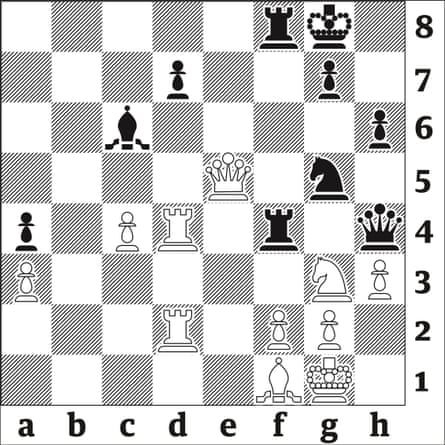
4016: 1…Nxh3+! 2 gxh3 ( if 2 Kh2 Nxf2+ 3 Kg1 Ng4 soon leads to mate) Qxg3+! 3 fxg3 Rxf1+ 4 Kh2 Rh1 mate.