3 hours ago
10
3 hours ago
10
In January 1969, João Saldanha was appointed as Brazil’s coach. Saldanha was barely a coach – he had had a brief spell in charge of Botafogo more than a decade earlier. He was an immensely popular football journalist, who with typewriter or microphone had the fluent gift of communication, talking about the game in language that was both fresh and straightforward, easy to understand. And he was so much more. He was a charismatic powerhouse, who claimed to have popped up at many key moments in history, usually in the service of international communism. Because, yes, at the right-wing height of Brazil’s military dictatorship, a communist was appointed to coach the national football team.
João Havelange, the president of the Brazilian sports confederation, knew what he was doing. At a stroke, he had cut away all the intrigue and politicking which was surrounding the side. Saldanha’s opening move was to announce his starting lineup and his reserves. No argument, no discussion, no balancing off one region against the other. Just one man picking the team. And it worked. Brazil sailed through qualification for the 1970 World Cup.
But Saldanha was never likely to make it all the way to Mexico, for a number of reasons. One, obviously, was his politics. It seems clear that authorities in Brasília were gunning for him.
Another reason is his own erratic behaviour. He had a penchant for waving his gun around, he was observed drunk in public. But the main reason that Saldanha was sacked was almost certainly pragmatic – it was hard to imagine his Brazil winning the World Cup. He played an old style 4-2-4 – fine against the likes of Venezuela in qualification. Mexico would be another matter. His last matches in charge were a couple of friendlies at home to Argentina in early March, a 2-1 win preceded by a 2-0 defeat, a match where his relationship with Pelé broke down.
Saldanha was replaced by Mario Zagallo, the “little ant” from the triumphs of 58 and 62. “I took over without a fixed idea of what I was going to do,” he told me many years later, “but I knew there would be a lot of changes, because I didn’t accept the idea of 4-2-4.” But before thinking about tactics, Zagallo had to sort out a key personal relationship – the one with Pelé.
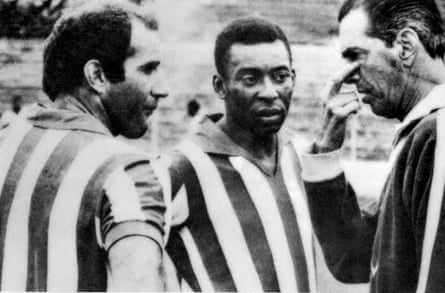
It seems bizarre in hindsight – from the point of view of July 1970, let alone well into the 21st century. But Pelé could easily not have gone to the Mexico World Cup.
Saldanha had been chuntering about him, hinting that Pelé owed his place in the team to financial considerations, questioning his fitness as well as his eyesight. He was backed up by Aymore Moreira, who when Saldanha was sacked wrote an article under the headline “I, too, would have dropped Pelé”. He was specific. “The problem of the team was structural. And it has a name – Pelé. He can no longer help out the men in midfield because physically he does not have it in him to work back and forth.”
Otto Glória, who had been in charge of Portugal in 1966, had been a candidate to replace Saldanha. “The way he is playing,” said Glória, “Pelé would not have a place in my team. He is not fighting in the area or working back as part of the midfield block.” An opinion poll in Placar, the new football magazine, showed that a significant number of people were in favour of dropping Pelé, from 27% in São Paulo (the state where he played with Santos) to 59% in the state of Minas Gerais (where Dirceu Lopes was a competitor).
Zagallo wanted to nip this in the bud. In the first training session, he reassured Pelé of his importance. The team, said Zagallo, would be Pelé and 10 more. But who would be the 10? Here, Zagallo had a luxury that modern international coaches can only dream of – months on the training ground to get the blend right.
He was not happy with his defence. And so Wilson Piazza was withdrawn from midfield to supply more quality, opening up space for the young Clodoaldo, who had taken over from Zito at Santos as the classy and combative box-to-box midfielder. His lung power would create space for Gérson, the midfield pass master. Zagallo wanted Paulo César on the left wing, but it was not working. And so in came Rivellino – whose natural position was central midfield creator – as a false left-winger. This could have meant that the team were blunt down the left flank, especially after the steady but limited Everaldo replaced the talented but flaky Marco Antônio at left-back. But Tostão was left-footed. He could drift out to the flank.
Tostão and Pelé had played together in the qualifiers. But Zagallo was initially not convinced, thinking that they were too similar. He wanted an out-and-out centre-forward, and brought players of this type into the squad. But Tostão, recovered from a detached retina, was technically brilliant and mentally sharp, and this made him an excellent partner for Pelé, who needed someone with whom to combine at pace. Improvised as a centre-forward, not his natural position, Tostão wrote of himself years afterwards that he “was slow and offered little threat to the goal”. But it worked because of Jairzinho, who would burst infield from the right wing supplying speed and physical presence inside the area. The parts fitted together and, going forward at least, the team gelled.
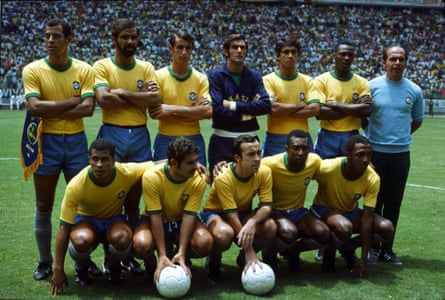
But how to defend? There was no Hilderaldo Bellini, Mauro Ramos, Orlando Peçanha. Zagallo’s idea, then, was to play as “a block, compact, leaving only Tostão upfield. Jairzinho, Pelé, Rivellino, all tracked back to help Clodoaldo and Gérson. We brought our team back behind the line of the ball. I’m happy to see the team in terms of 4-5-1.”
And if Brazil had moved forward in tactical terms, the same was emphatically true of physical preparation. Brazil already attached great importance to this area. Indeed, one of Havelange’s errors in 1966 had been to bring in a specialist with a background in martial arts rather than football. Now they put themselves ahead of the curve once more.
The dictatorship that took charge of the country in 1964 was an alliance between the military and the technocrats, one which made its presence felt very strongly in getting the national team into shape for Mexico. The technocrat class loved the data produced in physical preparation – what they could measure they could manage – and so, with military involvement and even some influence from Nasa, Pelé and company were prepared for the conditions in which the World Cup would be played; both the extreme summer heat of lunchtime Guadalajara and the altitude of Mexico City. This is the main reason that Brazil were the first team to arrive for the competition – with Zagallo promising that they would be the last to leave. Once the ball began rolling, could they live up to his words?
This is an edited extract from Mundiales: A South American History of the World Cup (Pitch Publishing) by Mark Biram and Tim Vickery. To support the Guardian buy a copy at guardianbookshop.com. Delivery charges may apply.