3 months ago
70
3 months ago
70
Key events Show key events only Please turn on JavaScript to use this feature
We have some texts, but we do not have the big one yet (the global mutirão decision).
So far, we have the final versions on the mitigation work programme, the global stocktake, gender, loss and damage, and the global environment facility.
We will bring you more when we have it.

Damien Gayle
Civil society campaigners from the developing world have accused the rich countries of spreading “duplicitous narratives” over their role in the Cop30 climate talks over the past fortnight.
As the talks in Belém, Brazil, passed the deadline for their resolution on Friday, European countries indicated they would walk away from any deal that did not include a commitment for “roadmap” to phase out fossil fuels.
Sources blamed members of a group known as the “like-minded developing countries”, a loose grouping which includes Saudi Arabia, Egypt, Iran and Bolivia for rejecting the wording.
But civil society groups, who are permitted to observe negotiations where the media are not, said the global north had refused the finance to make such a transition plausible.
“We want this to be a Cop of truth, as the Cop presidency has said it should be,” said Lidy Nacpil, the Filipino social justice activist who is coordinator of the Asian Peoples’ Movement on Debt and Development, late on Friday.
“And the narrative that is the developing countries that are not ambitious is not the truth. It is part of many duplicitous narratives that are coming out of this Cop and have come out of previous Cops.”
Speaking at an impromptu press conference in the halls of the conference centre where the summit had gone into extra time, Nacpil said: “We are the first people who have the greatest at stake, for a rapid, equitable, and just transition out of fossil fuels.
“But we cannot accept this circus over a roadmap that is offering us nothing. We cannot accept that this roadmap is now being held as an instrument to hold hostage all the other demands that we have that are equally urgent. So we reject a roadmap that has nothing in it, no climate finance, no clear commitment to a just transition, in fact, blocking it at every step.”
Tasneem Essop, of Climate Action Network International, said the EU, the UK and other rich countries had blocked progress on every single issue the developing world had asked for.
She said: “They blocked everything that the Global South needs from this Cop. And yet here we are with the EU claiming to be champions at this moment of the Cop, going out to the media declaring that they will walk out if they don’t get a road map on fossil fuels. There’s no substance to that road map.”

Even though we do not yet have a final agreement in Brazil, some have already seen enough. Writing in the Conversation this morning, Earth system scientists James Dyke and Johan Rockström say that the prospect of limiting global heating to 1.5C is over. They say that it could be brought back below that level in time, however.
This is an extract of what they have written.
The world lost the climate gamble. Now it faces a dangerous new reality
Ten years ago the world’s leaders placed a historic bet. The 2015 Paris agreement aimed to put humanity on a path to avert dangerous climate change. A decade on, with the latest climate conference ending in Belém, Brazil, without decisive action, we can definitively say humanity has lost this bet.
Warming is going to exceed 1.5°C. We are heading into “overshoot” within the next few years. The world is going to become more turbulent and more dangerous. So, what comes after failure?
Our attempt to answer that question gathered the Earth League – an international network of scientists we work with – for a meeting in Hamburg earlier this year. After months of intensive deliberation, its findings were published this week, with the conclusion that humanity is “living beyond limits”.
Exceed 1.5°C and not only do extreme climate events, like droughts, floods, fires and heatwaves grow in number and severity, impacting billions of people, we also approach tipping points for large Earth regulating systems like the Amazon rainforest and the Greenland and West Antarctic ice sheets. Tropical coral reef systems, livelihood for over 200 million people, are unlikely to cope with overshoot.
This translates to existential risks for billions of people. Not far in the future, but within the next few years for extreme events, and within decades for tipping points.

We are close to the beginning of the plenary. Our reporters on the ground say that delegates are rushing to the room. If you would like to watch along, the livestream will appear here.
Fossil fuel road map will not be in final agreement – Cop30 president
Cop30 president Andre Correa do Lago has said that a roadmap for phasing out fossil fuels will not be in the final agreement, and Brazil will take charge of the issue separately instead.
Speaking on Instagram around 8:10am local time, do Lago said he was positive that countries would back the agreement and that they had been in the negotiating halls into the early hours. “Countries worked together really well,” he told the camera.
At the end, do Lago says more on adaptation financing has been added to the text, but not language on phasing out fossil fuels, the main driver of global heating. Instead, the Brazilian government will oversee this as its own Cop30 initiative after the summit.
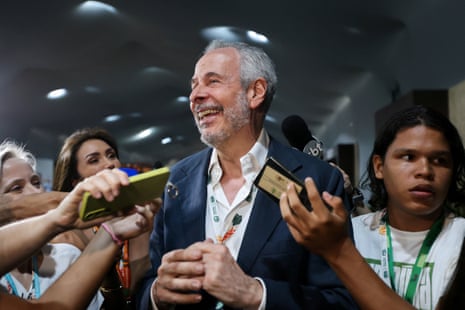
On the ground in Belem, the mood has changed ahead of the final plenary, which will begin in around 40 minutes.
“After a sleepless night in Belém, negotiations have moved in a more positive direction than many feared 12 hours ago. What’s emerging is a compromise that advances 1.5°C action, adaptation, and trade - and includes a provision that may not be called a ‘fossil fuel roadmap,’ but is clearly meant to achieve the same end. Brazil deserves credit for the energy it has invested across this COP cycle but must keep pushing. The next few hours will be pivotal in deciding whether COP30 stumbles or sprints across the finish line,” says Clare Shakya, global managing director of climate with the Nature Conservancy.
In the venue, people are already busy packing up pavilions. As my colleague Damian Carrington snapped this morning, the Saudis are already shutting up shop.
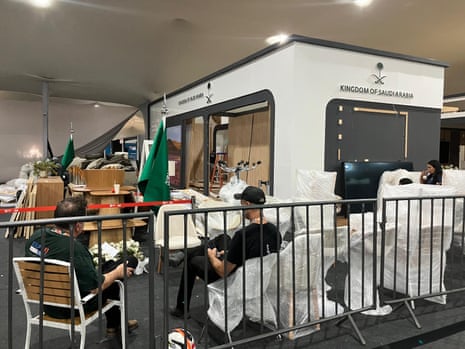

Damian Carrington
The US – by its absence not presence – has had a major impact on what appears likely to be a disappointing deal at the Cop30 climate summit. This is because the US is the only country with the power to influence Saudi Arabia, observers say.
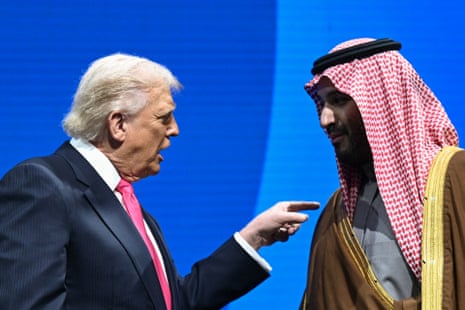
The oil-rich kingdom has a decades-long history of obstructing the climate talks to protect its lucrative industry and has been widely blamed here in Belém for leading efforts to block any mention of fossil fuels. With Donald Trump calling climate change a “con job”, the US did not send a delegation to Cop30 and is withdrawing from the Paris agreement. Saudi Crown Prince Mohammed bin Salman had a friendly meeting with Trump on Tuesday.
“Unfortunately with the departure of the US, we have lost one of the most powerful countries,” said Tom Rivett-Carnac, political strategist to the UN climate chief when the Paris agreement was done.
“In the years when I was involved in Cops, when the US is really behind an agreement and really wants to make it happen, and is prepared to exert its economic authority in bringing, for example, the Saudi Arabians round, then we can really do things,” he told the BBC.
“The trouble I think we are experiencing in Brazil is we don’t have that big push from the US and there is an emboldened attitude among the oil producing countries who feel there won’t be a consequence for them if they delay.”
Sources inside the negotiations have made the same point to the Guardian. The diplomatic might of the US, under presidents backing climate action, has often been a key factor in getting Cop deals over the line.
In October, bullying tactics by the US and a vote called by Saudi Arabia killed a plan to place a small levy on the carbon emissions on shipping.
What happens if too many people leave the summit?
As Cop30 continues to overrun, a growing concern is what happens if delegates start to leave the venue. For all UN meetings, a key percentage of government need to be in the room. If it slips below that figure, the meeting is adjourned and everyone goes home.
The excellent Ed King wrote about this in his Climate Diplomacy Brief this morning:
Quorum is key: as cruise ships leave, many delegates have nowhere to stay tonight and will be heading out. Pacific delegates and many UN staffers are among those impacted. Brazil faces a race against time. Lula faces the prospect of explaining to G20 leaders why a summit he hoped would propel him to election victory in 2026 has ended in abject failure, with little to no support from his Brics allies and Saudi Arabia, which tried to kill efforts to talk cuts on Friday.
Remember, while large countries can have delegations of a few dozen people, many developing countries only send one or two representatives. If you need to fly home from Belem to a Pacific island or central Africa, bookings are hard to move.
At the biodiversity Cop16 in Cali last year, the meeting ended in disarray after too many negotiators were forced to head home. The meeting had to be completed in Rome a few months later. That is a scenario we cannot rule out.
Ahead of the final plenary, I checked in with our environment editor Fiona Harvey in Belem to ask what we might expect in the next couple of hours. The word on the ground is that we should expect a final plenary to begin in the next 90 minutes or so. But in truth, it is unclear.
This is what she told me:
It’s as clear as mud. They have called the plenary for 10am Belem time but we don’t know what is happening to the text or if they will try to gavel something through without that. It could be that there’s a plenary and then it adjourns quite quickly for people to finish the negotiations – or they just try to barrel it all through. We just do not know.
Meanwhile, ministers are arriving at the venue.

Good morning and welcome to our coverage of Cop30 in Belem.
We are at the business end of the climate summit. Today appears to be the day that we will get an agreement in some form, but anything is still possible at this stage. Delegates are tired – ministers will have likely negotiated into the early hours – and return flights are getting closer. We are still waiting for a revised text for governments to debate at a closing plenary, which is set to begin at 10am local time (1pm in London). But as always, timings are flexible.
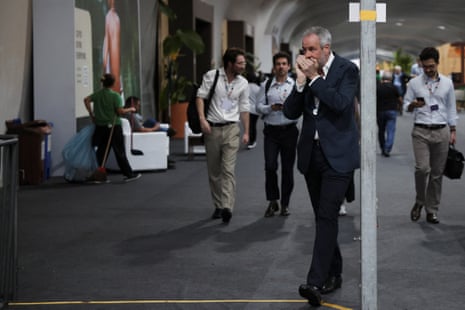
Cop30 president Andre Correa do Lago has arrived at the venue. He was photographed whispering into his phone a few minutes ago. Countries appear to be still far apart on any agreement to draw up a roadmap to transition away from fossil fuels. Can do Lago and his negotiating team thread the needle?
If you would like to catch up on the state of play, our reporters on the ground have been hard at work summarising proceedings. Here is a summary of the headlines:
-
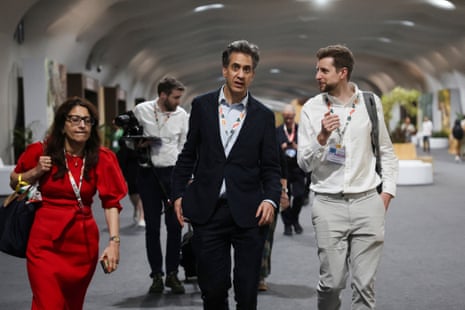
The UK energy secretary Ed Miliband said a deal to create a roadmap away from fossil fuels needed to happen “one way or another” – even if it was a voluntary process.
-
One representative from a country vulnerable to the climate crisis said: “Sometimes it’s like we are arguing with robots.”
-
Observers claimed the Arab group of nations had warned any mention of phasing out fossil fuels in final negotiations would see the talks collapse.
-
The architect of the Paris climate deal, Laurence Tubiana, said countries should not fear pursuing a deal on a roadmap.
-
Turkey and Australia has agreed to the details on hosting next year’s Cop31 summit, that will be held in Turkey. Turkey will take on the Cop31 presidency and an Australian – energy minister Chris Bowen – will be appointed vice-president and “president of negotiations”
-
Africa governments were still pushing for a tripling of the finance available from rich countries to help the poor world adapt to the impacts of the climate crisis.
-
AP reported that Juan Carlos Monterrey Gomez, a top negotiator for Panama, had said the decades-long United Nations process risks “becoming a clown show” for the omission of burning of fuels such as oil, gas and coal as causes of global warming from the final text.