2 months ago
127
2 months ago
127
Dan Simmons, who has died aged 77, was a versatile, prolific and genre-stretching writer whose work embraced the definition of SF as speculative, rather than simply science, fiction. In fact, before he wrote the four massive space opera novels that became known as the Hyperion Cantos, he had already made his name as a writer of horror. His first novel, Song of Kali (1985), won the World Fantasy award; his next, Carrion Comfort (1989), won the Bram Stoker, Locus and British Fantasy awards.
Hyperion and Fall of Hyperion were originally one novel. Divided into two, each won a Locus award, while Hyperion also captured a Hugo, and Fall of Hyperion the British Science Fiction Association prize. His two Endymion novels, again originally one book (1996), finished the Hyperion series.
Later in his career he moved to a series of hard-boiled thrillers and stand-alone books that merged historical themes with genre touches, most notably in The Terror (2007), based on the ill-fated John Franklin expedition to discover the Northwest Passage, spiced up with a supernatural monster. It was made into a 2018 television miniseries in the US.
Simmons drew on an array of literary and mythological sources. If his books can often seem prolix (a New York Times reviewer called The Terror “a 769-page novel about men stuck in the ice”) they reflect exhaustive research and wide literary influence. The Terror consciously recalled Herman Melville’s Moby-Dick and Mary Shelley’s Frankenstein, as well as crediting the 1951 horror movie The Thing. The novel, and its miniseries adaptation, may also have influenced Guillermo del Toro’s 2025 film version of Frankenstein.
Some of this desire to explain may have come from Simmons’s first career as a teacher. He was born in Peoria, Illinois, to Kathryn (nee Catton) and Robert, the manager of an automobile electric firm. They moved with Robert’s work, and Dan grew up in small towns in Illinois and Indiana.
After gaining a BA in English at Wabash College in Indiana in 1970, then a master’s in education at Washington University in St Louis, he taught grade school first in Missouri, then Buffalo, New York – the home city of his wife, Karen Logerquist, whom he married in 1974 – and finally in Longmont, Colorado, where the couple settled.
But he wanted to become a writer, and by his own description was desperate enough to pay to attend a writer’s conference in 1981, where a story called The River Styx Runs Upstream impressed the SF writer Harlan Ellison – notorious for “strongly discouraging” writers whose talents did not meet his standards – so much that he recommended Simmons for the Milford Writers Workshop, a finishing school for SF talent.
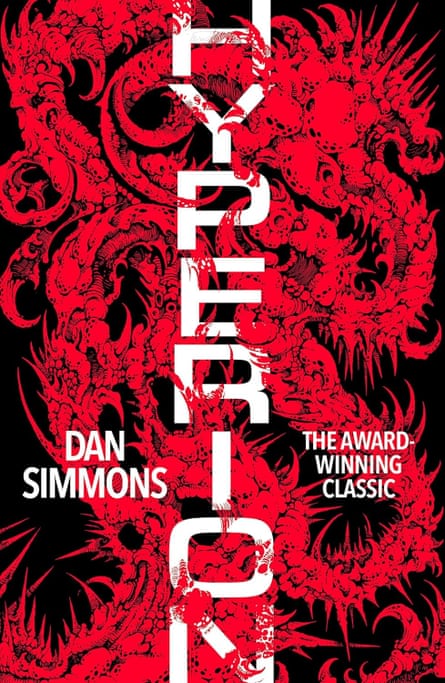
River Styx became his first published story, in Twilight Zone magazine, in 1982; following the success of Song of Kali, he eventually gave up teaching to write full-time, with three novels appearing in 1989. Carrion Comfort is focused on soul-devouring villains but driven by the fierce pace of a conspiracy thriller. Hyperion diverges to tell the story of seven pilgrims, echoing the Canterbury Tales, while Phases of Gravity is barely SF at all, being the story of a grounded astronaut regaining his mental health. A series of horror novels followed.
After his Endymion novels and a detective trilogy, Simmons returned to epic mythic space opera with Ilium (2003) and Olymos (2005), drawn from the Iliad and Odyssey, as if proving he could move beyond Hyperion. But he was impressive in shorter lengths: his novella Muse of Fire (2007) was set in a travelling Shakespeare company, Earth’s Men, who come to believe their performances are influencing the alien race who dominate the galaxy.
Meanwhile, Simmons moved into historical fiction. The Crook Factory (1999) was set among Ernest Hemingway’s sea-going posse searching for German spies and submarines in second world war Cuba. Drood (2009) delved into Charles Dickens’s unfinished final novel, with a drug-influenced Wilkie Collins as the narrator. Black Hills (2010) was a thriller built around a Sioux shaman inhabited by the spirit of George Custer during the Little Big Horn battle. His last published novel, The Fifth Heart (2015), brought together Sherlock Holmes and Henry James; if the James character is disappointing, Holmes is fascinating in his ambiguity about whether he is real or not.
In 2011, Simmons’s novel Flashback, set in a near-future dystopia in which an eponymous drug allows its users to retreat to their best memories, attracted strong criticism from readers who believed Simmons appeared to be endorsing America’s Tea Party movement, as it echoed their positions to explain the causes – among them Barack Obama’s policies – of the dystopia. Although there were thematic echoes of Philip K Dick’s alternate-world dystopia The Man in the High Castle, notably a blurring of dream and reality, Simmons’s expository style imbued Flashback with what seemed a relentless rightwing point of view.
In his defence, Simmons pointed out that the original short story that he had expanded into the novel had set Ronald Reagan in the Obama role; this failed to convince his most insistent critics. But the theme of a society drawn down by an over-demanding poor was presaged by his earliest work: Song of Kali’s evil cult could be seen as a product of endless slums as much as of the goddess’s followers, while the political arguments of Carrion Comfort, made by its vampiric oligarchs, include long jeremiads against the laxity of “entitlement” society.
Simmons was among the most honoured SF writers, taking eight Locus awards for novels and another four for shorter works and a collection. In 2013 he was honoured with a Grand Master award by the World Horror Convention.
At the time of his death, Simmons had reportedly nearly finished his long-promised final novel, Omega Canyon, a spy thriller set in 1945.
He is survived by Karen, their daughter, Jane, two grandchildren, and a brother, Wayne.