2 months ago
89
2 months ago
89
August Strindberg’s portrait of marriage is unremittingly bleak in Dance of Death. It features the kind of couple who find their partner’s way of breathing offensive – or just that the other is still breathing. She wishes him dead, he pretends to rise above it but is biding his time. They seem to exist on co-dependent hate, not love.
So if in bleakest British mid-winter this Nordic blast of nihilism seems too chilly a prospect to sit through, there is a surprise afoot: Richard Eyre’s candescent adaptation brings comedy and tenderness alongside the savagery. Strindberg’s couple is turned from merely horrible to humorously, movingly, horrible.
It is awful yet entertaining as they fight it out on Ashley Martin-Davis’s drawing room set design, full of long-faded grandeur. You can see the play’s influence on Edward Albee’s Who’s Afraid of Virginia Woolf but here the existential depth and questioning enters into the realm of tragicomedy with black laughs.
Also directed by Eyre, it is helped by two astonishing lead actors in Will Keen as the ailing army captain, Edgar, and Lisa Dillon as his thwarted wife, Alice – a one time actor who repeatedly reminds him she might have been a star of the stage had she not married him. They stew in a pool of mutual regret and irascibility, playing power games reminiscent of Hamm and Clov in Samuel Beckett’s Endgame (who is master and who is slave here?), but also bearing something of the desperately isolated, absurdist couple in Ionesco’s The Chairs. Geoffrey Streatfeild is able but a little overshadowed as Alice’s cousin, Kurt, who becomes a pawn between them.
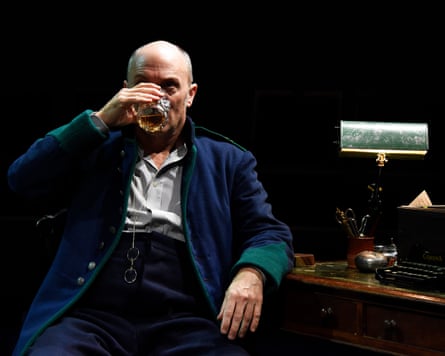
Because this production really is a two-hander in spirit, balancing the question of who is the protagonist and who the antagonist within the marriage – and the drama. Keen and Dillon bring such spark and mischief to their parts. You laugh at each of them, but feel for them too. He exudes pursed-lipped stoicism until his lashing out; she is childlike in her spite yet you suspect she is the real victim here.
Eyre moves its original 1900 setting to the time of the Spanish flu, in 1918. It is an inspired idea, to impose this compulsory closeness on the couple, which rings of reports over the Covid pandemic of domestic disharmony and rising divorce rates in its aftermath.
The set intermittently opens up to azure strips of sea waves, as if to suggest that there is more to life out there than this terrible claustrophobia. Yet, there is anxiety around isolation, absent children and most of all the fear that there is nothing out there, beyond mortality. The ailing Edgar is not so much terrified of death as the spectre of no afterlife in a Godless universe. Is it a play about mortality dressed up as a marital drama? Do the characters tear pieces out of each other to fill their void? These are questions I had not asked myself until seeing this production.
So, a terrible tango to the death but one which brings a rare and captivating pathos. For a play that risks shrinking into joyless desolation, this expands into something much bigger than a mere marital misery-fest. Not to be missed.