2 months ago
117
2 months ago
117
Labyrinth arrived 40 years ago with David Bowie at his most devastatingly charismatic, a breakthrough performance by Jennifer Connelly, and lots and lots of puppets. The film about the quest of stroppy teen Sarah (Connelly) to rescue her baby half-brother from the clutches of Jareth (Bowie), the nefarious goblin king, was a dark fantasy that played out like a trippy Alice’s Adventures in Wonderland. As Sarah tries to navigate an ever-shifting maze, the story evolves into a thoughtful coming-of-age tale.
Director Jim Henson, the creative powerhouse behind the Muppets and Fraggle Rock, breathed life into Labyrinth, and his company Creature Shop designed a dazzling array of puppets to appear alongside the human cast. Labyrinth was visually groundbreaking, but audiences weren’t so keen – the film bombed at the US box office and some reviews were far from glowing. It was only years later, when the film was released on home video and then DVD, that it became the cult classic it is considered now.
We speak to the cast and crew, who look back at how the film was made, its reception at the time and its legacy.
Soon after the release of 1982’s The Dark Crystal, director, animator and puppeteer Henson was keen to follow up with a film that combined human actors with quirky puppets. Terry Jones of Monty Python fame was hired to write the script, while George Lucas served as executive producer.
Brian Froud, conceptual designer and costume design: We’d just had a showing of The Dark Crystal in San Francisco. In the back of the limousine, Jim said: “Should we do another one?” I said: “What about goblins?” Jim’s eyes lit up. Then into my head came a labyrinth and I had a vision of a baby surrounded by goblins. He said: “That’s great” – and that was it.
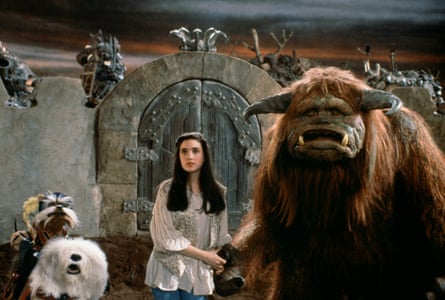
Auditions for the lead role of Sarah started in England in April 1984, before moving to the US. Jane Krakowski, Sarah Jessica Parker, Marisa Tomei, Yasmine Bleeth and Laura Dern were among the actors trying out.
BF: In England, at Jim’s house, he introduced me to a girl. We shook hands, and she laughed. It seemed like she was laughing at me. She went, and I said to Jim: “That’s her?” He said: “No, I don’t think so, because she’s done nothing.” I said: “I don’t care, she’s going to be a star,” and that was Helena Bonham Carter. I think he wanted it to have international appeal [by casting Jennifer].
Henson had his heart set on a musician to play Jareth the goblin king.
Brian Henson, the voice of Hoggle (a cowardly dwarf who reluctantly helps Sarah), and puppeteer coordinator: My dad [Jim] wanted a huge rock’n’roll icon. He was pretty much only considering Sting, Michael Jackson and David [Bowie]. I was a big cheerleader for David. I had seen him in The Elephant Man on stage. Modern Love was my favourite song. Let’s Dance was my favourite album. So I was thrilled when my dad decided to offer it to him.
Labyrinth started filming in April 1985 at Elstree Studios, Hertfordshire, with a $25m budget. The five-month shoot involved multiple animatronic creatures and puppets.
Karen Prell, a puppeteer for the Worm (a blue-haired worm with a cockney accent), Firey 2 and the Junk Lady: There were two versions of the Worm. There was a large hand-puppet used in closeups, but for the wide shots it was a little finger-sized worm. For the large worm, I had a joystick for the eye controls. The firey gang [hedonistic, orange-furred beasts] were very big bunraku puppets, where different puppeteers would hold different body parts.
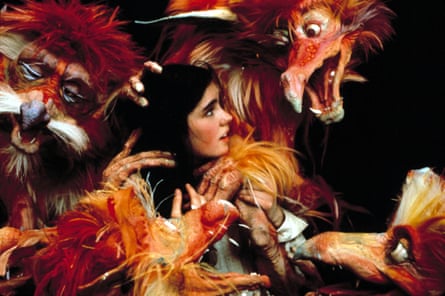
Dave Goelz, puppeteer for Sir Didymus (a chivalrous fox), Left Door Knocker, the Hat and one of the Four Guards: We rehearsed with Didymus for three weeks. I got a great group to work with. You have a step-by-step plan of exactly how you’re going to do it. Everybody learns the feel of putting the eyebrow up, making the sneer happen and looking the eyes to the right on that syllable.
BH: For Hoggle’s face, we needed four puppeteers including me. Then Shari Weiser was inside. Hoggle was the first time we made a character that could walk around without a wire. I was performing the mouth, so I ended up voicing Hoggle. The reason he is [grumbling] all the time is because the only way that Shari could see was if Hoggle’s mouth was open. So I had to come up with all that as an excuse to open his mouth a little bit.
Connelly, who had been acting since she was 11 years old, was 14 when she made Labyrinth.
BH: I had a big brother-little sister relationship with Jennifer. I spent a lot of time with her. She was super fun to work with, professional, never forgot any lines, quick to laugh. She loved when things went wrong, that would tickle her.
KP: It was very much like her character, just being in this amazing world; she was drinking it all in, but also she was very serious. She was rehearsing, and really wanting to get things right. I was very impressed with all the physical stunts she ended up doing – she just went with it and embraced it all joyfully.
Bowie was electric as mullet-haired, leather-clad Jareth, who was inspired by Wuthering Heights’s brooding antihero Heathcliff.
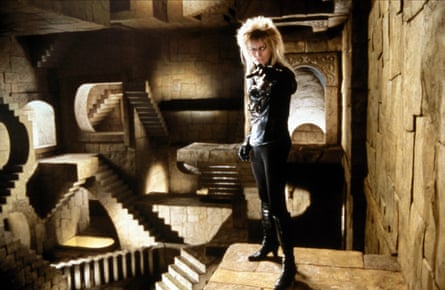
BF: A few days before we started the film, I met David in his dressing room and gave him a little flute as a present. He took it, leapt up on to the counter in front of the mirror and played it. It was astonishing. I thought: “Oh, this is gonna really work.”
BH: David was a crazy workaholic, just like my dad. They were both people who were used to being creative every waking moment of their life. So for David, doing Labyrinth was like being on vacation. He was a really wonderful spark of a person.
KP: He was really fascinated by the process with the puppets. He would also hang around the puppet workshop and just see how things were built and performed. He was very down to earth and game for anything. He would go and have a pint in the studio pub with the crew.
Froud’s one-year-old son, Toby, was cast in the film as Sarah’s brother, with the crew having to come up with lots of inventive ways to keep him engaged.
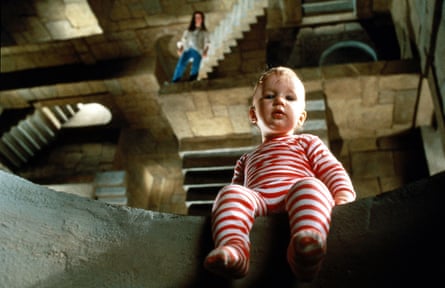
BF: Toby is called Toby in the film because he would only respond to his name. We would call him or use party blowers and balloons so he would move and look around.
BH: Toby just loved Shari. Every time you see Toby alone, we would make little spots where Shari could hide in a hole, like with her head coming up in a box, so she could see him. As long as Toby could see Shari, he was OK.
BF: When he’s in the MC Escher set with all the upside down stairs, it looks as if he’s really high up and it’s dangerous, but we actually filmed those segments on the floor, there were like three steps.
There were failed pranks and laughter on set.
KP: When we were getting ready to shoot Magic Dance with David and all the goblins, we decided: we’re gonna play a joke. Someone had a cassette tape with a copy of David’s The Laughing Gnome song on it. When they started filming, instead of playing Magic Dance, we wanted to play The Laughing Gnome. We were trying to get the cassette player to hook into the sound system to play over the speakers, but we couldn’t get it to work. It would have been the most glorious outtake in history.
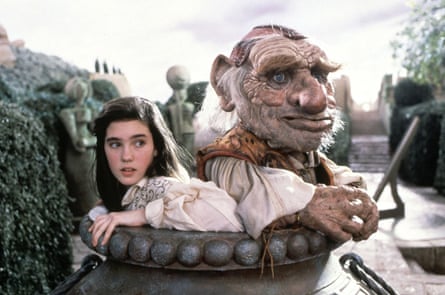
BH: I think one of the most absurd moments was David throwing the enchanted peach to Hoggle and Hoggle saying: “What is it?” David kept laughing, and then I’d start laughing. Shari would be inside going nuts, because she had to catch the peach with these mechanical hands, which was really hard. Everybody was laughing, except for Shari, who you could hear yelling from the inside of Hoggle: “Guys, just get it together and do this.”
The tunnel of helping hands, which Sarah falls down, was one of many elaborate scenes.
KP: There was a 40ft-tall shaft built with puppeteers behind it, reaching through. You’re just all mashed together.
DG: It was really not fun. Having both hands in latex rubber gloves, and doing performances with another little team of adjacent gloves that make expressions while your nose itches … is awkward.
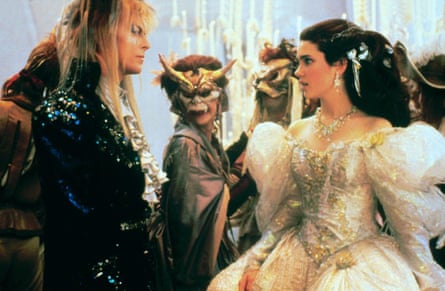
Labyrinth was the last feature film directed by Henson before his death in 1990.
DG: Jim was the best collaborator, the best boss, the best spirit guide. He always had fun.
KP: He was like a joyful magician ready to cook up some more magic.
BF: Jim never criticised your work. [Puppeteer] Frank Oz said Jim Henson had a whim of steel – he’d never say: “It’s bad.” He’d just go: “Hmm, I think we can do better.” And indeed we could.
The film was released in June 1986 with a royal charity premiere taking place in London’s Leicester Square a few months later.
BF: Prince Charles was there, and so was Diana – there are photographs of her looking at Ludo [the puppet], bemused. A few years later, Charles opened the Museum of the Moving Image in London. I was invited and when I met him, I said: “Actually, sir, you were at one of my films.” He said: “Oh, Labyrinth.” He said that the bog of eternal stench was very funny.
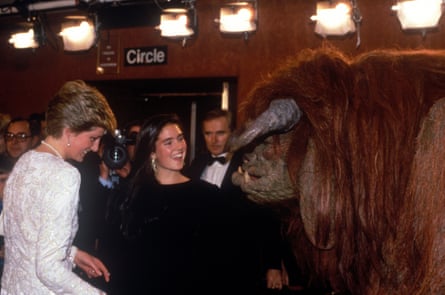
Critics gave Labyrinth mixed reviews and the film only earned $12.9m at the US box office during its theatrical run – although it did well in the UK and overseas, grossing $34m worldwide.
BH: I was furious. One of the papers accused the film of shamelessly abusing children where Bowie is throwing a baby in the air. This was just old-fashioned comedy. Everybody knows that’s not really the baby.
DG: Jim was deeply disappointed by the response. I had lunch with him in LA after the release of Labyrinth. I could see that he was not his usual self. He was shaken because he had always followed his beacon, and it had always been true. He was shocked that he wasn’t in sync with his audience. He said: “You know what my favourite part of this whole thing was? When we laughed.”
Labyrinth is now regarded as a cult classic and has been adapted into comics, video games and board games. A sequel to the film, which will be directed by Robert Eggers and co-produced by Brian Henson and his sister Lisa, was announced in 2025.
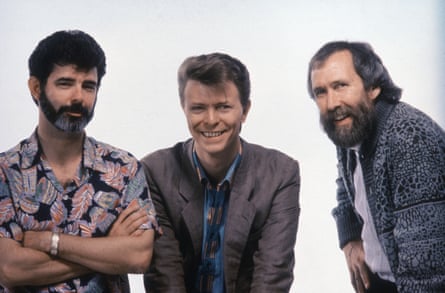
BH: My dad didn’t live long enough to see the rebound that came with its video release. It’s unique. It’s got a little bit of The Rocky Horror Picture Show camp rock’n’roll in it, and yet it delivers as a deep fantasy. People just love it.
BF: I’ve been to some conventions for Labyrinth, and you see this wonderful relationship between mothers and daughters – the girls come dressed in Sarah’s ballroom dress, and the mothers come in her jeans, waistcoat and big shirt. What we discovered over the years is how people, especially girls, really respond to it. It’s a very emotional journey for them: it speaks to them of their place in the world, and that transition of moving from girlhood into womanhood.
KP: I wish Jim was still around to see how much people have embraced the movie. At least now they are appreciating it, and making all that hard work worthwhile. Hopefully it inspires more young puppeteers.