2 months ago
77
2 months ago
77
You’d be forgiven for thinking that we didn’t need another TV series about the drug kingpin Pablo Escobar’s life, and that it’s been milked for all its worth in popular culture. Escobar’s murderous Medellín cartel was most ruthless in the 1980s and 90s – but this century alone, the Colombian druglord and politician’s biography has inspired numerous books, Hollywood films, the Netflix series Narcos, and even the title of Kanye West’s 2016 album Life of Pablo. The new Spanish language series Dear Killer Nannies, however, manages to find a new and unexpected way into the life of an archetypal villain, which focuses very little on the bloodshed that has made his life so ripe for movies and television. In terms of genre, the show – co-created by Escobar’s son Juan Pablo Escobar – is far more coming-of-age than action.
Instead of following the usual beats that mark Escobar’s rise, fall and eventual death (during a shootout with Colombian special forces), our way into the story is seven-year-old Juan Pablo, also known as “Juampi”. Juampi is sweet, sensitive and soft around the edges in the way most boys are before being exposed to the ravages of patriarchy. We meet Juampi as his head bobs above the surface of a lake, beaming and soaking up the sun, when a speedboat zooms into frame, headed straight for him, causing him to panic. The boat swerves at the last minute, narrowly avoiding him. Enter: Juampi’s “nannies”. These are associates of his father, who double as childcare while he’s out of the country attending to cartel business. What could possibly go wrong in such an arrangement?
The things that crop up are, in some ways, obvious: Juampi is exposed to murder, violence, sex and abundant drug taking, and, relatedly, struggles to connect with children his own age. Taken in isolation, these plot points could simply serve as shallow shock value; it is obviously outrageous, for example, to watch our child protagonist gain entry to a nightclub and be offered a dance by a topless woman. But Dear Killer Nannies is far more interested in the emotional impact these experiences have on Juampi, and how they shape him as a person. This ability to draw out the psychic impact of chaos and violence undoubtedly carries echoes of The Sopranos.
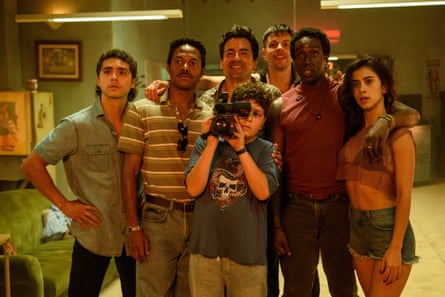
Take the crescendo of the first episode, in which Juampi accidentally witnesses an act of violence against a cartel enemy that would scar a hardened veteran, let alone a seven-year-old boy. In theory, the point has already been made: what’s happened to Juampi is frightening and traumatic. But, as the series proceeds, we see how instances like this come back to haunt him in the form of flashbacks, nightmares and bedwetting. We also see how they lead Juampi to harden. As the show goes on, another tragedy unfolds through Juampi’s eyes: the experience of realising that your father is not the hero you thought (quite the opposite – he’s responsible for thousands of murders). The narration, voiced by Juan Pablo himself, adds another layer of reflection and intimacy, evoking a therapy session.
Some of these themes feel relatable to anyone whose family histories are marked by violence and trauma. Juampi is told early on that life is precarious, with one nanny telling him: “Future is a word that doesn’t mean a thing for people like us … people like us can only move forward day to day to day.” At the same time, he’s told he can’t trust anyone who’s not family. He is also tasked with the responsibility of being the “man of the house” when his parents go away on business (again, he is seven). While Juampi’s experience is extreme, there is a universality in his story, one of being forced to grow up too fast.
Dear Killer Nannies is a technical feat as well as an emotional one. The jumps between Juampi’s childhood, adolescence and, occasionally, adulthood feel seamless, and as if they’re building the foundations for a grander narrative. Moments of surprise and misdirection are sparing but powerful. The performance, particularly by the child actor Miguel Tamayo, is as smart as its script, making it easy to lose yourself in a binge of the show’s bite-size half-hour episodes.
So, while it may be true that we didn’t need another show about the violence that characterised Escobar’s life, Dear Killer Nannies is actually a show about Juampi, a child who finds himself caught in the crossfire. More than that, it’s a surprisingly emotionally-literate story about adultification, loss of innocence, masculinity and trauma – experiences many of us can see or relate to in our own lives too. Of course, you can expect the obligatory car crashes and shootouts. But Dear Killer Nannies’ biggest gut-punches are quieter and bloodless.
Dear Killer Nannies is on Disney+ now