3 hours ago
9
3 hours ago
9
Deirdre McSharry, who has died aged 94, edited Cosmopolitan in the magazine’s golden era. As fashion editor when the UK magazine launched in 1972, within a year she was elevated to the top spot. Under McSharry, “Cosmo” was witty and forthright, addressing women’s careers, style, health and, notoriously, their sex lives. Like its editor, it was guided by joie de vivre.
A 1973 documentary captured a conversation between McSharry and one of Cosmo’s occasional nude centrefolds. The model was irked – the centrefold showed him laughing. He preferred to smoulder.
As he explained to McSharry that women found a sultry look sexier, her smile broadened and her eyebrows rose. She knew better. The jollity of the centrefold was part of the point, she told the documentary crew: “For years, men have been picking up magazines with pictures of busty ladies, and we thought it was a good joke to simply reverse the role and make the man the sex object.”
For her team, she was a powerful inspiration and a formidable boss, not shy of criticism, but always interested in their lives and opinions. All were “Cosmo girls”, representing the magazine’s readership. They gathered weekly for editorial meetings and exercise classes. “What she couldn’t tolerate was lack of ambition,” recalls Pattie Barron, Cosmopolitan’s then health and beauty editor.
McSharry was ambitious for her staff in return: “It was typical Deirdre to push everyone to the max and then push them out of the Cosmo nest, never holding them back to keep working for her. She wanted to see us fly.”
Caroline Coon, a regular contributor in the 1970s, recalls the cultural impact of the magazine and its feminist editor: McSharry “promoted actual change that could be achieved, with a dollop of glamour and fun”.
She was born in West Ham, east London, to Mary (nee O’Brien) and Jack McSharry, an Irish doctor who worked with tuberculosis patients before succumbing to the disease himself. In 1939, newly widowed, Mary moved with her two children to Dublin. Deidre was sent to a convent school and her mother went to work, becoming editor of Woman’s Life magazine.
It came as a shock to realise that her schoolfellows pitied her for having a mother with a career. She “always made work seem very special and glamorous,” Deirdre recalled.
In the holidays, she and her brother Sean were taken to the theatre, to lunches at the Stephen’s Green Club, and to the magazine office, where Deirdre learned to type and to paste articles into the “dummy”. Her mother encouraged her to paint and steered her towards biographies of clever women. All this proved formative.
At Trinity College Dublin studying English, McSharry started to write and act. Her mother died just before she reached 21. She did not graduate but turned to the theatre, performing with the Dublin Players and in late-night revues at the Pike theatre. Throughout her life she retained the crisp diction and elegant poise of an actor.
Joining the Gate theatre under the founding directors Hilton Edwards and Micheál Mac Liammóir, she was part of the ensemble during a two-month tour in Egypt in 1956. The trip was a revelation, introducing McSharry to exquisite textiles and richly patterned designs that became an enduring obsession.
Following a brief marriage to Linton Stone in 1955, McSharry moved to New York. There she made a definitive shift from theatre into journalism, with a role on Women’s Wear Daily.
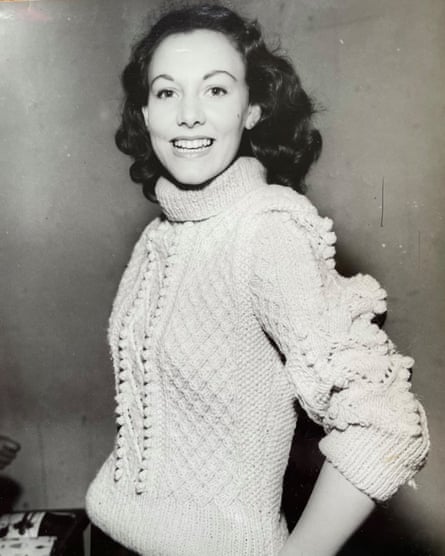
Later in the 1950s she moved to London as a fashion writer. A photograph shows her modelling an Aran jumper for a magazine shoot – the reverse carries a wry note that she was “saving the price of a model for George Newnes, publisher of Woman’s Own (circulation 4m)”. That figure was no exaggeration. In 1958, Time magazine cited “Britain’s proliferating women’s weeklies” as having a collective circulation of 10.4m. The newspapers paid attention: McSharry was lured on to the Daily Express as fashion editor.
She was a natural tastemaker, curious and enquiring, confident in her judgment. In 1966, she so liked the look of a model used for a daringly short haircut by Leonard’s of Mayfair that she called her in to the Express and commissioned a shoot. McSharry’s headline proclaimed the teenager, dubbed Twiggy, “the face of 1966”.
She married her second husband, Peter King, in 1967. The end of that marriage, in 1984, caused a period of ill health that precipitated her departure from Cosmo. After recuperating, in 1985 she became founding editor of Country Living, a magazine that reflected an era of growing affluence and social mobility in the UK.
McSharry identified a middle-class readership for whom renovating rural property was aspirational. She promoted eclectic, inventive interior schemes that were understood as expressions of their owners’ personalities. Designers, makers and artists she admired were promoted both on the page and off. After encountering Candace Bahouth at the Crafts Centre in Covent Garden, the artist made frequent appearances in Country Living and became a close friend. Kevin McCloud, then a lighting designer, recalls her as “a sparkling and tireless champion of other people”, and admits that his “career in no small part started thanks to her”.
McSharry was twice awarded editor of the year by the Professional Publishers Association – in 1981 for Cosmopolitan, and in 1987 for Country Living. In the mid 80s she met Ian Smyth, with whom she lived in a sequence of beautiful homes in the UK and US, before settling in Bath, where she became a cornerstone of the city’s cultural scene. The couple married in 1999 and remained devoted until Smyth’s death in 2022.
McSharry is survived by her sister Mary and her brothers Sean, Harry, Frank and James, and by her stepchildren Matthew, Lucy, Malachi and Patrick.