3 months ago
82
3 months ago
82
Monday
When even your mother calls you out as a cheat and a liar, then it’s probably fair to assume you’re a wrong ‘un. Not that this stopped Donald Trump from appointing Pete Hegseth as his defence secretary. Or as Trump prefers, his war secretary. After all, there’s no point in having all this shiny military hardware if you’re not going to use it. For most of the past two weeks, Hegseth has been the president’s cheerleader-in-chief for the war on Iran, and at the weekend he decided to have a pop at the media for not being enthusiastic enough. It seems we’ve been concentrating on trivial matters like asking what the overall plan for the war is. We heard the president talk about regime change and then change his mind when it was clear that, though he had killed Ayatollah Ali Khamenei, the regime was still in place. We heard the president say he wanted to neutralise Iranian nuclear facilities when he had already claimed to have done so last year. We heard Trump say that the war was already won though he fancied winning a little bit more, while the Iranians were insisting they were not beaten.
Trump had dismissed the Brits, claiming we had done too little too late and were not needed anyway. A week later he was asking for help from the UK and other European allies in keeping open the strait of Hormuz. It turned out that in all the back-of-a-cigarette-packet planning for the war, no one had told Trump’s war cabinet that the strait of Hormuz was a critical pinch point for 20% of the world’s oil. If only someone had been able to find a map. But this is just old-school pessimism. A failure to see the benefits. Take Russia. There’s a clear winner. With oil in excess of $100 a barrel, Russia is getting a windfall of $250m a day. So the US has unwittingly helped fund Russia’s war in Ukraine. But the real lesson is that this war has mainly been one of entertainment, with Trump talking of bombing Kharg Island “for fun”.
Tuesday
It was the war in Iraq that was the beginning of the end for Tony Blair. The country never forgave him for the dodgy dossier. Keir Starmer, though, has been having a good war so far. Declining the American invitation to join in the bombing campaign and send ships to open the strait of Hormuz. Preferring to keep an eye on the legality of the war and the absence of a clear strategy. Both Kemi Badenoch and Nigel Farage have been left to play revisionist nonsense. Trying to claim they hadn’t initially been all for going to war, when it’s a matter of record that they were. Even so, Starmer’s record as a serious leader in a time of war may still not be enough to keep him in a job. There’s a flatlining economy, high unemployment, a lost byelection, and the promise of more grief to come in the May local elections. But perhaps the real nail in Starmer’s coffin will be his decision to appoint Peter Mandelson as ambassador to the US. At a press conference this week, Starmer claimed that the problem had been a failure of process and that he had since worked tirelessly to tighten up the process. All of which rather missed the point. The vetting document had already highlighted the risk of reputational risk to the government and Jonathan Powell, the national security adviser, had said the process appeared to be unusually rushed. Crucially, the fact was that Mandelson had remained friends with Jeffrey Epstein while he was in prison for child prostitution. Here’s where it gets baffling. Because we don’t know if Starmer even wanted Mandelson or whether he had just been told he wanted Mandelson by his then chief of staff, Morgan McSweeney. Throughout the process, Starmer appears to have shown a bewildering lack of interest in the appointment. He has said he was lied to by Mandelson, but there is no record of him ever having spoken to him about any concerns. Nor does he appear to have briefed him on what he expected of him in Washington. The lack of curiosity will be his downfall.
Wednesday
And the winner is … I’ve nothing against Hollywood’s insatiable desire to confer baubles on a gilded few. After all, it’s mildly endearing to hear actors describe one another as “remarkably brave”. But does the awards season have to go on quite so long? The whole thing drags on for months. By the end, I feel as if I don’t care if I never hear about another film or actor again. Couldn’t they just squeeze everything into a month and get it over and done with? Other industries have their awards but seem to get by with making much less fuss, so maybe Hollywood could tone it down a bit. Winners aside, the talk of this year’s Oscars seemed to be that Timothée Chalamet’s career was in crisis after failing to win the top prize for a third time. Three nominations, more money than you could possibly spend and directors queueing up to work with you by the age of 30? That’s the kind of failure most of us could live with.
One TV show that does deserve an award is the Israeli drama Tehran, about Mossad spies inside Iran. I’d never heard of it till earlier this year, but we have binge-watched all three series. A fourth series is in the works, but I can’t help but think there will be significant rewrites given the war. As for the “Melania” of recent TV? The second series of Apple TV’s Hijack. None of the plot made sense.
Thursday
Life keeps coming at you. It was the first anniversary of my mum’s death last week. Her death was expected and unexpected at the same time. She was 101 and had been living in a care home for seven years as she had Alzheimer’s. Yet she had appeared physically well only moments before she died. Then a month after my mum, our dog, Herbie, broke our hearts all over again. He died in our arms on a sunny Sunday afternoon in April. Not long afterwards, my wife, Jill, was diagnosed with cancer and the last nine months have been spent in hospitals and clinics as she underwent a brutal regime of major surgery and chemo.
It’s taken its toll on both of us. Recovery is painfully slow. All of which is a long way of saying that I’ve realised I haven’t got round to properly grieving my mother. I had thought it didn’t matter that much. That it was something I could put on hold as I was dealing with other more immediate matters of life and death. But my psyche is telling me it does matter. That there is unfinished business. My mental health is not great and my anxiety levels have been off the scale. The thing is, I’m not really sure if I know what the grieving process should be.
Things are complicated. Of course, I loved her deeply but our relationship wasn’t always the easiest. And things were made more difficult by her dementia. It had felt as if I was grieving her when she was alive. Her decline into the person she had never wanted to be. So partly her death had come as a relief. But with Alzheimer’s it feels as if you lose the person twice. Once when they are alive and again when they die. This second loss is still unresolved a year on. Maybe to acknowledge it is the beginning of the process. Try to be gentle on both my mum and myself. Enjoy the warmth and the longer days. Stare at the crab apple tree in the garden with its brightest of bright green leaves. Breathe.
Friday
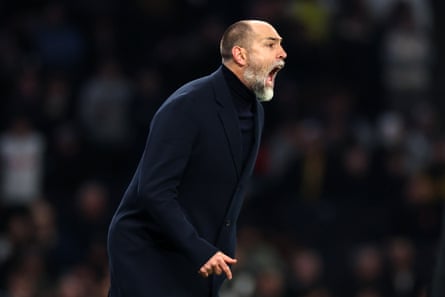
Part of me was a little disappointed when Spurs got a late equaliser against Liverpool. Not because the point wasn’t very welcome, but because it offered a reprieve to the interim manager, Igor Tudor, who had previously lost his first four games in charge of the club. Tudor’s management style had been suspect to say the least. Quick to rubbish the team, he had said there were three things wrong with Spurs. No defence, no midfield and no attack. He also observed that the players needed to toughen up and show some character. Tudor wasn’t necessarily wrong in his judgment, but trash-talking the team in public didn’t seem like the way to get the best out of a side that was clearly in freefall. It appeared we had reached rock bottom when we went 4-0 down inside 22 minutes against Atlético Madrid in the first leg of the Champions League and the manager ignored the young goalkeeper whom he had substituted.
So sacking Tudor for leaving the club in an even worse state than he had found it seemed like the best hope of avoiding relegation. Now, I don’t know what to think. In the second leg against Madrid on Wednesday, Spurs were a team transformed. They played with a passion and self-respect I hadn’t seen all season and on occasion threatened to overturn the three-goal deficit as they ran out 3-2 winners. And none of us have a clue if this was down to the manager or despite him. Whether this was a performance the players found for themselves or if they had finally bought in to the manager’s mindset. At the end of the game, Tudor walked straight down the tunnel without congratulating the players. Make of that what you will. So no one knows which Spurs will turn up on Sunday for the vital game against relegation rivals, Nottingham Forest. If it’s the one from Wednesday, then they should win easily. But the possibility also remains that Spurs are so fragile they can only turn it on when they believe the game is out of reach and there is nothing to play for. Spurs seem to exist to torture me.