3 months ago
133
3 months ago
133
With astronauts set to fly around the moon for the first time in more than half a century when Artemis 2 makes its long-awaited ascent sometime this spring, 2026 was already destined to become a standout year in space.
It is also likely to be one of the most pivotal, with new leadership at Nasa in billionaire private astronaut Jared Isaacman, and the tycoon-led private space industry assuming more than a mere supporting role to help win for the US its race with China back to the lunar surface.
Combined with Donald Trump’s pre-holiday directive for “American space superiority”, which includes planting the stars and stripes on the moon before the end of his second term, it marks the beginning of potentially the most consequential period in human spaceflight in more than a generation.
“This past year was actually a sense of defining, at least a turning point, for the Artemis program, firmly placing it as a priority and framing it explicitly as a race against China,” said Casey Dreier, director of space policy at the Planetary Society.
“Now it’s about execution, and I think it’s going to see whether Jared Isaacman is going to be able to bring a certain kind of different approach and actually see results rapidly.”
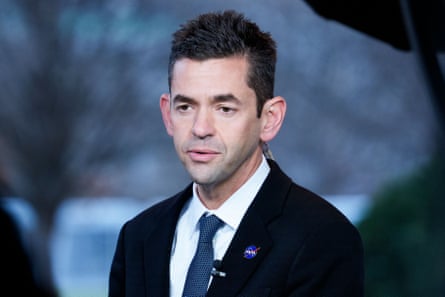
The December confirmation of Isaacman, a friend and ally of SpaceX chief Elon Musk, as the US space agency’s next administrator was almost a finishing touch to the Trump administration’s long-stated policy of landing Americans on the moon before China, which is looking to get there in 2030 through its Chang’e project.
After a faltering nomination process that began more than a year previously, Isaacman was quickly on message in a post to X last week declaring: “Our number one priority: American leadership in the high ground of space.”
With Artemis 2 nearing the launchpad for a mission targeted anytime from February to April, and Artemis 3, which will carry an as-yet-unnamed crew of four, including the first woman and first person of color, for a lunar landing set for mid-2027, the US program appears in better shape than a year ago.
Then, the future of Nasa’s own over-budget and years-delayed Space Launch System (SLS) rocket for the Artemis 2 and 3 missions was in immediate doubt, potentially pushing back the project years if Nasa had ditched it in favor of Musk’s much-improved heavylift Starship to conduct further lunar adventures, and trips to Mars beyond.
That is still likely to happen, experts believe, but perhaps not until Trump gets his flag-planting moon moment. Isaacman, at his original Senate nomination hearing in April, seemed to concur.
“I believe the SLS and existing Artemis architecture represent the fastest way to get American astronauts back to the moon. But over the long term, it’s not a sustainable or affordable solution,” he told senators.
Dreier, meanwhile, said that success for Nasa’s first crewed moon missions since the last Apollo program landing in 1972 is far from certain. He also pointed to a year of upheaval at Nasa that included a wholesale slashing of jobs, an “extinction level” science-killing budget proposal by the Trump administration that was ultimately rejected by Congress, and the off-again, on-again saga of Isaacman’s confirmation.
“You just saw a significant amount of disruption that was imposed, non-strategically, probably randomly, and kind of a consequence of various other forces within the administration, like Doge [Musk’s so-called “department of government efficiency”], and the office of management and budget through the budget-cut process”, he said.
“Ultimately it created a lot of friction and havoc and loss of Nasa expertise without any kind of positive or redirected focus. You had a situation where they kind of squandered a year, and now Isaacman is coming in with at most three years, and potentially one year before a relatively politically hostile opposition party takes over the House at least, or maybe even the Senate.
“They lost a lot of time imposing any sort of coherent strategy. They just lost that year.”
Other space experts welcomed Isaacman’s confirmation as an opportunity to provide clarity in several areas where Nasa has contracted or partnered with private operators, including SpaceX and Blue Origin, the newly ascendant space company of Amazon founder Jeff Bezos.
“Space policy is largely in good shape, so the real work is on implementation, with challenges for project management, funding and systems integration,” said Scott Pace, director of George Washington University’s Space Policy Institute, and executive secretary of the National Space Council during Trump’s first term.
“As a near-term issue, I expect he is looking closely at the Artemis 2 mission and decisions needed for a safe flight. That said, I hope we’ll see clearer paths forward on several items.”
Pace listed a number of initiatives: phasing out SLS and buying commercial heavylift services from at least two providers; leasing private space stations in Earth orbit by 2028 to support the planned winding down of the International Space Station (ISS) by 2030; incentivizing and leasing lunar communication and navigation services from commercial providers before 2030; and operating a privately owned nuclear reactor on the moon by 2030.
He said he was also looking for missions to demonstrate the commercial acquisition and return to Earth of rare earth materials from an asteroid.
“That, and human spaceflight safety, would make for a good year,” he said.
Most experts agree that 2026 will see further advances in private-public partnerships in space, especially with Nasa under Isaacman’s watch. Blue Origin proved in November that it was finally capable of getting its pioneering New Glenn rocket off the launchpad and on its way to Mars, and plans a test flight early this year of its Blue Moon lunar lander, selected by Nasa for Artemis 5, no earlier than March 2030.
Musk’s SpaceX, which is building a human landing system (HLS) for Artemis 3 and 4, continues to dominate the sector, ferrying astronauts in low Earth orbit to the ISS and expanding its Starlink satellite communications network. In 2025, the company set another record for launches in a single year - 165 - not including a handful of Starship test flights.
Even Virgin Galactic, one of several private Nasa contract holders but largely muted since the retirement of its SpaceShipTwo tourism enterprise in 2024, has expansion plans, aiming to launch its new Delta-class spacecraft before the end of the year.
Dreier said he would look further afield, beyond the Artemis 3 moon landing, before being able to gauge how successful Nasa’s reliance on private partners, specifically SpaceX and eventually Blue Origin, for human spaceflight will have been.
“The launch is the easiest part of all of this. Getting things into space, that’s the easy part,” he said.
“Landing is a lot harder, particularly landing on a different celestial body. We’ve put a huge amount of national prestige, policy and to some extent national security planning around the fact that one or two companies who’ve never done this before will do this for us.
“So the US has become somewhat of an observer to its own national priority, as opposed to being in control of it.”