2 months ago
88
2 months ago
88
Endo Kazutoshi spent decades climbing to the top of the culinary world, only for a devastating fire to threaten it all. I joined him in the aftermath as he travelled around his homeland, visiting the people that helped make him
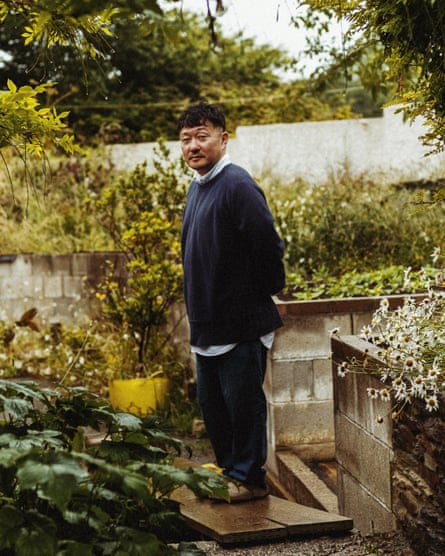
Endo Kazutoshi was on the train to Paris when he heard about the fire. A few hours earlier, at 2am, he had left his restaurant – the tiny, Michelin-starred sushi counter, Endo at the Rotunda, in west London – and headed home, where he got changed and packed his bags for the 6am Eurostar, upon which he planned to sleep. As he boarded the train that morning, 6 September 2025, he was unaware that just after 3am, the fire brigade had been called to a blaze at the Helios building, where his restaurant was located on the eighth floor. The fire had started on a terrace and a few hours later had reached the restaurant’s dining room – built mostly from 200-year-old hinoki wood – the prep kitchen, everything.
Shortly after departure from St Pancras, the news began to reach Endo through early-rising friends; they reassured him and would keep him updated, though details were still unclear. The trip to Paris was intended as a moment of respite after a busy summer’s service. Instead, Endo cleared his schedule and booked the first train home. But there was one appointment he couldn’t bring himself to cancel.
L’Ambroisie – a three-Michelin-star temple on the Place des Vosges, which had held its stars since 1988 – is legendary among gastronomes worldwide, but particularly in Japan, where it is viewed as the pinnacle of fine dining. Endo had booked two months in advance, and this would be his first visit. Unable to return to London until mid-afternoon, he kept his reservation. Underneath a giant Aubusson tapestry, in the grand siecle dining room of his dream restaurant, Endo sat in a fugue state. More than 100 firefighters and 15 fire engines had been deployed to tackle the blaze back in London. “My brain stopped,” he told me. He could only sip sparkling water. He didn’t register the food. “I had no passion. Can’t focus. Zero.”
Racing back to the station after lunch, Endo began to process the scale of what had been lost. The Rotunda was not Endo’s only restaurant in London, but he called his counter his “home”. He thought of the row of plaques bearing his Michelin star, which he’d held on to for six successive years; his stacks of white-spined Harden’s Restaurant Guides, in which his restaurant was listed as No 1 in the UK in 2025. His rice, his fish, his seaweed, his vinegar, his sake, his plates and bowls and chopsticks, all of which he’d sourced himself. Most painful of all: his knife rack, and in particular, two blades. The first was given to him by the sushi master who taught him his craft, to mark the opening of the Rotunda; the second by his father, himself the owner of a sushi restaurant in Yokohama, who had died before he could see Endo behind a counter of his own.
As a third-generation sushi chef, raised inside a restaurant, Endo had always been working toward a place of his own, where he could run everything to his specifications. Over the previous 30 years, he had tracked his progress along shu-ha-ri, the three-part Japanese concept of mastery: first, you follow the rules; then you break with them; then, if you’re fortunate, the craft becomes natural and you transcend the rules altogether. He was close, he felt. He had been preparing to write a book about this journey, and I was signed on as his ghostwriter. Shortly before the fire, we had booked a week in Japan, where Endo would show me everything I needed to know about the craft of sushi.
What had taken Endo three decades to build had been snatched away over the course of a Saturday morning. As his Eurostar returned to St Pancras, the restaurant was still smouldering.
When you think of a sushi master, you probably picture a bald, monastic, almost pre-modern figure. You think, perhaps, of Jiro Ono from the documentary Jiro Dreams of Sushi, wordlessly slicing planks of ruby tuna at a 10-degree angle, occasionally pausing to grunt at deferential trainees.
You do not, I expect, picture Endo Kazutoshi as he greeted me at 7.25am in Tokyo station at the end of October. Tousled short hair, peroxide-blond; designer sunglasses and hoodie; a penchant for swearing in cockney-flavoured English, learned from 30 years of listening to the Sex Pistols. “Finally,” he said triumphantly with a hug and a fist-bump, “we’re fucking here mate!”
It had taken two years of schedule-shuffling to make this trip happen. The book project had been intended as a kind of victory lap: a chance to put the Rotunda’s achievements into physical form. Then came the fire. In response, Endo had thrown himself deeper into plotting the trip’s itinerary, heading out a couple of weeks earlier than me, bending ears and calling in favours with farmers, business leaders, even members of local government. He was gathering what he needed for when he reopened his restaurant.
Endo is 52 and looks a decade younger. He is a frequent hugger and cheerer, reliably the most impressively dressed person at any food industry event and a good candidate for last man standing at the afterparty. Off the clock, he throws himself into galleries, cinemas and record crates: 70s punk, Yellow Magic Orchestra, skateboards, DJing. Unusually for a chef of his stature, let alone a top sushi chef, there is little guarded about him.
But Endo’s gregariousness belies an inner discipline. As Jonathan Nunn remarked for Vittles, Endo is “a serious man pretending that he’s unserious”. He originally intended to follow in his father’s footsteps, serving good local sushi to the people in his neighbourhood of Yokohama. Instead, he left home and settled nearly 6,000 miles away in west London, becoming one of the world’s most respected practitioners of omakase.
Omakase translates best as “I leave it to you”, an instruction from diner to chef. The elite sushi masters take this as an opportunity to offer a showcase of their life, journey and talents. At the Rotunda, only 20 people a time could leave it to Endo, but in return, he would proffer a sequence of dishes that told the story of the fishing boats, markets and craftsmen that produced the food in front of them. Everything in his space was filled with symbolism, from the flower arrangements to the calligraphic brushstrokes he’d leave on the menu at the end of each meal as a memento.
Omakase counters like Endo’s exist in every major city – from Masa in Manhattan to Shoukouwa in Singapore. Many serve similar dishes, but the experience is intended to be as personal and cohesive as a music album, says Dylan Watson-Brawn, the youngest westerner to train at the three-Michelin-star RyuGin in Tokyo. “There should be cohesiveness, ups and downs, interludes, things that build to create moments.” What makes Endo unusual, said Watson-Brawn, is that he has “a deep understanding of a very traditional craft, but then he can innovate from that base”. That’s why, amid sushi classics, Endo’s customers were equally likely to encounter Hong Kong crab rice, poached Irish oysters or steak in pepper sauce.
Endo’s parents spent his childhood preparing him for the family business. “We never had western anything, only Japanese,” Endo said. “When I was 10, I tried ketchup for the first time at a friend’s birthday party and I started crying. I’d never had that kind of flavour.” Growing up in Yokohama, a port city full of American soldiers and British music, other western products infiltrated his life. He fell in love with punk and played guitar in a band, before being warned off it by his father. The strings would thicken his fingertips, diminishing his ability to make sushi.
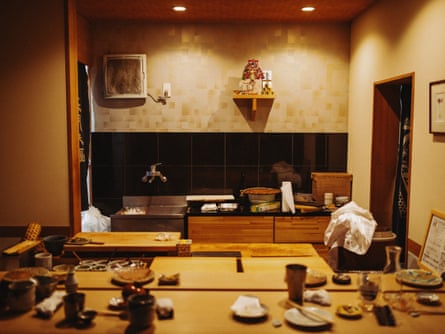
On our trip, Endo led our pack from the front: along with me, there was our photographer, Ben, and Shioka, Endo’s manager, interpreter and all-round fixer. We would cross Japan from coast to coast, with Endo bringing a Harrods bag full of chocolate brazil nuts, gifts for the suppliers we would be meeting. Some already knew about the fire, and some were about to hear the news. It would be eight cities, eight days, on eight trains and eight planes, beginning with a visit to one of the most important people in Endo’s life: his rice meister.
The bullet train from Tokyo north to Fukushima took just over two hours. At the station we were met by Mr Izuka, the rice meister – a “meister” being a German loanword Japan has adopted for certified master craftsmen. Izuka drove us toward his biodynamic rice plant in a car with a small TV built into the dashboard: the news bulletins showed Trump visiting the new prime minister, Sanae Takaichi. All the way, Endo and the meister were deep in conversation, the dipping, swooping, exclamation-filled symphony of passionate Japanese debate. I looked at Shioka for a translation. She leaned over, amused. “They’re talking about rice.”
Rice is harvested brown; polishing removes the outer bran layer to reveal the white starch beneath, and the percentage removed dictates everything: the quality of sushi rice, the grade of sake, the price per kilo. We had arrived for a tour of the polishing plant, the rice’s final step between paddy field and pantry. Fukushima rice, Endo told me, is the Louis Vuitton of the industry, and we were entering the atelier.
In the packing hall, sacks from various farmers were sorted by grade for different clients. Endo guided my attention to an unlabelled bag on a shelf to his right – destined, he said, for Sushi Saito in Tokyo, the hyper-exclusive restaurant which held three Michelin stars until 2019, when it stopped accepting reservations from new customers.
Next door, staff heaved sacks of grain through rattling steel grates, the air sweet and milky with starch dust. I watched handfuls of rice inspected for stinkbugs, then scanned for protein levels. Low protein makes rice softer and stickier, better for moulding nigiri; high protein makes it harder. Most forms of Japanese white rice come in at between 7% and 10%, but Endo wants his between 5% and 6%, softer than most chefs opt for, or even care to specify.
A piece of nigiri is, at its essence, almost nothing: a slice of fish draped over a small ovoid of warm rice. It is among the simplest objects in all of cooking, and among the hardest to master. When Endo shapes nigiri, there is no recipe, only the feel of the rice against his palm, a knowledge built over decades of repetition. Each piece is shaped in a few seconds with movements so practised they appear effortless – a light press, a turn, another press, the fish laid on top with the pad of his thumb. He instructs guests to insert the nigiri into their mouths at a 45-degree angle, as soon as he hands it to them. After three to five seconds, he says, the quality begins to degrade. The nigiri – barely held together, the rice at body temperature, the fish slightly cooler – is designed to collapse on the tongue. The whole thing should dissolve before you’ve thought to chew.
Breaking from our factory tour, we ate lunch on tatami mats in a nearby restaurant – shoes off, legs folded beneath a low table, lacquer bento boxes set before us. Around the table sat the farmer who grew Endo’s rice, the meister who polished it, and the besuited company chairman – all of them deferring to Endo while topping up his tea. At the table, Endo told them the story of the fire. I came to recognise its rhythm over the days that followed – his pauses and exclamations, the careful way he set up the scene, the sharp intakes of breath from his audience, their shocked reactions and immediate offering of solidarity.
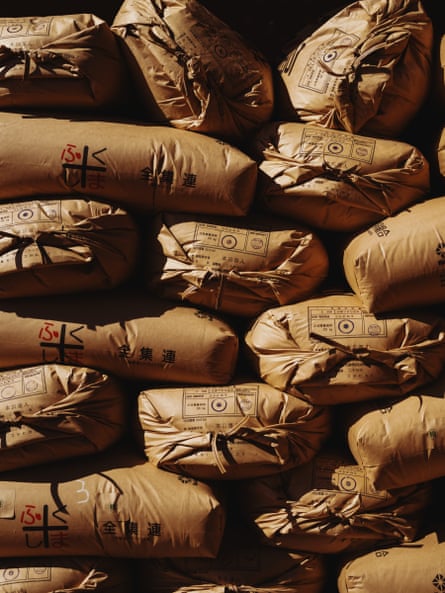
After lunch we drove out to the paddy where Endo’s rice is grown. The harvest had been made a few weeks earlier, but green shoots were already appearing above the surface, weeks ahead of schedule. “They shouldn’t be there yet,” the farmer said, pointing. “It’s too warm.”
In a nearby storage unit, a rice cooker had been prepared with the newest batch. The meister scooped out a portion and we gathered round, pinching clumps between our fingers. “It’s sweet, really sweet,” Endo said.
“Too sweet,” the farmer said, shaking his head. “It’s the heat. Global warming. It’s worse than last year’s batch.” A pause. The storage unit hummed. “It will just be like this now,” he said, “unless the heat can be reversed.”
“Rice is 80% of my sushi,” Endo told me on the journey back. He doesn’t just import the grain to London, he imports the water, too. Fukushima spring water, shipped in gallons. “Life and cooking rice are very similar,” Endo’s father once told him. “Always, we are adjusting to try and find consistency.”
That evening, Endo took us to his grandfather’s favourite unagi restaurant in Tokyo’s Asakusa district, overlooking the river. We ate eel four ways – encased in egg; innards skewered and grilled; one fillet unglazed; the other bronzed and sticky – served over rice, with a broth of the bones for sipping. This was edomae style, literally “in front of [the river] Edo”, the old Tokyo tradition from which Endo’s cooking descends. We drank sake and watched the light fade on the water, and for a few hours all thought of the fire seemed to melt away. Endo was energised by showing us his city, topping up our glasses before we’d noticed they were empty.
We moved on to a cocktail bar where we traded opinions about which London restaurants deserved their Michelin stars and which were coasting. Then, sated, Endo called it a night, while Ben and I went in search of two more Sapporos.
A few hours later, back at the hotel, I left Ben in the lobby and made a detour to the FamilyMart convenience store downstairs for a trinity of pre-bedtime indulgences: a Suntory highball, a spicy chicken cutlet and something called a Pork Tongue Stick. Ben was waiting by the lifts when I emerged, arms full. “You’ll regret this,” he said, a warning I laughed off. I didn’t get hangovers, I explained.
At 7.15 the next morning, I reconvened with the group, aching, sweating Suntory and salty meat through my pores, sustained only by a milky bottled coffee from a vending machine. Optimal conditions for a morning at the world’s largest fish market.
Toyosu market is the successor to Tsukiji, once described by Anthony Bourdain as “the awe-inspiring, life-changing mother of all fish markets”. Tsukiji was rat runs, cigarette smoke, buckets of viscera. Toyosu, on the other hand, feels more like an international airport than a world-leading seafood emporium. The site is enormous, nearly the size of Vatican City, a maze of clinical, unmarked hallways patrolled by security guards.
The smell of fish was absent as we passed through the first few phases of Toyosu security, but once we broke through to the trading floor, it was suddenly overwhelming. Forklift trucks careened around bends sodden with fish sludge and meltwater, while the air hummed with the churn of 100 filtration tanks. We walked past enormous, doleful spider crabs pressed up against glass, pupils large enough to make eye contact; minuscule clams stacked high like pistachio shells; iridescent flanks of kohada, the gizzard shad Endo pointed out as his favourite.
In London, Endo sources most of his fish from British suppliers, especially from his beloved Cornwall. But tuna is different. No fish carries more weight in the sushi tradition: its rich, marbled flesh, ranging from the lean akami to the butter-soft otoro, offers unmatched complexity of flavour and texture. For diners, it is the climactic act of any serious omakase; for chefs, it is the ultimate test of their supply network. It is not enough for a chef to merely learn a trader’s name and contact them – the connection must be earned. Endo’s suppliers are perhaps the most celebrated tuna merchants in the world: Hicho, in the business since 1861.
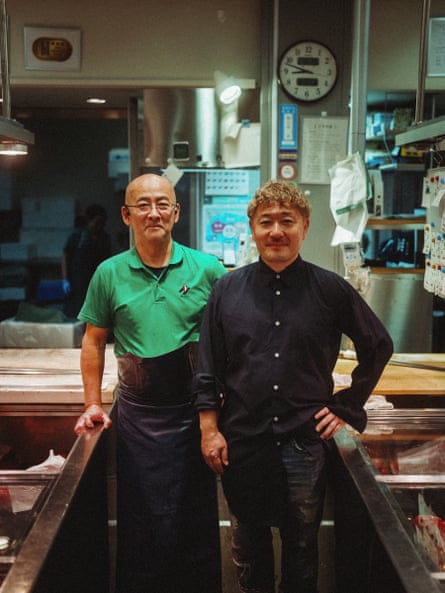
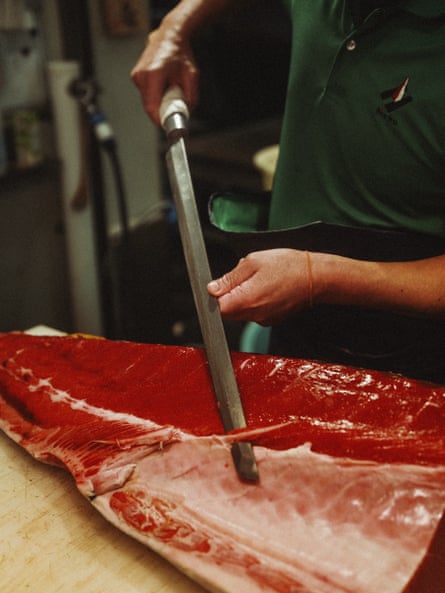
Endo instructed us to watch them work. So for an hour and a half, we did. Six men in constant motion, heaving 100kg tranches of bluefin on to the carving slab. In the centre stood Toichiro Iida, head of the family firm, whose eight generations made Endo’s three seem like a passing fad. He sends his agents to the pre-dawn tuna auctions, where they read carcasses for fat marbling, colour and provenance. Then, from 6am until 11am, the team carves the fish – 13,000 yen (£62) a kilo, hundreds of kilos apiece.
Iida filleted with huge knives in clean, deliberate strokes – cold, watery, bloody work. Each cut was made with a particular chef in mind: he knows what quality each client will appreciate, what size, what fat content. One of his workers had a deep gash from a tuna bone, but his forearm was so cold and calloused by the freezing work that he didn’t seem to notice. Occasionally, Iida slipped one of the crew a sliver of prime catch to sustain them. Nearby, a processor sliced off tranches of frozen tuna with an angle grinder, shedding mounds of pearly-pink snow on to the metal slab. A staff member hoisted a portion on to a scale, bagged it and tore off a label from the column at the centre of the room: the Peninsula, the Park Hyatt, the Mandarin Oriental.
Iida’s relationship with Endo stretches back 25 years. “My master would send me here to just watch and watch,” Endo told me later. “Every day, ask questions, show interest. So that when I had my own place, they could trust me.” Hicho select their clients carefully. “We never talk about money,” Endo said. “Iida-san picks out the cut he knows I’d like. Then it’s down to me.”
Endo’s seaweed supplier arrived and echoed the same refrain I had heard in the paddy fields – the water’s too warm, the top-level stock is shrinking. Iida nodded. Quota restrictions, stock depletion, rising costs and a warming ocean had conspired to reduce the fishing fleet.
They all spoke as though they had arrived at the end of something. And yet the numbers tell a different story. Omakase’s global popularity has climbed steadily for a decade; in London alone, the number of high-end sushi counters has comfortably tripled since Endo opened the Rotunda. Prices keep rising – £300, £400, £500 a head – and the biting point, when demand finally peaks, has not arrived. If anything, scarcity has made the product more desirable: the chefs who can still access the best ingredients – not just through money, but through long-term relationships – only become more prized.
Leaving Toyosu, we took a short cab ride to the city’s portside industrial district, the site of Tokyo’s only traditional vinegar brewery, Yokoi. This stop was an even greater assault on my fragile senses. After removing our jewellery – the fumes would tarnish metal within minutes – we stepped into breathable bodysuits for a tour. Yokoi occupies an entire city block: vast fermentation halls lined with vats the height of double-decker buses, corridors stretching so far into the building that the far end dissolved into haze. Wobbly pallets of feculent brown sake sludge, used for brewing their famous akazu red vinegar, trolleyed past us, pulled by hazmatted factory staff.
After a further hour spent inhaling vinegar, tasting different vinegars and posing for a staff photo where we all cheered “Vinegar!”, my physical state had not improved. Things weren’t letting up, and the gridlocked, stop-start drive through traffic – the fault of the visiting President Trump – did little to help my comeback effort. We were due for what was meant to be a highlight of the trip: Endo was taking us to a tiny place at the back of Toyosu market, far from the tourist trail, run by a real sushi master. As good as it gets.
Rocked by what I was calling car sickness, I wobbled into the tiny dining room and tried to handle things early. “Pardon me,” I told the table, chair creaking outward mere moments after settling into place. I walked confidently to the back of the restaurant, then directly into the kitchen. No bathroom. I returned to my seat. Our first piece was placed in front of us: a squeaky cut of clam resting atop a clump of vinegared rice. I chewed; I kept chewing; I got it down. “One sec,” I told the table, chair creaking outward with more urgency. Behind me, I could hear Trump’s voice coming through the TV, expressing praise for Japan’s “incredible prime minister”. I darted to the back again, this time straight upstairs. Private dining area, staff changing room. No bathroom. Back down I went.
Endo, Shioka and our friendly vinegar sales rep were all chatting away, overjoyed at the arrival of each new piece of nigiri. At this point, Ben noticed a bead of sweat forming on my temple. “Oh mate,” he said. More sushi followed: tight rolls of gunkan piled high with raw shrimp; puckering fillets of Endo’s beloved gizzard shad, lightly pickled; an almost saccharine wedge of rolled omelette, bound with a strand of nori. Everyone’s counters were clear except mine. “Excuse me,” I asked the table firmly, smiling to ward off suspicion. “Do you know where I might find the bathrooms?”
Obliging to the last, the vinegar man stepped out and led me through the market maze to an outrageously spartan toilet, while trying to engage me in conversation about the Premier League. I stepped in, splashed my face, then skipped back to the restaurant, feeling revived. I’d even perked up enough to talk more about Liverpool. This phenomenon is known to doctors as “terminal lucidity”. About 90 seconds after returning, I sprinted back out into the concourse, now completely unable to locate the bathroom I’d just visited, and cosmic retribution came flowing, at pace, through the nearby drainage grates of the market’s loading area. “I knew it,” Ben said, patting my back encouragingly as I returned, ghostly but unstained, to my untouched sushi, my wasted privilege, my all-pervading shame. “Do you mind if I have yours?”
I took some comfort in later learning that sushi’s origins were no more elegant than my departure from that restaurant. Its earliest form – narezushi, fish fermented in a sour rice sludge – bore an unfortunate resemblance to what I had deposited in the drainage grates. One Buddhist parable, recorded in the 12th-century folk anthology Tales of Times Now Past, recounts the story of an early sushi peddler selling her wares despite having thrown up into the vessel, because the sushi inside was “very similar in appearance” to vomit.
From there, the evolution was slow. Fermented sludge gave way to vinegared rice; raw fish replaced the rotting kind. By the mid-19th century, sushi had become street food – quick, proletarian, ubiquitous. Then came the neighbourhood sushi bars, proliferating across Japan through the early 20th century. In 1940, Endo’s grandfather opened a restaurant in central Yokohama, with Chinese food downstairs and sushi upstairs. Later, Endo’s father took over the business but moved the location, opening Midori Sushi in the suburb of Tsunashima in 1959. It is still there today.
A rickety local train took us on the hour-long journey from Tokyo into Yokohama’s suburbs, the cityscape giving way to quieter residential streets. In Tsunashima, we crossed a bridge near Endo’s old school, before arriving at the family restaurant. A recent renovation had given the place a surprising sleekness – charcoal grey paint, a recessed entrance demarcated by a tiny wooden lightbox. Inside, we found Endo’s brother, Toshio, in robe and wooden sandals, cleaning up after lunch service. Toshio was markedly more reserved than Endo; taciturn, mildly bemused by our intrusion. After a few stage directions, Ben coaxed a smile out of him as he assembled the brothers for a photo behind the counter.
Endo’s mother, Sumi, came down from the apartment above. She was in her 90s, small and unhurried, and when she appeared, everyone straightened up. Here we were, standing in the court of the matriarch. Returning older brother in a blue schoolboyish jumper. Younger brother minding the fort at their late father’s counter. This was meant to be Endo’s destiny.
In Japanese family businesses, the third generation are often seen as trouble, prone to squandering what their forebears built. Sumi had been determined that Endo would not make those mistakes. As a boy, she decided everything: what he studied, where he went, what he ate. She enrolled him in tea ceremonies, floristry, calligraphy – disciplines that taught precision, and an attentiveness to form. When the other children teased him for arranging flowers, she sent him to judo.
He excelled. His coach, recognising something in the 13-year-old, recommended Endo to a more prestigious programme in amateur wrestling, offered by a local high school. Within three years he had finished in the top five at the All Japan high school championship – twice. Then Kokushikan University – the best college in the country for wrestling, with multiple national titles and a head coach with an Olympic gold medal – offered him a scholarship.
His parents allowed Endo to go, granting him four years before he returned to continue his path. Four years later, as he neared graduation, his high school wrestling coach asked whether Endo would like to succeed him after he retired. Endo called a family meeting to discuss the idea. Five of them around the table: his parents, his younger brother, his older sister and him. When he asked if he could take up the offer, his mother’s response was immediate: “You have two choices. One: you take over the family business. Two: if you choose your dream – tomorrow, we go to the town hall, and we remove your name from the family register.”
The next day, Endo apologised to his coach. That was the beginning of his life as a chef.
At first, he says, he knew almost nothing. He had never made sushi outside his parents’ restaurant, had no idea what distinguished great sushi from ordinary. When he contacted top restaurants for an entry-level job, they rejected him outright. At 22, having graduated university, he was considered too old to begin an apprenticeship.
In Kyoto, he finally found a restaurant that would take him. He earned the equivalent of £500 a month, and bathed at public bathhouses alongside other broke young cooks. The culture was different from Yokohama, the kitchen logic was different. As the youngest in the restaurant, he made staff meals every day for two years. (At the start, he called his mother from a payphone to ask for recipes.)
His next posting was in the city of Nagoya, under a master who had trained with Jiro Ono himself. For three years, Endo was forbidden from touching fish – he scrubbed drains, made tea, and watched. His technical foundation was laid in that kitchen. How to cut, how to marinate, how to balance the vinegar in the rice.
By the time Endo returned to his father’s restaurant at 27, he found it wanting. After the precision of Nagoya, the compromises of a neighbourhood operation were difficult to accept. One night, after service, the family sat drinking together. Endo raised the subject that had been gnawing at him for months. “I’m really confused,” he said. “The quality is not perfect. Why are we not using the best produce?”
His mother cut him off, chiding him for speaking disrespectfully. His father said nothing for a moment. Then he told Endo that if he didn’t want to be here, he should get out. Endo packed his bags that night, another step in the journey that would eventually lead to the Rotunda.
Before we left the restaurant, Ben gathered the family one last time at the doorway – Sumi in the centre, her two sons flanking her, the restaurant sign glowing faintly behind them. They stood together, Ben’s cheery prompts drawing faint smiles. Then Toshio returned to the counter to prepare for dinner service, and Sumi shuffled back upstairs to the apartment where she had raised them both.
At the turn of the millennium, after his abrupt departure from the family restaurant, Endo worked in a small restaurant in Tokyo, and then for two years in Spain, where he was a chef at the Japanese embassy. When Endo returned, he found a job in Ginza, the centre of Tokyo’s high-end sushi world. He was content. Then Rainer Becker, the German restaurateur behind the global chain Zuma, invited him to London for a visit. Becker’s pitch was simple. In Tokyo, Endo was one sushi chef among thousands – talented but anonymous. In London, he could be the star.
He arrived in 2007, and Becker gave him free rein. Endo was different from other Japanese sushi chefs, Becker told me: more open, more communicative, better with his staff. Behind the counter, though, it was clear who was in charge: “Authority with a healthy bit of arrogance” is how Becker put it.
On Friday lunchtimes at Zuma, twice a month, one of his regulars would sit at his counter. Endo recognised her face, but knew little about her. Then, one day, she handed him her business card and asked him to visit. He looked at the card. It said “Café”. He told his wife they should probably eat before they went – it was just a cafe, after all.
When they arrived at the River Café, Endo realised his mistake. The woman who had been eating his sushi was Rose Gray, its co-founder and one of the most influential figures in British culinary history. She had already written about him in her Guardian column – the first press coverage he had ever received – without his knowledge. After the meal, Gray sat him down. She had eaten a lot of sushi in her life, she said, but his was the best. Then she gave him two instructions: use your talents on British produce, and win a Michelin star.
On his days off from Zuma, Endo began training at the River Café, learning the restaurant’s skilful marriage of Italian technique and local produce. From Gray, he discovered how to source in Britain, how to make provenance part of the story. Cornwall, Devon, the seasons, the flowers, the vegetables – the langoustine and olive oil nigiri that still appears on his menu is a direct inheritance from her kitchen. “I didn’t learn this from Zuma,” he told me. “I learned it from her.”
Later, when Gray became ill with cancer, she and her River Café partner Ruth Rogers would still come to Zuma every other Friday, and Endo would give them his full attention. When she was admitted to hospital, Endo made her a bento box – arranged with the care he would give at the counter, every element considered – and gave it to her son to take to her. She sent back a note that said thank you. A couple of days later, she passed away.
Gray’s advice stuck with Endo. He was conscious that Zuma was expanding – Dubai, Hong Kong, New York – but the name wasn’t his, the sourcing wasn’t his, and the clientele were there for the brand, not the chef. After opening New York in 2015, something shifted. “My feeling was, ‘I’m done,’” he said. Gray had given him a mission, and the mission required his own restaurant. He left Zuma the following year, in search of a new home – a journey that brought him to a vacant floor atop the BBC’s old Television Centre in west London, where he would build the Rotunda.
The final leg of our trip dissolved into a blur of bullet trains and tiny planes. In the space of 24 hours we hopped from Kyoto to Ehime Prefecture, then back to Tokyo, finally rattling onward to Fukuoka, the largest city on Kyushu, the southernmost of Japan’s main islands.
Upon landing, we went immediately to Studio 1156, a ceramics store in the centre of the city, where we met Mr Koyanagi – store owner, ceramicist and a close friend of Endo’s. They’d met years prior, on Endo’s first hunt for suppliers when he was putting together his ideas for the Rotunda. Endo had called more than 100 craftsmen and producers, seeking to handpick every detail of his new space, from the chopstick shape to the sake cups. Only a handful replied. “I still remember his first email,” Koyanagi said with a smirk. “He was intense. Serious. Maybe too serious – and that’s why nobody responded.”
Then came the imprimatur that changed everything. Endo managed to interest Kengo Kuma, the world-renowned Japanese architect, in his project. Their families were from the same neighbourhood in Yokohama; Endo had reached out cold, with little to offer except this shared geography. Kuma agreed to design the space personally – and to deal with Endo directly, which was unheard of for an architect of his stature. As it transpired, Kuma had eaten at Endo’s grandfather’s restaurant. When Endo called suppliers again and mentioned Kuma’s name, suddenly everyone listened.
Koyanagi, the ceramicist, was one of the handful who’d said yes back when Endo was nobody. They formed a fast friendship over food, pottery and, as evidenced by the car stereo, music: Nirvana, Michael Jackson, trashy ska classics from the Kerrang! era. We moshed gently to In Bloom as Koyanagi drove us to his pottery workshop in the village of Imari, renowned as the birthplace of Japanese porcelain.
Back when Endo was preparing to open his own restaurant, his research wasn’t limited to Japan. He spent five months living with dayboat fishers in Cornwall – waking with them, eating with them, hiding his sea sickness as he fished alongside them. Scotland, Ireland, Devon; divers, farmers, fishers – Endo went everywhere, asking questions no other chef had thought to ask. In Cornwall, people laughed as he cut open the belly of a fish to inspect the guts. “What are you doing?” they asked. “I’m checking what they’re eating,” he replied. He was building a world he could control entirely – every ingredient, every relationship, every detail – and fulfilling the promise he had made to Rose Gray.
As he began to build out his vision, his father died. It was 2017, 18 months before the Rotunda would open. Endo returned to Yokohama for the funeral. Cleaning up afterward, his uncle told him something his father had said the night Endo was cast out, all those years ago. “Maybe this is for the best,” his father had said. “His philosophy is already bigger than mine. My restaurant is too small.” He had understood his son had to leave, though he never said so directly. “That’s very Japanese,” Endo said. “Old school style.”
Years later, at the Michelin ceremony, Endo wanted to thank his mother, father and Gray as he accepted his star. He had rehearsed what he would say. He stood at the podium, opened his mouth, and couldn’t speak. “I was crying, completely,” he told me. “No words.”
In Imari, we toured the workshop as rows of craftspeople sat in humid rooms, tapping pointillist dots on to tiny leaves – a hallmark of the local ceramic style, each plate requiring days of concentrated, silent work. Through the workshop windows, the Kyushu landscape lay open before us – beaches, factories, forests, all bathed in the light of a red sun.
Our final visit complete, the four of us – Endo, Shioka, Ben and me – sank into our seats. Eight cities, eight days. We’d watched Endo move through a world he had built relationship by relationship: the rice farmers, the tuna brokers, the ceramicists and knife-sharpeners. “These things take so long to build and develop,” Dylan Watson-Brawn told me. “They’re acts of love.”
In the months that followed, Endo kept moving. A few weeks after our trip, he flew to Berlin to cook with Watson-Brawn. Back in London, he checked in on the restaurants – Kioku, Nijū, Humo and Sumi, named after his mother – he oversees with his partners at the Creative Restaurant Group, and began sketching new menus. The book was still in progress. The suppliers were still in touch.
Then, shortly before we were due to meet again, his mother passed away. Endo returned to Yokohama once more, just as he had last year, after the fire. Back then, he’d spent two weeks with Sumi in Yokohama, numb with shock, not wanting to speak to anyone. She sat with him, until one day, he said: “I lost everything.” “Nothing is finished,” she told him firmly. She told him not to cry. Not to be too negative. When I heard the news about her death, I thought of the photograph Ben had taken at the end of our visit: Sumi in the centre, her two sons behind her, stood in the old doorframe. Endo told me how grateful he was for that moment.
When I met Endo again, on the first sunny Thursday of spring, he welcomed me through to the trade entrance of Annabel’s, a members’ club in a Palladian townhouse on Berkeley Square, where he was doing a temporary residence. Tucked away in a side room on the top floor, reached by passing through maximalist decor that seemed to belong to a different universe entirely, Endo’s space was calm: a long pinewood counter, 10 seats. The prep kitchen was upstairs. That was it. The Rotunda team were working again. The suppliers had returned – some with free produce, others bumping him to the front of the queue for replacing lost stock. Endo told me that, astoundingly, one of the firefighters who responded to the blaze had eaten at the Rotunda, remembered where the knives sat, and had rescued them.
“I’m not sad any more,” Endo told me, behind his counter, his restored knives stacked on a shelf behind him. For the first time, he could speak about the fire without flinching. “The Rotunda was seven years – seven great years that the fire can’t take away.” Next to the knives was a picture book from his restaurant’s early years – signed menus, blurry Polaroids – spared from the blaze and brought from home. I thought of his Instagram tribute to his mother: her message, Endo wrote, had always been to “accept every event and every existence in this world … to accept it all and move forward”. Now he was ready to do so.
Discover a selection of the Guardian’s finest longform writing, in one beautifully illustrated magazine. In this issue, you’ll find stories about how private equity is plundering the world and what it’s like growing up in a family of Nazis. Plus: why do we think the perfect buggy will make us better parents? Order your copy here – and if you’re in London on 8 April, join us for an evening with the Guardian Long Read, featuring readings and discussion with some of our writers