3 months ago
155
3 months ago
155
There are many ingenious ideas in Anna Ziegler’s spare, sensitive two-hander, which features a sensational stage debut by screen star Erin Kellyman. She could not be more confident as Delilah, a bolshie, half-American daughter in mourning, who has a spiky relationship with her buttoned-up British stepmother, Jennifer (Anastasia Hille).
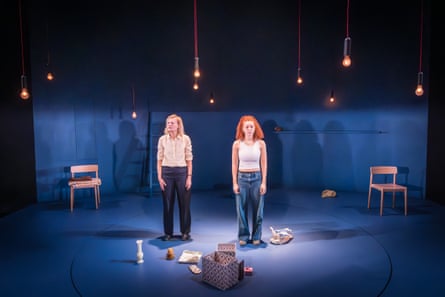
Artfully directed by Diyan Zora, the play is both a telling (the women narrate in third person) and an enactment of their developing relationship within a circle on stage, which revolves as the two psychologically orbit each other. We see them meet, clash and misunderstand each other while confessing their inner worlds to us, just outside this dramatic circle.
Delilah’s Jamaican-born, Brooklyn-based mother died at the age of 39 from cancer. An unspoken rage, mixed with grief, burns off her first encounters with her new, ever-so-English stepmother. Jennifer is seven years older than Delilah’s father, John, and has spent her life unmarried until now, looking after her late mother.
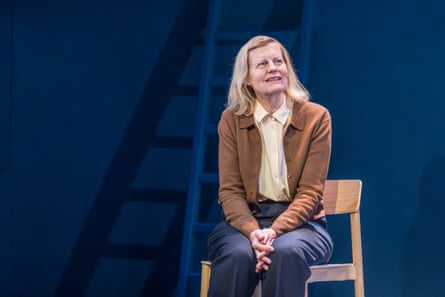
Delilah bristles at Jennifer’s maternal interloping, taunts her with games of one-upmanship (“Dad doesn’t keep anything from me”) and is granite-like in her rejection of Jennifer’s overtures. But Kellyman allows you to see her character’s vulnerability and fragmentation, too, and you feel her emotional push-and-pull towards Jennifer.
Hille, who gives an impressive performance too, draws out the quiet regret of her character’s life, making you lean in to hear Jennifer’s every, uncertain word and piece together her backstory. There is not quite enough meat there, though, and Jennifer is too much of a type, excruciatingly understated in her Britishness and self-deprecating to the point of cliche.
She seems like one of Anita Brookner’s socially awkward, librarian-like women from a bygone Britain with an admin job (she organises medical records) who has found herself in a marriage, in middle age, and cannot believe this late flowering. John, for his part, remains off stage and you do not quite believe in him, or this marriage, either. Humour lightens the tone but seems too much as if it is trying to soften the edges of the story. It is a little tame and twee, too, getting in the way of the delicately captured emotional drama between the women.
The play’s title is taken from Wallace Stevens’ poem Thirteen Ways of Looking at a Blackbird, about perspectives on the same scene. It deals in a kind of emotional Rashomon effect as we try to work out who is right or wrong, victim or villain (if there is one). Delilah is suspicious of Jennifer and that feeds into a melodramatic plot line, which enters the territory of psychosis but does not have enough of a payoff.
There are riches here nonetheless and the play has an incredibly original focus. In its best moments, it seems like a modern version of Hamlet, complete with the ghost of a parent who seeks revenge and the paralysis of a grieving child.
Basia Bińkowska’s set design is full of beautiful whimsy: there is shadow-play and clever use of props, which initially sit on a shelf. The monochromatic wash of the set suggests a Maggie Nelson kind of blue, the madness of grief but also a dream-world cast with this melancholic dye.
The play’s power, ultimately, lies in its liminal spaces: between dream, psychosis and reality, between fiction and its creation, and between the tragedy of death and the capacity for healing found within it.