6 hours ago
8
6 hours ago
8
Jan van Loon remembers the moment well. As Arsenal’s head of coaching he was guiding Freddie Ljungberg’s first steps in management with the under-15s when Bukayo Saka joined the squad. Saka was regarded as one of the academy’s standout talents but Ljungberg soon concluded the youngster was in danger of not fulfilling his potential.
Towards the end of 2016, Ljungberg delivered words to Saka that, according to Van Loon, have shaped the winger’s career. It was a one-on-one evaluation, typically held twice a year in the academy, but also in the room were Van Loon, a strength and conditioning coach and Saka’s father, Yomi.
“Bukayo was sitting there feeling pretty confident because he was scoring goals and things were seemingly going well,” Van Loon says. “But Freddie said: ‘I’m actually not that satisfied, because you’ve got so much more in you. You need to take a good look at yourself. From now on, I want to see the real Bukayo. No more hiding in training or going through the motions. No, you’re the first one out there on the pitch and the last to leave it. You’re going to carry the team and take on a leadership role.’”
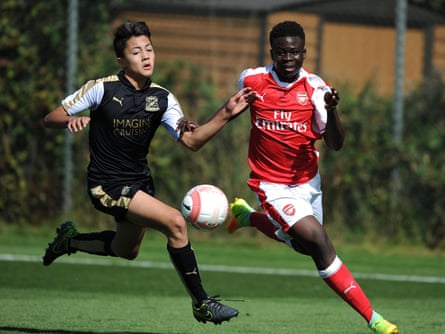
Saka, Van Loon recalls, was taken aback. “He didn’t expect criticism, that he needed to do much more. But he quickly realised that Freddie was doing it out of respect. Freddie said: ‘I’m going to help you with this, I’ll support you, I believe in you.’ And very quickly it turned into something positive.”
The conversation remains etched in Van Loon’s memory. “You have to picture it like this: Bukayo was sitting at the table and his dad was in a chair a few metres behind him. We looked them both in the eyes and his dad had a big smile, like: ‘Finally, someone who’s going to help my son get the most out of himself.’ Because he could see there was so much more in Bukayo.”
Ljungberg twice won the Premier League with Arsenal, including as part of the Invincibles, and was a member of their team that lost the 2006 Champions League final. Twenty years on the club return to that stage against Paris Saint-Germain on Saturday and if Saka shines on the biggest stage, Van Loon will surely reflect again on that meeting between two of the club’s most celebrated forwards.
“It was as if everything just clicked right there, like the pieces of a puzzle falling into place,” he says. “In that moment I felt something great is happening here. It was pure gold … Sometimes, in a player’s career, you can trace things back to one moment where he realises: ‘I can’t let the talent I’ve been given slip away. I have to put the work in now.’ Bukayo made that decision right there. He completely embraced that mindset, and he is still doing that today.
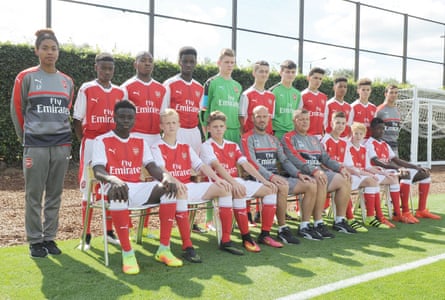
“Up until that meeting, Saka wasn’t really standing out. In a way, it was almost too easy for him. Even at 50 or 60% of his ability, he could already be the best on the pitch. He became comfortable, he wasn’t being challenged. Freddie saw that.”
Ljungberg left for Wolfsburg the following February and Van Loon took over the Swede’s team. “I hardly had to do anything because Bukayo was doing it all,” says a laughing Van Loon, who departed Arsenal later in 2017. “He was running the dressing room, organising the warm-up, making sure the intensity in training was right. If the work rate wasn’t there, he’d say: ‘Coach, do you have a second?’ He’d stop the session and tell the other players: ‘Right, now we’re going to work … You need to press harder …’ That’s when Bukayo really took off.”
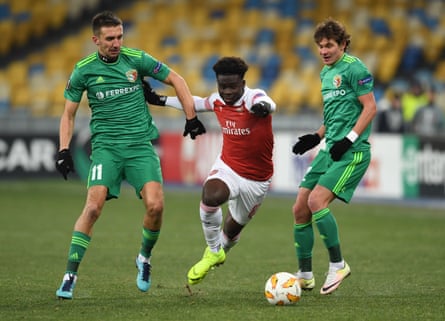
A year later Saka was playing for the under-23s, coached again by Ljungberg, and on a freezing night in Kyiv in November 2018 he made his first-team debut. Unai Emery selected him for a Europa League tie at Vorskla Poltava and Saka, aged 17, came on for the final quarter with No 87 on his back. It completed a path shaped by sacrifice – the hours spent honing his skills with his father and brother in the garden, the countless car trips to the Hale End academy with his dad.
Within two years Saka had his first England cap, his smooth transition leaving a mark on Chris Powell, Gareth Southgate’s assistant. “I remember how seamless it was for him to fit into training and into the level of play, which was impressive for someone so young,” Powell says. “Playing for your country and being alongside the elite players can be overwhelming for some, but Bukayo has such a good temperament.”
Not that Saka’s journey has been without adversity. Most devastatingly, he was one of three England players to miss a penalty in the Euro 2020 final shootout defeat by Italy. Powell made a point of consoling him on the pitch. “I have a son the same age and I just remember thinking: ‘That could have been my son standing there.’ I put my hand on his shoulder to show him he wasn’t alone.”
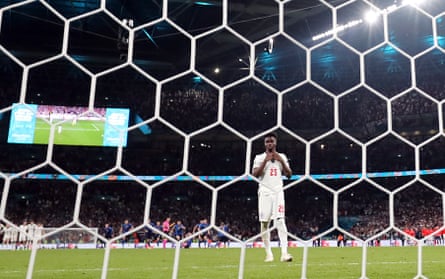
Powell admits he was worried, though: “I thought he might not come back from it. Standing there with Saks on that Wembley pitch, it was in my head that there would be a backlash.”
Unfortunately there was, with Saka, Marcus Rashford and Jadon Sancho, who also missed penalties, subjected to racial abuse online. Powell says support from Southgate and Arsenal, including from their manager, Mikel Arteta, was vital.
“Not only did we get Bukayo back, but I think we got a better player back,” he says. “Sometimes you go through very difficult moments, but those experiences can help you in the end. He has been amazing since, which just shows you his strong mindset and mentality.
“I think it’s been almost the making of him. Such a huge moment in his young fledgling career – but he overcame it. He has been taking penalties for Arsenal and England since, scoring massive goals like the one away at Real Madrid last season and producing other massive moments for them. It just shows the stature of a player who is still only 24.”
Powell left the England setup after the 2022 World Cup but Saka went on to be coached there by Jimmy Floyd Hasselbaink, who from March 2023 until after Euro 2024 worked primarily with the attacking players.
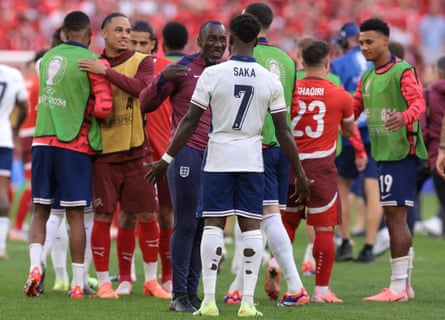
“He listens, asks questions and takes on board what you tell him,” says Hasselbaink, who well remembers how Saka achieved redemption from the spot by flawlessly scoring a Euro 2024 quarter-final penalty in the victory over Switzerland. “He was asked and he wanted to take it,” Hasselbaink says. “We practised it many times in training and he looked sharp, full of confidence.”
Hasselbaink had helped Saka and others focus on penalty routines. “For some, it’s important to start without a goalkeeper and focus purely on a corner and hitting the far corner, and then repeat that many times. What I also did was mark the middle of the goalpost with bright tape. That highlighted the area where the ball shouldn’t go, because that’s the height where it’s easiest for a keeper to save it. You either hit it hard and high into the corner, which carries some risk, or hard and low.”
Hasselbaink admires Saka’s defensive diligence but urges him to focus on his attacking game when he faces PSG’s Nuno Mendes on Saturday. “With Mendes, the most important thing is to attack him, to keep him pinned back as much as possible,” the former Chelsea striker says. “Mendes will want to get forward as much as he can. It should be a very interesting duel.” Hasselbaink is confident Saka will shine: “In big matches,” he says, “ he always shows up.”
Saka, 10 years on from that chat, has certainly made the most of his talent. “He constantly wants to keep improving, both as a footballer and in his behaviour as a role model for the youth,” Van Loon says. “He shows that hard work can pay off and that you can deal with setbacks.”