2 months ago
102
2 months ago
102
Oliver Bearman emerging unhurt from a huge accident at the Japanese Grand Prix was considered a lucky escape. Formula One must think it is catching a break given there is a full month to work out how best to mitigate against it happening again. It is going to need every minute of that time given the complexity of the problem.
Bearman’s Haas car was travelling at 307kmh (191mph) when he was forced to veer off track as he came up behind the relatively slow-moving Alpine of Franco Colapinto. The closing speed between the two cars was 50kmh, a frightening pace. The scenario was one many had been warning about before the season had even begun. With the deployment of electrical energy, and its subsequent recovery now an integral part of F1, Bearman was using his boost mode while Colapinto was recovering energy, hence the big difference in speed.
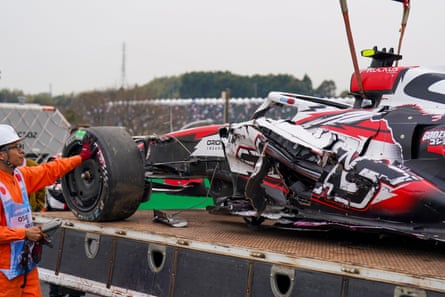
There was no underhand behaviour. Colapinto was on a defensive line as they came round the right-hand curve toward Spoon corner, but he did not cut across. Bearman simply came up on him so fast he had to swerve off the track to avoid hitting him. He did so and then piled into the barriers with a 50G impact from which he remarkably emerged with only some bruising, although his car was in pieces.
His team principal, Ayao Komatsu, said it had been a lucky escape and he was right. If Bearman had hit the rear of Colapinto’s car there was every chance he could have been catapulted into the air and suffered a far more violent crash, as well as Colapinto taking a big impact.
Equally, as the Williams driver Carlos Sainz said, it was lucky it happened at Suzuka where there was wide space and run-off for Bearman to take to before he hit the barriers. What, Sainz wondered, would have been the result on high-speed circuits such as Baku, Singapore or Las Vegas, where walls that are feet away, rather than grass and gravel, delineate the track.
He was not alone in a criticism that has been aired repeatedly this season. Nor has it been ignored. The FIA has been clear it is closely monitoring and assessing every aspect of the new regulations, with particular attention to their impact on safety, which is always the governing body’s first priority. It has been assiduous in this over the first three races. There was always going to be an examination and discussion of changes after the opening meetings.
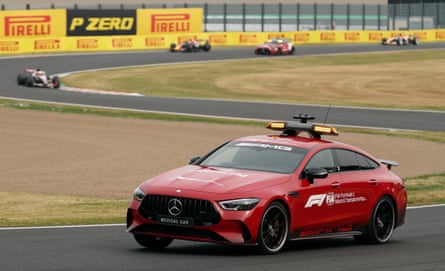
Fortunately, with the cancellation of the Bahrain and Saudi Arabian Grands Prix and the next round not for five weeks in Miami, there is time to give the problem the full attention of everyone involved – the FIA, F1, teams, engine manufacturers and drivers.
They have their work cut out. The McLaren team principal, Andrea Stella, summed it up best. “I don’t think a simple solution exists,” he said, with a typically astute engineer’s evaluation. He was not alone. Komatsu said: “I don’t know what the solution is just yet, but we just have to be calm and discuss it all together as an F1 community.”
The views align because it is so complicated. No part of the new engine regulations exists in a vacuum. Changes in one area affect others, while each engine manufacturer also has its vested interests, although to be fair these would probably be shelved for a clear issue of safety.
At its heart is the use of the electrical energy, which has divided so many in the sport, and the complex analysis of data that comes with it. Changes on how much energy can be recovered when super-clipping – charging the battery while at full throttle – have been mooted, but this would slow the cars more.
It had been set at a lower level to try to avoid such a differential. The counterargument posits that allowing a higher rate under super-clipping would negate the need for drivers to lift and coast, the situation that creates an even greater speed differential against a following car that is deploying energy.
There are cause-and-effect complications here of labyrinthine complexity, not least because teams take different approaches to how and where they manage their energy. Nor, as has been suggested, can the sport simply increase the internal combustion engine power output and lessen the role the hybrid energy plays.
Changing the power distribution from the almost 50-50 split to, for example, 70-30 would require increasing the fuel flow, and thus bigger fuel tanks, in turn meaning a redesign of the car. Nor would it necessarily be agreed, given the split was the formula designed to attract back engine manufacturers such as Audi and Honda. If that is to be the direction of travel it will almost certainly not come until next season at the earliest.
There is at least a genuine agreement and will to deal with it, especially after Bearman’s crash. Equally, there is no shortage of sharp minds now focused on the issue, a real positive in what is so often a competitive atmosphere. The challenge is that F1 is now adapting as the season progresses and each event presents a new test, so there is no little pressure to get it right, rather than be at the mercy of another lucky escape.