3 months ago
126
3 months ago
126
There are times when football is gloriously silly, times when the logic of your eyes and all your experience tells you one thing is happening, and then it turns out the reality is quite different. What seemed at the break as though it was going to be an easy away win unexpectedly became a draw and, as a result, both ends of the table looked quite different at the final whistle to how it appeared they were going to look at half-time.
It was a case of multiple immutable but incompatible laws running into each other. On the one hand, Tottenham are terrible and have picked up only 10 points at home this season. But on the other, City have developed a habit of needlessly squandering points and somehow always do worse than expected against Tottenham. The consequence was a game that simultaneously made very little sense but at the same time was predictable, at least in the way it remained true to those fundamental principles.
This fitted a concerning pattern for Manchester City. Although they beat Leeds and Fulham they conceded five goals in total in the second half of those two games. Level at half-time at Manchester United, they lost 2-0. Leading at half-time against Brighton and Chelsea, they conceded in the second half to draw 1-1. There has been a clear trend in recent months of City conceding important goals after half-time. Seven points have been lost through the concession of second-half goals this year alone; if they had those seven points, City would be a point clear at the top of the table.
But Spurs this weekend will also have been thinking about half-times and how different things could look. At half-time at Stamford Bridge on Saturday evening, West Ham led Chelsea 2-0; at half-time here, Spurs trailed 2-0. Had those results remained like that, Spurs would have been only five points above the drop zone and it would have been increasingly difficult to maintain the belief that they are not engaged in a relegation battle. As it is, after Chelsea’s comeback and Solanke’s two goals, the gap is nine and it feels a lot less like Spurs are sleepwalking into a dogfight.
It wasn’t just that City led at half-time; it was that Spurs had been shambolic. They looked a team without resistance, without a clue. If the booing at half-time was relatively restrained, it can only have been because so many fans were so numbed by what they had seen. And, being fair, perhaps also because there was a recognition that it’s not really fair to judge Spurs when they’re without 11 injured players.
From Tottenham’s point of view, the opening goal was inexcusably limp. Yves Bissouma was dispossessed on halfway by Bernardo Silva and then Rayan Cherki, having been released by Erling Haaland, was given an extraordinary amount of time and space to measure his shot across Guglielmo Vicario and into the bottom corner. Frank’s fury was obvious as he slammed an environmentally sustainable water carton to the ground (he may have been angry, but Frank remains responsible and Danish). Whatever the issues of personnel and whatever problems Frank has had, this was just poor play by two players who should be better.
Or maybe they shouldn’t be. After all, Radu Dragusin, recently recovered from an anterior cruciate ligament injury, had played only seven minutes this season and hadn’t started a game for 371 days. He had a nightmare first half, at one point sliding past Rayan Cherki as he chopped inside, like a passing bobsledder with only a vague interest in the game, but perhaps that’s not unreasonable for a player who has played so little over the past year. Bissouma, similarly, had not played for the club this season before coming off the bench at half-time in the home defeat against West Ham a fortnight ago.
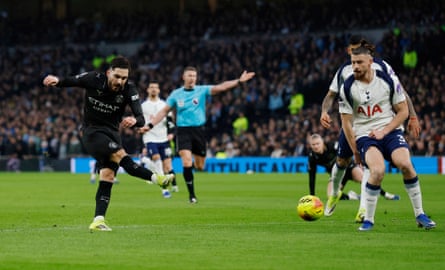
City’s second was almost as facile, as Dragusin’s long pass from near his byline was intercepted and Cristian Romero was somehow left with two to deal with. Silva slid it square and Antoine Semenyo finished a straightforward chance. It was all extremely easy. The sense was almost of an early-round Cup tie, the bigger side holding the plucky underdogs at arm’s length and picking them off as and when.
When Romero did not reemerge for the second half, the assumption was that it would just get worse for Spurs. But the assumption was wrong. It wasn’t only Dominic Solanke’s involvement in the two goals – although that did serve as a clear reminder of what Spurs have been missing in his absence for much of this season. Xavi Simons has looked increasingly dangerous over the past few weeks, Dragusin settled and João Palhinha emerged as a dominant figure. And City, again, buckled, only two fine saves from Gianluigi Donnarumma preserving a point for them.
In the end, although City’s expected goals was more than double their own, Tottenham will probably feel the draw was the least they deserved. What does it mean? Certainly no one at Spurs could look at that first half and feel much in the way of positivity. The injury list, similarly, can inspire only dread. But there was at least fight and that hasn’t always been true in the recent past.