2 months ago
68
2 months ago
68
Charisma is something you can’t fake and Frida Kahlo had it before she became an artist, let alone a modern hero. In photographs, the teenaged Frida appears both in a silk dress staring boldly from beneath her already colliding black eyebrows, and posing as a man in suit and tie. In a home movie her husband, the Marxist mural painter Diego Rivera, woos her and they cuddle. Those were the good times. Rivera is so fat and ugly next to his wife, you’d think he would have appreciated his luck more.
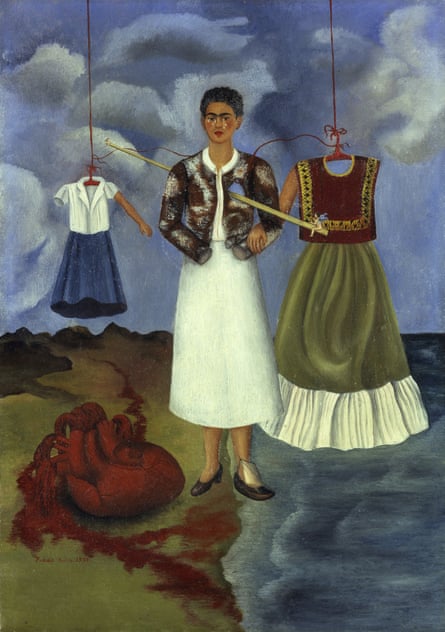
Every image of Kahlo is interesting but nobody could portray her like she portrayed herself. She took self-portraiture to new levels of interior revelation, psychological and physical. Inspired partly by the surrealists and partly by Catholic traditions of depicting pain, Kahlo took herself apart and put herself back together in images of suffering, survival and triumph. In her 1937 painting The Heart, she stands neat and calm while a sword pierces her chest and her disembodied arms reappear in two floating, otherwise empty outfits. The most complete of the Fridas has a brace on her left foot which could be a Freudian symbol except it’s a factual reference to the physical challenges she suffered all her life after she was severely injured in a bus crash when she was 18.
Her most shocking works depict the accident directly. In a 1926 drawing Kahlo sketches flattened bodies strewn around streetcar wreckage, while in the foreground she lies bandaged in hospital. In another work she restages the accident with a toy cart and doll. These memories have a primal quality as if this devastating event was the end of childhood innocence. One of the surgical corsets she wore is in a glass case nearby. On it she has painted a red hammer and sickle, where the cast is moulded to her breasts: below, over her abdomen, is a picture of a foetus squatting in the womb.
Magic, myth, doubles and dreams: Kahlo takes you inside, into her mystery. She even lets her hair down, literally, in a 1947 self-portrait that shows her dark locks hanging loose like a river. The effect is disarming. You look in the mirror with Frida as she gazes into her own deep dark eyes.
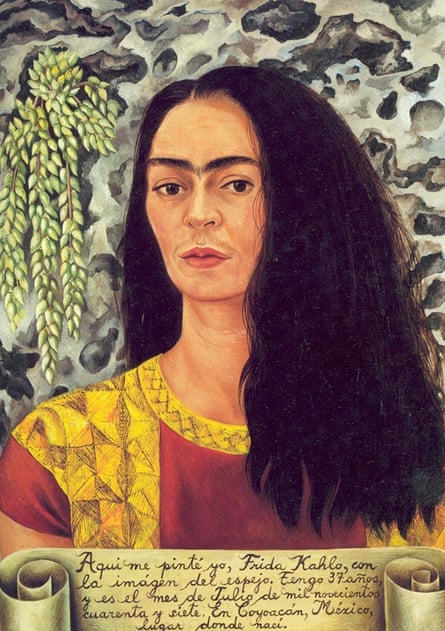
Tate’s blockbuster show about this rightly beloved artist asks how and why she became an “icon”. But I’ve never seen an exhibition about how Picasso got famous or the cultural invention of Rembrandt. We know they are great artists and how they were historically recognised is for scholars. Here, those assumptions are reversed. Kahlo’s image and fame are picked over obsessively as her work suddenly disappears to be replaced, about halfway through, by homages, restagings, deconstructions and, finally, merchandise.
An artist, it turns out, can be too famous. Kahlo’s “icon” status has made it hard to borrow her works. In short there are only 36 of them here. Kahlo’s collectors, it seems, don’t care about supporting museums or sharing their treasures – I’m talking to you, Madonna. As a result, this is an exercise in covering the cracks, compensating for a thin haul of Kahlo’s actual art firstly with works by her contemporaries, then by artists since the 1970s who have been inspired by her one way or another.
At times this is an impressive performance, a filibuster in which the curators throw in every possible bit of context and affinity to stretch out what would otherwise be quite a small exhibition. One beneficiary is Rivera. He gets impressive works in, including a stunning nude drawing of his wife as well as a tender portrait of her. And you can gruntingly acknowledge that contemporaries Olga Costa and Maria Izquierdo painted flamboyant self-portraits, but they are not in Kahlo’s league.
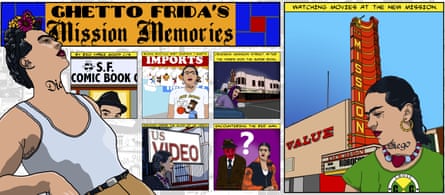
Nor are most of the artists who have paid her homage since the 1970s. Comic book, pop art versions of Kahlo’s unmistakable face are not enough to keep this show alive. Is Kahlo a plastic “icon” anyway? No, she was a real person who made intensely autobiographical art. That is almost lost when lesser artists make posters of her face or dress up as her. Does Yasumasa Morimura have a right to pose as Kahlo in her painting The Broken Column, with prosthetic breasts parted to reveal, in his version, an upright arm with clenched fist? No, it’s egregious trash. The original shows Kahlo’s spine as a shattered classical column. It’s a portrait of her pain. Of course, The Broken Column itself, like other Kahlo masterpieces, is not here.
Then, triumphantly, Kahlo steals back her show. Her 1951 painting Self-Portrait with Dr Farill shows her in a wheelchair looking fixedly at us next to her easel, on which there is a huge picture of a doctor she was so grateful to: he looks like a Soviet leader in a social realist artwork.
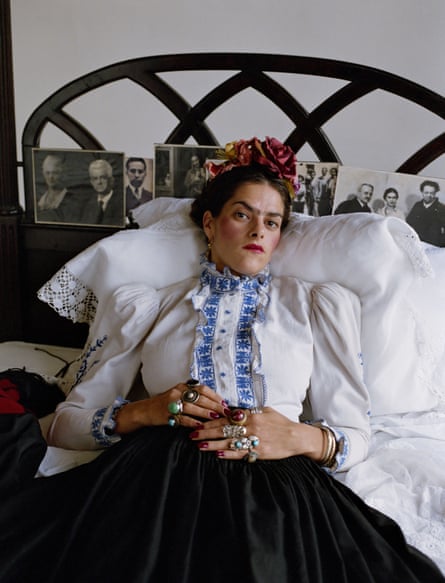
Of course in tracking her rediscovery by post 1960s artists attuned to body and performance art, Tate has a point: the way we see Kahlo is conditioned by contemporary ideas in which life and art can be understood as one. A photograph by Mary McCartney captures Tracey Emin lying on a bed, dressed and made up as Frida. It’s a striking resemblance and Tate Modern wants you to see it, for Kahlo’s show faces Emin’s A Second Life on the same floor. Inside Emin’s, the crowds are absorbed and silent – hypnotised by the artist’s truth. They deserve to be hypnotised by Kahlo too, but I don’t think they will be when her magic is diluted by so much dross.