2 months ago
99
2 months ago
99
It started with a notice in the local newspaper and ended with winning one of the world’s most prestigious environmental prizes. In 2010, Sarah Finch was flicking through the local planning notices when one caught her eye: a proposal to drill for oil at Horse Hill in Surrey, just outside Crawley, over the border in West Sussex, 6 miles (10km) from her home.
Surrey is not the kind of place one expects to find the oil industry. It’s a county of little villages, farms, woods and commuter railway stations. Its semi-rural landscape stretches off towards the horizon in a typically English green patchwork. It is difficult to envision it littered with nodding donkey pumpjacks and gas flares.
Finch was shocked. A longtime environmentalist, she had been an early adopter of climate politics, working as a climate press officer for Greenpeace and protesting against the Kingsnorth power station in Kent. But this was the first time it had come so close to home. “This is local,” she thought. “I’d better get involved.”
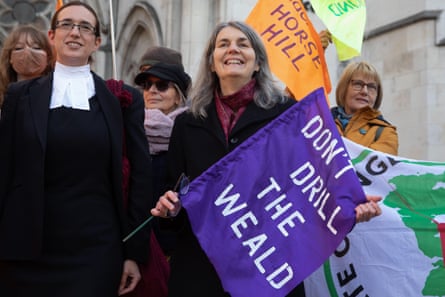
Horse Hill was part of a network of drilling sites proposed to tap the Weald basin, a shale rock formation deep beneath southern England’s home counties. Oil prospectors believed they could use the latest fracking methods to turn Surrey into the new Texas, yielding a potential 100bn barrels of oil.
Finch was drawn to the campaigns against the proposed oil rush, bringing together her Surrey neighbours and anti-fracking campaigners to form the Weald Action Group (WAG). They fought plans to sink wells in the town of Balcombe, organising mass demonstrations in the town that drew thousands. Together, they succeeded in getting a number of drilling applications refused or withdrawn. But not all.
In 2014, oil prospectors drilled a first exploratory well in Horse Hill, followed by a second in 2017. Then in 2018, the company Horse Hill Developments Ltd applied to Surrey council for permission to drill four more and begin commercial production. Over 25 years, they would pump more than 24m barrels of oil.
Finch and her fellow campaigners worked to build community opposition. But, despite their objections – and just months after declaring a climate emergency – Surrey approved the plan.
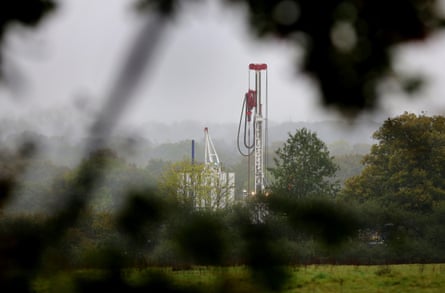
But WAG did not back down. As they dug into the planning application they became aware of “scope 3 emissions” – those that burning the oil itself would produce. Surrey had told the developers they should be included in an impact statement. The developers disagreed. The council gave in.
That meant the project’s environmental impact statement mentioned emissions from local operations – such as drilling and roadworks – but omitted the 10.6m tonnes of CO2 that would result from burning the oil.
With Finch as the lead claimant, WAG applied to the high court for a judicial review of Surrey’s decision, arguing that because it had failed to account for the scope 3 emissions the decision had not been properly made. The court disagreed. They appealed. They were denied.
Finch had not considered what might happen next. But their loss had serious, unexpected consequences. Shortly after, Michael Gove, then the communities secretary, was asked to decide on the UK’s first new deep coalmine in 30 years, the Whitehaven colliery in Cumbria, criticised by environmentalists as a “carbon bomb”. He approved it.
Looking through the decision document, Finch’s stomach turned as she saw her name appear 85 times – Gove repeatedly citing her case as showing emissions from the coal dug up from Cumbria were irrelevant to the planning application. She felt naive. She had not expected her attempts to block a local oil well could end up relaxing planning rules for fossil fuel developments entirely.
There was one last hope: a last-ditch application to the supreme court. A split judgment at the court of appeal had given Finch the chance to appeal to the UK’s highest court. Against the odds, it accepted her case – the first climate case it had ever heard.
Meanwhile, the stakes kept getting higher. Legal objections to other fossil fuel projects – including the Cumbria coalmine and the Rosebank and Jackdaw oil fields in the North Sea – were frozen, awaiting the outcome of Finch’s case. The Cumbria mine’s developer and the government intervened as interested parties on the side of Surrey council; Friends of the Earth and Greenpeace joined on the side of Finch.
On a sunny morning in June 2024, almost five years after Finch began her legal challenge, the decision came. The climate impact of burning coal, oil and gas must be taken into account when deciding whether to approve projects, wherever that burning takes place, the court ruled.
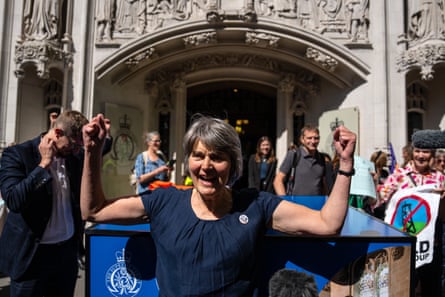
It was a small change in interpretation of the Town and Country Planning Act, but the effect was momentous. Permission for the Cumbria coalmine was quashed by the high court. The government spent a year rewriting guidance for the offshore oil and gas industry, pulling support from Jackdaw and Rosebank, which were then ruled unlawful.
The Finch ruling has been one of the most groundbreaking environmental cases of the century. But it is already under threat. The government has said it is considering replacing the entire environmental impact assessment regime, which could nix it entirely. In any case, the government still has discretion and, with fuel shortages caused by the war in the Middle East boosting calls for drilling, there are fears that Rosebank and Jackdaw could be revived.
On Monday, Finch was awarded one of the world’s most prestigious annual environmental prizes, alongside six other women from around the world. The Goldman Environmental prize, founded in 1989, has to date honoured 239 grassroots activists from 98 nations.
Finch, meanwhile, continues campaigning. “It’s a kind of war of attrition with the fossil fuel industry,” she says. But she believes its days are numbered. “You know, renewable energy is more efficient, cheaper, cleaner, less prone to being disrupted by mad dictators.
“In every way, I think clean energy is preferable and that’s our future. But it’s just not happening fast enough.”