3 months ago
128
3 months ago
128
Key events Show key events only Please turn on JavaScript to use this feature
EU launches investigation into Elon Musk's AI bot Grok
Elon Musk’s AI chatbot Grok faces an investigation by the European Commission into whether it spreads illegal content such as manipulated sexualised images in the EU.
The Commission said today that it will examine whether X properly assessed and mitigated risks related to Grok’s functionalities in the 27 country bloc.
Users have been able to ask Grok on the social media platform to edit photos of people, including removing clothing and putting them in provocative poses, often without their consent, which were then published in replies on X.
Grok AI generated about 3m sexualised images in less than two weeks, including 23,000 that appeared to depict children, according to researchers at the Center for Countering Digital Hate.
EU technology chief Henna Virkkunen said:
Non-consensual sexual deepfakes of women and children are a violent, unacceptable form of degradation.
In response to the investigation, X provided a link to a statement it published on 14 January:
We remain committed to making X a safe platform for everyone and continue to have zero tolerance for any forms of child sexual exploitation, non-consensual nudity, and unwanted sexual content.
Here’s our full story on Ryanair:
Spire Healthcare shares jump after it says it's in talks with two buyout firms
Shares in the UK’s biggest private health provider have jumped after it confirmed that it is in early talks with two buyout firms to be taken private.
Spire Healthcare shares jumped as much as 20%, and are now up 15% at 205.5p, valuing the company at nearly £826m and making it the biggest riser on the FTSE 250. However, they have fallen 11% over the past year.
The FTSE 250 index is down 15 points, while the FTSE 100 index is broadly flat, dipping just 3 points to 10,140.
Spire said private equity firms Bridgepoint Advisers and Triton Investment Advisers are among the parties in discussions with the company, but added:
These discussions remain at a preliminary stage.
Spire first announced a strategic review of its operations in September, saying it was in discussions with several parties to explore options including a potential sale of the business.
Spire runs 38 hospitals and more than 50 clinics, medical centres and consulting rooms across England, Wales and Scotland. It was founded with the acquisition and re-branding of 25 Bupa hospitals in 2007, and floated on the stock market in 2014.
It has come under pressure from investors, led by Harwood Capital Management, which told the Times last September that it felt Spire’s share price “fails to reflect the company’s value, most notably its unencumbered hospital portfolio worth in excess of £1.4 billion, and its occupational health business, where management has an ambition to deliver £40 million per annum of ebitda [earnings before interest, tax, depreciation and amortisation] over the medium term”.
Spire owns the Claremont Hospital in Sheffield and has acquired a string of other sites, such as the historic St Anthony’s Hospital in south London from Daughters of the Cross, an order of nuns who had run the hospital for 120 years. The firm has also built two new hospitals, in Manchester and Nottingham.
Spire warned in December that annual adjusted core profit would be at the bottom end of its guidance range of £270m to £285m. While more people have been paying for private treatments out of their own pockets, and Spire also benefits from patients with private health insurance, work it carries out for the NHS has slowed. It said at the time:
This has not been sufficient to offset the well-publicised recent slowdown in NHS commissioning activity to the independent sector, due to integrated care board budgetary restrictions.
Ryanair CFO: we would be open to using Musk's Starlink wifi in future

Lauren Almeida
Ryanair would be open to using Elon Musk’s Starlink wifi on its planes in the future, its finance boss has suggested, amid a feud between the US tech billionaire and the boss of the Irish airline.
The budget airline would look at “whoever is the best, when the tech and price is right”, Neil Sorahan, chief financial officer, said.
It comes after an online spat between Ryanair boss Michael O’Leary and Musk, after O’Leary was asked whether he would follow Lufthansa and British Airways in installing Starlink satellite internet technology on his fleet of 650 aircraft.
The Ryanair chief executive rejected the idea, saying that adding antennas to the jets would result in a “2% fuel drag”, adding an extra $200-250m to its $5bn annual kerosene bill.
Musk said the interpretation was “misinformed” in a post on his X platform, triggering a tit-for-tat exchange of insults, with each man calling the other an “idiot”.
Sorahan said the spat was “good fun” and had brought more people to the Ryanair website. O’Leary said last week that his quarrel with Musk had boosted bookings between 2-3%.
However, Sorahan added that in-flight wifi was still a long way away for Ryanair.
I have been looking at wifi for as long as I have been at Ryanair. There is still a fuel cost that we would have to absorb.
Oil prices slip after report Opec+ plans to keep output steady
Oil prices have slipped after a report that the oil cartel Opec and allies signalled steady output.
Oil gave up earlier gains sparked by production disruptions in major US crude-and natural gas producing regions as winter storm Fern struck the US coast.
Brent crude futures fell by 0.3%, or 24 cents, to $65.65 a barrel, after rising to $66.30 a barrel earlier. US West Texas Intermediate crude hit $64.49 a barrel, up 0.7%.
Both benchmarks notched up weekly gains of 2.7% to close on Friday at their highest levels since 14 January. A US military aircraft carrier strike group and other assets are expected to arrive in the Middle East in the coming days.
Opec+ delegates said they expect to stick with plans to keep oil production steady next month when they meet on Sunday, as the group grapples with a global surplus and a spate of geopolitical risks, Bloomberg News reported.
Key members led by Saudi Arabia and Russia will hold a monthly video conference to review a decision, first made in November, to freeze output levels during the first quarter, after rapidly ramping up production last year.
Bloomberg cited four delegates as saying their expectation is that the policy will remain unchanged, although two added that discussions among members have yet to take place.
Carney: no intention of pursuing free trade deal with China
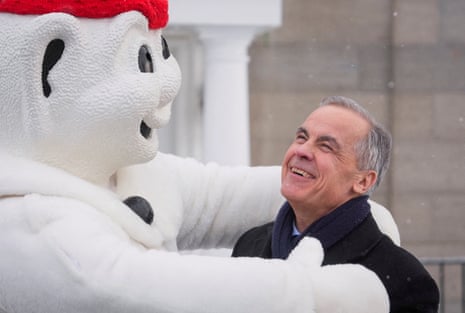
Canadian prime minister Mark Carney said on Sunday his country has no intention of pursuing a free trade deal with China, in response to Donald Trump’s threat to impose a 100% tariff on goods imported from Canada if the country made a trade deal with Beijing.
Carney said Canada’s recent agreement with China merely cuts tariffs on a few sectors that were recently hit with duties.
Trump claimed otherwise, posting that “China is successfully and completely taking over the once Great Country of Canada. So sad to see it happen. I only hope they leave Ice Hockey alone! President DJT”.
Carney said Canada’s free trade agreement with the US and Mexico contains commitments not to pursue free trade agreements with nonmarket economies without prior notification.
We have no intention of doing that with China or any other nonmarket economy. What we have done with China is to rectify some issues that developed in the last couple of years.
Trump wrote on his Truth Social platform on Saturday:
China will eat Canada alive, completely devour it, including the destruction of their businesses, social fabric, and general way of life.
If Canada makes a deal with China, it will immediately be hit with a 100% Tariff against all Canadian goods and products coming into the [US].
Introduction: Gold soars past $5,100 an ounce, silver hits new record on tariff and US shutdown fears
Good morning, and welcome to our rolling coverage of business, the financial markets and the world economy.
Gold has soared past $5,100 an ounce, as investors pile into safe-haven assets amid Donald Trump’s threat of new tariffs on Canada and fears of another government shutdown in the US.
Trump threatened Canada with 100% tariffs if America’s northern neighbour “makes a deal with China”, and after the US president’s dramatic showdown with Europe over the future of Greenland.
There is also a risk that the US government could shut down for the second time in months, after Democrats threatened funding for the Department of Homeland Security in the wake of the weekend shooting of a man in Minneapolis by federal immigration agents.
Spot gold climbed 2.2% to touch a new all-time high of $5,110.50 an ounce. It gained 64% in value last year, its biggest annual increase since 1979. A weaker dollar and interest rate cuts have added to gold’s appeal, and it has also been boosted by central bank buying and record inflows into exchange-traded funds.
So far this year, the gold price has risen more than 18%.
Silver prices also continue to go up after rising through $100 an ounce on Friday. Spot silver climbed 4.5% to $107.6 an ounce, after hitting a record of $109.44.
Ipek Ozkardeskaya, senior analyst at Swissquote, said:
What’s striking is that this renewed flight to safe havens is unfolding without any major geopolitical headline this morning. There has been no new escalation over the weekend — no fresh breach of international law, no invasion, no immediate military threat. The US did, however, threaten Canada with 100% tariffs, after Mark Carney approached China last week, defying the White House — a reminder that trade tensions remain alive and well. Beyond that, the news flow is thin. Yet the bid for precious metals suggests that market stress is far from over.
She added:
Last week was marked by the escalation — and partial de-escalation — of geopolitical and trade tensions between the US and the EU, Macron’s now-famous glasses that grabbed headlines at the World Economic Forum, and renewed stress around Japan’s swelling public debt. The latter triggered a sharp sell-off in Japanese government bonds, pushing some long-dated JGB yields to multi-decade — and in some cases record — highs.
The yen spiked on Friday and has risen by 1% to 154.06 per dollar today, sparking speculation over potential intervention. The New York Federal Reserve conducted rate checks on Friday, Reuters reported citing sources, raising the chance of joint US-Japanese intervention to halt the slide in the currency.
Since Sanae Takaichi became Japan’s prime minister in October, there have been fears that her fiscal spending plans and tax cuts could worsen the country’s debt burden, which is more than double its economic output. She has called a snap election for 8 February.
The Japanese stock market fell by 1.79% on today, while South Korea’s Kospi was down 0.8%.
The Agenda
-
9am GMT: Germany Ifo business climate index for January
-
1.30pm GMT: US Durable goods orders for November