3 months ago
171
3 months ago
171
When Pep Guardiola was preparing for the challenge of taking on Jürgen Klopp’s peak Liverpool team at Anfield in February 2021, training that week at Manchester City was a little different, according to Oleksandr Zinchenko. Guardiola’s instructions seemed counterintuitive. “Guys, let’s start from the goal-kick, I want you to make at least three or four touches on the ball,” the manager told them. “Most of the teams come to Anfield and shit themselves. They want to play one touch, two touch. ‘Oh, don’t give me the ball! Oh you take it!’ But you have to play with big balls at Anfield! Big balls! ‘Give me the ball!’ Demand it! If you need to dribble past two or three players, do it. But play football. I want you to play football.”
Zinchenko recalls that Guardiola made the same speech before they walked out at Anfield. “Teams coming here are scared. They play one or two touches, and that’s what Liverpool like, because they get the ball back so quickly. I want you to be brave. Play your football!” as Zinchenko puts it in his autobiography, Believe. Admittedly that game came in the midst of City’s record-breaking 21-game winning run that season but was also Guardiola’s first win at Anfield, so not dissimilar to the title showdown at the Etihad Stadium on Sunday with Arsenal.
It remains indicative of the Guardiola mindset, forged by Johan Cruyff’s commitment to create and take risks. It’s difficult to imagine Mikel Arteta saying something similar to his Arsenal players on the latest step of their nervous, anguished quest to the finish line. Zinchenko, who has played for Arteta and Guardiola, formed the opinion that his City coach was “crazy but right”. In recent weeks it seems that theory has been borne out: a slick, relaxed City seem to be relishing chasing down Arsenal, while their opponents, burdened by legacy and history, have stumbled and look uninspired.
While Arsenal struggle for goals from open play, their creative force seemingly overdependent on set pieces, City, with Guardiola’s eclectic tactical mix, are pressing opponents into submission and enjoying football on the front foot. Nothing encapsulates the respective mindsets of the squads more than Rayan Cherki’s joyful (disrespectful?) ball juggling in the Carabao Cup final and Ben White’s reaction, dumping Cherki on the floor: one team totally in the groove, the other lashing out as control of their destiny slips away.
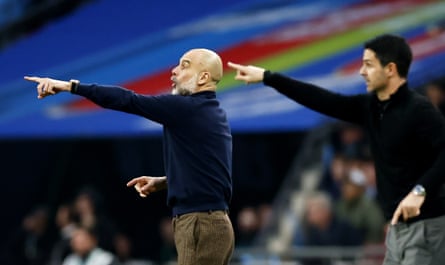
Guardiola’s ability to accommodate Cherki’s creative idiosyncrasies into this late title charge stands in stark contrast to Arsenal’s more functional forward line. It was instructive that the City manager compared Cherki with another very un-Pep like player whom he also accommodated, Sergio Agüero, after the key role he played in victory over Chelsea at the weekend. “Sergio was not the incredible high-press player but he tried his best and all I ask is that,” Guardiola said. “Do your best and you can do it, because he has another quality. Every player has his own ability.” Indeed, the blossoming of Cherki – with notable admonishments for rabona crosses and Carabao Cup showboating – has been key to freeing up City in the home straight.
And while neither Cherki nor Martín Zubimendi are likely to be aware of Danny Kahneman and Amos Tversky’s Nobel prize-winning paper on Prospect Theory, both demonstrate intuitive understanding of the basic concepts in their respective form.
Published in 1979, the seminal paper, which deeply influenced data-led decision-making in sport, showed that human beings suffer from loss aversion when in a favourable position. Thinking becomes dominated by what they could lose whereas, in pursuit, you have a clear target, full focus and less to lose and are thus much more open to risk taking.
Sir Alex Ferguson might call it Devon Loch syndrome, famously citing the horse that collapsed within sight of the Grand National finish line to bait Kevin Keegan’s Newcastle into their own meltdown in the 1995-96 title race.
Arteta’s Arsenal look like a team set up not to lose. And it’s not a recent phenomenon confined to this mini slump. Even back in February, in the “goals from open play” table, City were ranked first with 83% with Arsenal 16th, at 58%.
“Outcome pressure” is how Martin Fairn of Gazing, the company the All Blacks hired to transform their losing mindset to win the Rugby World Cup in 2011, describes it. Once you start obsessing about the outcome, as Arsenal appear to be, decision making goes awry. “In the mission simulation training we do with the British army, they give themselves 24 hours to reach a target,” says Fairn. “One hour in, it all feels pretty relaxed. As they go through the night and get closer to the enemy, there’s more jeopardy and decisions are harder. And if you make a stupid decision 50 yards from the enemy, that is life and death jeopardy.
“The question is, how heavy does the context and the associated pressure weigh on your shoulders? And are you diverted and not able to think clearly, or are you able to maintain agile thinking?
“Outcome pressure limits our ability to think clearly. Either you over-engage – ‘we have to fight to win, to save our lives’ – which can flip over into frantic stupidity, or there’s passivity, where you just freeze and people disappear. They’re playing but they’re off the pitch. You start to just feel the weight of being in the lead. And that’s exactly what’s happening with Arsenal now. It gets called choking and various things like that. It just means you feel the weight of being favourites because you’re closer and closer.
“The question is, how do you free up the mentality to acknowledge the significance of the outcome while resetting your attention. The zoom-out moment says we are not where we are by mistake. We’re at the top of the league because we’ve competed and delivered results consistently through the season.”
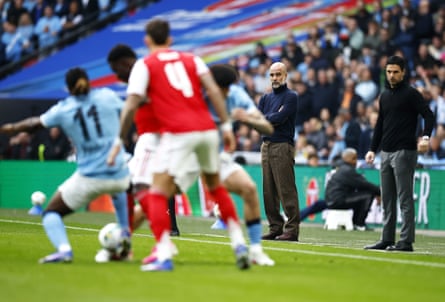
The twist is, of course, that Guardiola and Arteta go way back, not just to their days together at Manchester City, where Arteta was Guardiola’s assistant, but to Barcelona’s youth academy, which forged them both in the values of Cruyff’s risk-taking, possession-dominant football. Indeed Arteta partly couldn’t progress at Barcelona because Guardiola played in his position and Xavi was the better contemporary.
One of the few first-team appearances Arteta had was in a pre-season friendly against Hertha Berlin where, as a callow 17-year-old, he came on for Guardiola, the 28-year-old established pro. “With Xavi, Iniesta and Arteta, everything suggests Barça won’t have problems in this position for the next 20 years,” Guardiola said encouragingly after that game and he wasn’t wrong, even if Arteta wouldn’t feature.
And where once they both seemed to be inheritors of Cruyff’s legacy of playing football that demanded risk and creativity, it looks as though successive title meltdowns in the face of Guardiola’s City have forced Arteta into a more reductive way of playing. The irony is that this very caution risks being their undoing.






![[seagull] review – silence proves golden in innovative if puzzling shot at Chekhov](https://i.guim.co.uk/img/media/a24223b73f2f7fcf7ea7b4f5b4f001f968cd3eb9/153_281_3293_2634/master/3293.jpg?width=1200&height=630&quality=85&auto=format&fit=crop&precrop=40:21,offset-x50,offset-y0&overlay-align=bottom%2Cleft&overlay-width=100p&overlay-base64=L2ltZy9zdGF0aWMvb3ZlcmxheXMvdGctcmV2aWV3LTMucG5n&enable=upscale&s=a3d221f69bffd24b83d26e9be3f1c934)