2 months ago
53
2 months ago
53
“The Bundesliga table shows Bayern Munich on 70 points with an eye-popping goal difference of +72,” pops Chris Fryer. “Has any club won the league with a greater goal difference than points tally?”
Bayern Munich have won 22 and lost one in the Bundesliga this season. That was a 2-1 defeat against Augsburg, which means their 22 victories have produced a goal difference of +73. In other words, their average margin of victory is an absurd 3.32 goals.
As George Forsyth was first to point out, Hearts romped to the Scottish title in 1957-58 with a goal difference of +103. Their remarkable record – P34 W29 D4 L1 F132 A29 Pts62 – would have earned them 91 points in them modern era. Hearts’ list of victories included 9-0, 9-1, 8-0 and two 7-2s. Their GDP (goal difference – points) of +12 is the highest we could find.

+12 Hearts 1957-58 (Scottish First Division)
+7 Rangers 1898-99 (Scottish First Division)
+6 Liverpool 1895-96 (Second Division); Ajax 1966-67 (Eredivisie)
+3 Gretna 2004-05 (Scottish Third Division)
+2 Birmingham 1892-93 (Second Division); Bayern Munich* 2025-26 (Bundesliga)
+1 Preston 1888-89; Ajax 1997-98 (Eredivisie); Ajax 2009-10 (Eredivisie); Ajax 2018-19 (Eredivisie)
Despite their stonking goal difference, the Ajax team of 2009-10 did not win the Eredivisie title. They were pipped by Steve McClaren’s Twente, who finished a point clear and with a much more modest goal difference of +40.
There is a but. Rangers managed a GDP of +7 in 1898-99, when they played only 18 games. They won the lot, including 9-0 and 10-0 victories in successive games, which would have earned them 54 points in an era of three for a win. Pound for pound, or rather game for game, they outperformed even the Hearts side of 1957-58. If you divide the GDP by the number of games played, Rangers come out on top.
-
0.388 Rangers 1898-99 (Scottish First Division)
-
0.353 Hearts 1957-58 (Scottish First Division)
-
0.200 Liverpool 1895-96 (Second Division)
-
0.176 Ajax 1966-67 (Eredivisie)
-
0.09 Birmingham 1892-93 (Second Division)
Bayern’s equivalent figure in 2025-26 is currently 0.074
Bayern will do well to match Rangers and Hearts’ ratio, but they could well set a more significant record: the highest goal difference in any of Europe’s big five leagues. With seven games remaining, they are 20 short of the record set by Torino in Serie A in 1947-48 – but that was from 40 games rather than Bayern’s 34. In fact Bayern already hold the record for a 34-game season in the one of the big five leagues: their 2012-13 treble-winners romped to the title with a goal difference of +80. Thanks to Michael Haughey for pointing us in the direction of this list.
+92 Torino Serie A, 1947-48 (40 games)
+89 Real Madrid La Liga, 2011-12; Barcelona La Liga, 2014-15 (both 38 games)
+85 Barcelona La Liga, 2011-12 (38 games)
+83 Barcelona La Liga, 2015-16; Paris Saint-Germain Ligue 1, 2015-16 (both 38 games)
+80 Bayern Munich Bundesliga, 2012-13 (34 games); Real Madrid La Liga, 2014-15 (38 games)
+79 Barcelona La Liga, 2016-17; Paris Saint-Germain Ligue 1, 2017-18; Manchester City Premier League, 2017-18 (all 38 games)
Teams in italics did not win the title that season
Finals destination
“Sweden have reached this summer’s the World Cup despite winning only two games in qualification. Who were the last European team to reach a World Cup with so few victories?” asks Christopher Giles.
Sweden failed to win a game in their qualification group – D2 L4 – but reached the playoffs by virtue of their Nations League record. After Viktor Gyökeres netted a hat-trick in a 3-1 victory against Ukraine, Sweden beat Poland 3-2 in a thrilling match on Tuesday to reach the World Cup. Gyökeres was again the hero with a dramatic late winner.

We need to go back in time, when there were fewer teams and fewer qualification games, to find a similar example. In qualification for Argentina 1978, France, Republic of Ireland and Bulgaria were placed in a three-team group from which the winners would qualify automatically. France got the job done with two wins, a draw and a defeat.
There are plenty of historical examples of teams qualifying for the World Cup without winning a single game, usually because of opponents withdrawing. We think there are only two cases of winless teams going to a World Cup after playing some qualification matches. Both were in qualification for the 1934 tournament.
In their two qualification matches against Yugoslavia and Romania, Switzerland twice came back from 2-0 down to secure 2-2 draws, which proved enough to pip Yugoslavia in the three-team group. The other team was Belgium, who remarkably made it to the World Cup with just one draw from their two matches. After a dramatic 4-4 result with the Irish Free State (in which star striker Stan Vanden Eynde scored, sustained a broken leg and was then replaced by his brother, François Vanden Eynde, who scored two crucial goals off the bench), Belgium lost 4-2 to the Netherlands but still qualified via goal difference on account of the Irish Free State’s 5-2 defeat by the Dutch. Interestingly, the Netherlands, all-conquering in qualifying, then lost to the previously winless Switzerland in the round-of-16 at the finals.
Here’s the full list of teams who qualified for a World Cup without winning a match.
-
1930 All 13 teams were invited by Fifa
-
1934 Switzerland (drew both games), Belgium (D1 L1), Brazil (Peru withdrew), Argentina (Chile withdrew)
-
1938 Romania (Egypt withdrew), Brazil (bye), Dutch East Indies (Japan and USA withdrew), Cuba (Argentina withdrew)
-
1950 Bolivia and Chile (Argentina withdrew), Uruguay and Paraguay (Ecuador and Peru withdrew)
India qualified due to withdrawals but then withdrew themselves -
1954 Hungary (Poland withdrew)
A game of two similar halves
“Over the international break, Bulgaria defeated Solomon Islands 10-2, having been up 5-1 at half-time. Has there ever been a higher scoring match in which the score in both halves was identical?” asks Jack Hayward.
There has! In February 2000, Kuwait beat Bhutan 20-0 in a men’s Asian Cup qualifier, scoring 10 goals in each half. It’s also worth mentioning that Borussia Mönchengladbach were 6-0 up at half-time when they beat Borussia Dortmund 12-0 in the Bundesliga in April 1978. But we can’t find a higher-scoring game in which both teams found the net. If you can, drop us a line.
Knowledge archive
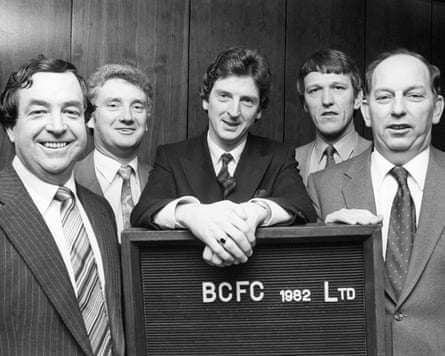
Roy Hodgson is the new manager of Bristol City, a mere 44 years after his first spell at the club. Let’s hope he fares better than the last British manager to scratch a (very) longstanding itch.
Knowledge archive (II)
This week’s Knowledge falls on April Fools’ Day for the first time in six years. Frankly nobody was really in the mood for jocularity on 1 April 2020, so this feels like a good time to revisit our piece on some of the best April Fools’ japed in football history.
Can you help?
“I’ve been wondering: who is the greatest footballer never to make an appearance in England was?” muses Cameron Turner. “Did any of the game’s greats go their whole career without visiting the home of football? I think the best bet might be a South American from the 1970s-1990s, though Brazil and Argentina often played friendlies at Wembley.”
“Gateshead feature Antony Gormley’s Angel of the North on their club badge. Do any other clubs feature works of art on their badge?” asks William Shiel Dods.
“Has there ever been a top-flight season in which the bottom three going into the final game all survived? And what’s the highest a team has been going into the final day only to be relegated?” wonders Dom Miller.
“I just noticed the Merseyside derby have both female names when shortened,” writes Mikhail Ridhuan. “Any other possible match examples? To make it harder, let’s stick to domestic matchups.”
“After Sunderland’s victory over Newcastle extended their unbeaten run in derbies to 11 games, I was wondering what’s the longest unbeaten run a side has had against their fiercest rivals?” asks Ian Bendelow.
-
Mail us with your questions and answers