2 months ago
101
2 months ago
101
This play is based around a single photo album sent to the United States Holocaust Memorial Museum in 2007. Inside were images from Auschwitz, not of the mostly Jewish prisoners but people working in the concentration camp, from top brass to those much further down the chain.
They are seen smiling, resting and putting up Christmas decorations. Whose album was this, who are the people in the photos and how can we ever fully know what led them here? In trying to reach its answers, this Pulitzer prize finalist, conceived by Moisés Kaufman, plays out like a profound, innovative and unique documentary detective drama.
The pictures are magnified on a back screen so that we see Josef Mengele, the “Angel of Death” physician, standing casually alongside camp commandants Rudolf Höss and Richard Baer, hands in pockets. There is the “Helferinnenkorps” – women who did clerical duties, who here eat blueberries, looking young, happy, guileless. There is Karl Höcker, assistant to Baer, in a deckchair at a facility within the Auschwitz-Birkenau complex that provided R&R for workers. It turns out that this album belonged to him and encapsulated “his Auschwitz”.
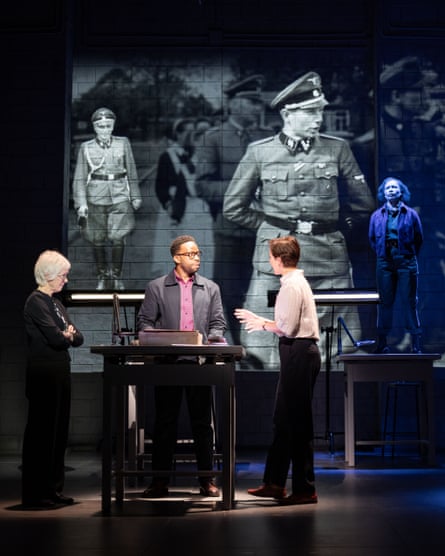
It is fascinating and sinister to see the Holocaust from the point of view of the perpetrators, smiling and sunbathing on the other side of the wall to the prisoners we do not see, for the most part. But there is never a minute when the production, co-written by Kaufman and Amanda Gronich, enters morally compromising ground.
Created with a team of devisers and directed by Kaufman, it is staged like a documentary but carries the tension of a police procedural as a number of archivists try to identify those in the album.
An eight-strong cast juggles the narration, also playing Nazis, descendants, Jewish survivors and archivists. Inquiries go in many directions, from tracing lives to interrogating methodologies around historical fact-gathering, and dwelling on photography, too.
It is less a portrait of evil than a complication of its meanings. The ordinariness of some in the photographs is pointed out. They make manifest Hannah Arendt’s theory on the banality of evil – the small, isolated acts that add to the big monstrous ones, the “following of orders”, the abnegation of responsibility and the denials. The closer you look into these grainy images, the less straightforward the individual “evil” seems.
The voices of Nazi descendants are woven in. Their stories – and trauma – still seem illicit to air yet they are an essential part of the reckoning. At one point, Höss’s grandson is asked why he hasn’t changed his last name when so many have. It is the ultimate revenge on his grandfather, he says, to live against his deadly ideology, and to tell the truth, with his name.
It is a reminder and a warning too in a world slipping into extreme intolerance. The first sign is always revealed in language, we hear, which chimes with the normalising of rightwing rhetoric today.
This 90-minute show bites off more than it can chew but that is not necessarily a weakness. The meaning of these pictures wavers yet that only proves that history is not based on absolute, pindownable truth but on incomplete stories and snapshots from among the “junk” of people’s past lives.