3 months ago
150
3 months ago
150
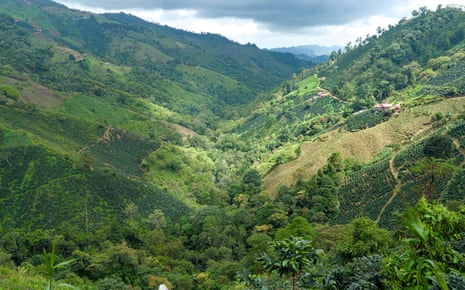
Mary Luz Pérez Arrubla and her brother, Rodrigo, are fourth-generation farmers cultivating coffee on steep Andean slopes near the town of Líbano, in the rich agricultural region of Tolima. Along with the rest of Colombia, the family has enjoyed a historic harvest amid surging global coffee prices, which hit record highs for the second year in a row in 2025.
Severe US tariffs imposed on Brazil and Vietnam, – the world’s two largest coffee producers – as well as poor harvests there, helped drive the surge. Both countries were hurt by the El Niño phenomenon, a cyclical weather pattern characterised by dry spells and aggravated by the climate crisis.
Those same conditions favoured many of Colombia’s high-altitude coffee-growing regions. It should have been a boom year. Yet some of the crop was left to rot on the ground, signalling that Colombia’s coffee industry – recognised by Unesco for its symbolic cultural significance – is at a crossroads, facing increasingly erratic seasons, labour shortages and rural abandonment.
Colombian coffee is not immune to the climate crisis. Average mountain temperatures have risen by about 1.2C since the 1980s, and the hours of sunlight have decreased by roughly 19%. Farmers connect these changes to increased droughts, heavier rains, and more pests and diseases.
Studies suggest that from 2041 to 2060, yields may decline by about 8% in lower-altitude areas but rise by about 16% at higher elevations, prompting farmers to move coffee cultivation further up slopes and adjust land use.
What is the Coffee crisis series?
ShowAs the climate crisis deepens, Latin America’s coffee producers – from the steep hillsides of Central America to the forests of Brazil and the Andean slopes of Colombia – are facing an existential threat.
While global markets still project an image of abundance, small farmers across the region are struggling with rising costs, unpredictable weather and a shrinking workforce, forcing many to question whether coffee farming remains viable.
The climate crisis poses an escalating threat by driving up temperatures in key growing regions. A recent Climate Central analysis found that the world’s five largest producers – Brazil, Vietnam, Colombia, Ethiopia and Indonesia – now face an average of 57 additional days of damaging heat each year.
The problem is evident across much of Latin America, a region that includes leading producers such as Brazil, Colombia, Mexico, Honduras, Guatemala and Peru, and accounts for more than half of global output. According to Climate Central, Brazil, the largest producer, now endures 70 more hot days a year.
“High temperatures place coffee plants under stress, reducing much of their productive potential. This is affecting coffee plantations around the world, as most are located within the same latitudes,” says Celso Vegro, an agronomist and researcher at São Paulo’s state agriculture agency.
According to Vegro, global coffee production has fallen short of expectations since 2021. Countries have been unable to keep pace with growing demand, leading to the depletion of global stocks, which has driven prices higher. “This year, Brazil’s harvest is expected to be large and to replenish supplies. But it will be only a temporary reprieve, as the same climate conditions persist,” he says.
In a new series, Coffee crisis, the Guardian spoke with producers from four Latin American countries to explore the challenges they face.
And though the country’s producers, most of them smallholders, are trying to adapt to an increasingly unstable climate and market, innovation remains out of reach for the majority.
The growers’ scramble to find coffee pickers has become desperate. There are no nationwide estimates for how much of 2025’s first harvest was left unpicked, but the complaints of labour shortages are widespread.
The Pérez Arrubla family say they lost 10% of their harvest due to a lack of workers. “We could not stop. All week, every week, for two-and-a-half months, we picked coffee,” Mary says. “I had to gather the coffee from the ground. It seemed that there was more of it lying on the floor than still on the branches.”
In a generation, the number of people working in Colombia’s coffee industry has shrunk by a quarter, while the proportion of people aged over 60 has more than doubled, according to the national Coffee Growers Federation.
Decades of conflict have seen millions leave the countryside for the cities, fleeing wave after wave of violence at the hands of guerrilla groups, paramilitaries, drug cartels and the state. And even where fewer people were displaced by conflict, youths have continued to drift to the cities, driven by a wage gap that has traditionally seen rural workers earn less than their urban counterparts.
“It’s brutal,” says Wilder Gomez, the Pérez Arrubla’s farm manager, showing his hands, callused and scarred from years of picking coffee himself. “It’s hard to find people.”
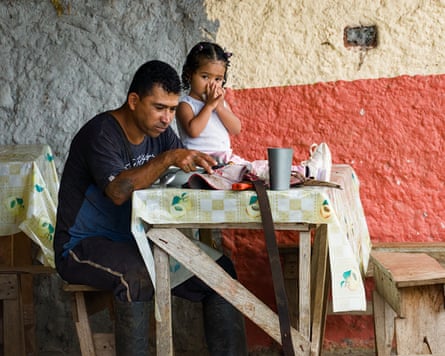
At the peak of the harvest, he begins his days at 6am in Líbano’s town square, struggling to hire 10 to 20 people, where 30 are needed. And those he manages to get do not stay long, moving from farm to farm in search of the biggest harvest opportunity that day.
The Pérez Arrubla family has increased pay to make their farm more attractive, but it is not enough.
“It isn’t just about the wage,” says Jacqueline Mazza, a professor of labour markets and international development at Johns Hopkins University in the US. She lists access to services, opportunities for growth and formal work, and stability as factors that draw coffee pickers to the cities.
Countries such as Brazil have dealt with rural abandonment by turning to large machines that shake ripe coffee cherries from the plants. But Colombia is locked out of this sort of mechanisation. “Brazil’s flat fields and distinct seasons let machines work. But our mountains? Every slope is different,” says Yinson Javier Díaz, an agronomist and administrator for the growers’ federation in Tolima.
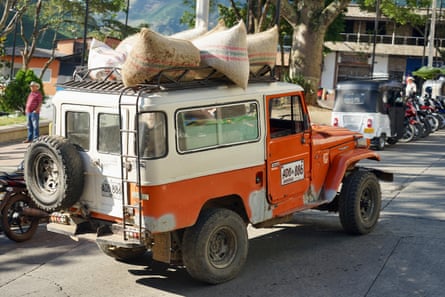
Another problem with these machines is that they don’t distinguish between ripe and unripe coffee cherries. The climate of the Colombian Andes – where cherries on the same branch can ripen at different times – makes that wasteful, according to Díaz.
Other technologies could lower costs. The growers’ federation has developed eco-friendly mills that use friction to remove “mucilage”, the sticky pulp surrounding coffee beans, reducing the amount of water and labour required to process them.
Machines that use AI to separate ripe beans from rotten ones, and drones that disperse pesticides with precision are also on the market and can replace teams of up to a dozen workers.
But few farmers in Colombia can afford these innovations. According to Díaz, less than 5% have been able to invest in the new mills, which start at 22m Colombian pesos (£4,150). AI-powered sorting machines and specialised drones are equally out of reach.
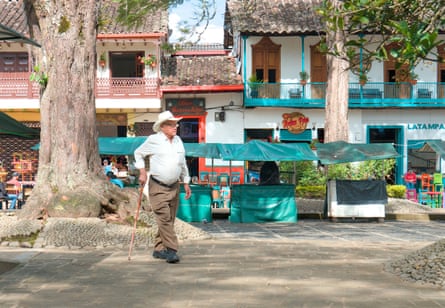
Though coffee remains one of the world’s most important commodities, farmers see little of the profit. Global coffee consumption is estimated at 3bn cups a day and is only expected to grow. Yet, barely 10% of the profit ends up in the hands of small producers from tropical and subtropical countries, such as Colombia, which grow 70% of the world’s beans.
And most of Colombia’s coffee producers are very small. The country’s half-a-million coffee-growing families own, on average, just 1.4 hectares (3.5 acres) each. In Brazil, the average plantation size is more than three times that and many industrialised estates cultivate hundreds or even thousands of hectares.
“Colombia could never aspire to [Brazil’s level of mechanisation],” Mazza says. “And it shouldn’t.”
The answer, she and other experts say, may lie in exploiting a niche market. “The strategy is to grow speciality coffees, differentiated by their origin or fermentation process, similar to wines or tequilas,” Díaz says. By focusing on quality over quantity, farmers can thrive on the profits from just a few acres.
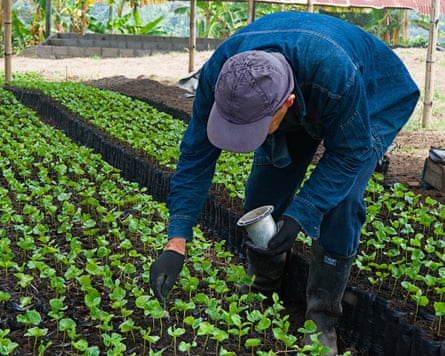
The Pérez Arrubla siblings use two hectares of their family farm as a laboratory to experiment with exotic blends. “It’s artisanal,” says Mary. “And that makes it more expensive, more valuable, than the bitter coffee grown in Brazil.”
Growing speciality coffee requires less investment than machinery, but it comes with risks. Most exotic varieties need longer to bloom, and produce a smaller harvest than traditional coffee.
Few farmers know how to connect with the brokers who act as gatekeepers for this niche market. And while the federation guarantees to buy up any beans at a set price, it does not pay a premium on speciality beans.
“The irony is that speciality coffees, which pay 300 to 400% more, are especially susceptible to roya [coffee leaf rust, a fungal disease]. Many coffee growers fall in love with the price without understanding the risks,” Díaz says.
A national analysis confirmed that short-term climate shocks, such as those in 2008–2011, can sharply increase rust infection cases. Smallholders, comprising about 95% of Colombian coffee farms, face erratic harvests and frequent losses, sometimes more than 50% during extreme heat or heavy rain, without price increases.
Given the trend of rural abandonment and the unattainability of innovation for the smallholders who define Colombia’s coffee culture, its future seems uncertain.
Families with two hectares or fewer can harvest their own crop but cannot risk growing speciality beans, according to Díaz, who says that the profit from such a small harvest of commercial beans will allow them to “just barely survive” while coffee prices remain high.
“And, if we want to compete with Brazil, we have to turn into them, become industrial,” he says, adding that “560,000 families depend on coffee farming, but industrial farming would only support 2,000 to 3,000 people. That would be a blow to coffee culture.”
Mazza sees a future for small-scale, specialised coffee production, combined with the planting of complementary crops and tourism.
But smallholder Colombian producers can’t build this model on their own, she says. They need someone to unite and organise them, “because a lot of it is capital-intensive, it requires a strategic investment”.
For the speciality model to succeed, according to Mazza, Colombia – and Latin America as a whole – will also have to cultivate domestic taste, rather than just sell to the west.
Mary says she is already seeing this shift, with more people buying speciality coffee rather than the 20p tinto typically served on every street corner.
“There has been a change. Now, people say, ‘Yes, I can spend 5,000 pesos [£1] because I am contributing to a coffee farmer, helping him survive.’”