3 months ago
190
3 months ago
190
Antonio de Aguiar Patriota, Brazil’s ambassador to London, had no difficulty joining the dystopians describing the modern world in a recent speech, a world suffering from “global warming and environmental degradation, multiple conflicts, rising military budgets, disregard for international law and international humanitarian law, disruptions to trade, erosion of democratic governance and technological developments that are met with excitement and fear”.
Yet beneath the surface, he said, “something is happening. Something is moving.”
The change Patriota could detect in “the global north” was a new division into “two poles, a unilateralist superpower on the one hand and a majority of multilateralists on the other”.
“The highly unpopular and illegal war in Iran is fast becoming a vivid example of the chaos and instability bred by unilateralism,” he said. “It is laying bare a perception that the world will not be made unipolar again.”
The argument that the current dark era of American unilateralism and lawless militarism may be coming to a premature end, sinking below the waters in the strait of Hormuz, is gathering momentum as other western countries recover their poise and place long-term bets that they can no longer cower under the US security blanket.
They have seen what meagre protection that blanket provided for the Gulf monarchies and how little it has promoted European interests in Ukraine, and many have finally realised they are better off with different, diverse friendship groups.
In a recent speech in China, the Spanish prime minister, Pedro Sánchez, explained “what is happening today is not a transfer of hegemonies. It is a multiplication of poles – not only of power, but also of prosperity.” This was something to be celebrated, the liberal leader said. “For the first time in contemporary history, progress is germinating simultaneously in many places across the planet. This is happening here in China, in Asia. But also on the African continent and in a region very close to Spain: Latin America.”
But it is not just leftwingers claiming the era of American primacy is on the wane. It is embedded in the thinking of Paris, Brussels, Warsaw and even Berlin. Friedrich Merz, the centre-right chancellor of the impeccably Atlanticist Germany, initially neutral about the lawfulness of the US attack on Iran, has declared that the US is being humiliated by Iran, and likens Donald Trump’s misjudgment in launching his attack on Tehran to those made by his predecessors in their invasions of Iraq and Afghanistan.
Instead of cowering, disagreeing or hoping Trump’s attacks on Europe’s feckless freeloaders might be a passing phase, many European countries are embracing his advice to take more responsibility for defence. As a result, a bypass around America is being constructed.
Similarly, on the global stage, the demands are growing that western powers – not just the US – relinquish their outsized representation in global institutions in favour of the global south.
Few of these changes will occur overnight or prove linear. But Iran, and the running mutual resentments it is stirring between Trump and Europe, are accelerating the process of detachment.
Decline in US dependability
Prof Stephen Walt, of Harvard University, recently explained this is partly because American influence is not just a function of its wealth or power. It’s also a function of how the US is viewed. He said it was important for allies “to think that the United States knows what it’s doing, not that it’s infallible, but it generally knows what it’s doing, that it can execute a plan in a competent fashion. The Trump administration has sent a message to the rest of the world that that’s not the case any more, and that means other states are going to be less likely to rely on American advice going forward, at least for a while.”
Walt added that “the other message this war has sent is that the administration really cared about only one other country in the world, Israel, and that came at the expense of other allies in Europe and Asia”, because of the huge economic damage the war has caused and the lack of consultation with other allies before the war began.
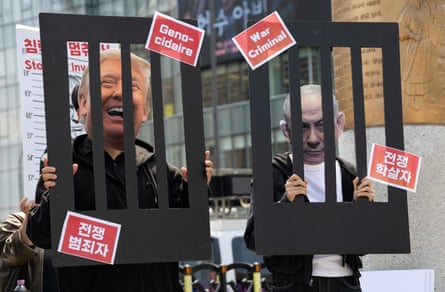
The former US ambassador to London, Jane Hartley, recently said of the British prime minister: “In defence of Keir Starmer, what was our goal in Iran? What was the legal basis for this war? What was our plan B? What was our exit strategy? We could not answer any of those questions. But what is most troubling is the public. Because the public no longer thinks America is a force for good.”
But for this to be more than another temporary episode of US retreat, it requires more than a change in attitude. What is needed is a serious attempt to build other poles and alternative forms of cooperation besides the US. That process is now under way.
Building new alliances
Mark Carney, the Canadian prime minister, has set out his concept of a middle powers grouping, and Canada has already signed more than 20 economic and security deals, including with China, to increase exports outside its US base. New ad hoc alliances and trade corridors that do not go through Washington are being formed. From the Brazilian perspective it is new “coalitions of the responsible” that are being created, with “coordination across regions, cultures and political systems”.
Patriota also praised the new, confident, more political groupings challenging populism and American militarism. The inaugural meeting of Global Progressive Mobilisation in Barcelona in April was attended by leaders including Brazil’s Luiz Inácio Lula da Silva, Mexico’s Claudia Sheinbaum, South Africa’s Cyril Ramaphosa, the Barbados prime minister, Mia Mottley, as well of course as the new poster child of the European left, Sánchez.
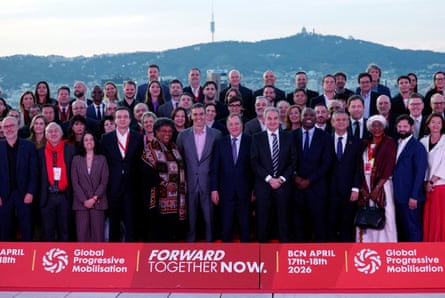
Sánchez told the progressives to be confident about what lay ahead despite a “horizon full of uncertainty” and “the noise of the subservient right”. “Do not be fooled,” he said. “The far right and the right are not shouting because they are winning; they are shouting because they know their time is running out.”
His willingness to condemn the Iran war as illegal, a view not initially voiced by the British or Germans, has infuriated Trump, but Sánchez knows, as does the European right, that Trump has become an electoral albatross. Even Nigel Farage denies him thrice.
Trump’s response is to threaten to throw Spain out of Nato, something he does not have the power to do, or to withdraw troops from Germany. US commitment to Nato becomes a bargaining chip. For instance, instead of praising Germany for planning to boost its number of active duty soldiers by 75,000 by the mid-2030s, Trump threatens. Like a pyromaniac, he burns alliances for fun.
Macron has warned that Trump’s daily questioning of US commitment to Nato is corrosive. “It threatens to empty Nato of substance,” he has suggested.
The signs of a reaction to this are springing up in surprising places. For instance, there can be few bodies that so faithfully represent the British establishment as the House of Lords select committee on international relations and defence. Its members include the former Nato secretary general George Robertson, the former UK ambassador to Washington, Kim Darroch, and the former Conservative chancellor, Norman Lamont.
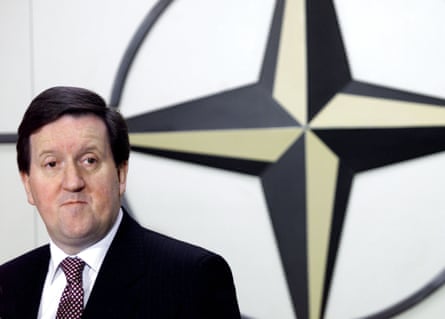
Yet in its recent report on the future of the US special relationship, the peers were unconstrained in their criticism of America. “US intelligence is being politicised … force is no longer a last resort. A leadership vacuum is being created … the changing complexion of US foreign and defence policy means the current degree of UK reliance is no longer tenable. Future UK policymaking on Russia and security in eastern Europe and the high north should no longer take US support in conventional deterrence as given.
“Nor can the UK rely on historic goodwill and cultural affinity to sustain the relationship in an increasingly transactional context.”
The solution was for the UK no longer to be infantilised by the US – in Robertson’s phrase – and “lead on a concentrated move towards greater European leadership in Nato”.
Defence in Europe
The idea of a European Defence Union, complementary to Nato, is now increasingly aired in the European Commission, one involving Britain, Norway and Ukraine as well as EU countries – something Volodymyr Zelenskyy himself advocates.
John Lough, the head of foreign policy at the New Eurasian Strategies Centre thinktank, said: “There is growing recognition in the European core of Nato that for Europe to defend itself against Russia will require integrating Ukraine into a European defence framework. Ukraine has the largest conventional army in Europe with more than four years’ up-to-date experience of fighting the Russians.
“It also has a capable and innovative defence industry that has shown the ability to develop new weapons at speed. The agreements signed between Germany and Ukraine earlier this month on drone production and the sharing of battlefield data for the development of new weapons systems are a sign of things to come.
“Ukraine is a world leader in the development of drone capabilities, including drone interceptors. It is hardly a surprise that Saudi Arabia, Qatar and the UAE have quickly signed deals with Ukraine on drone cooperation after coming under attack by Iran.”
Humanity at stake
But the transformation is not just about Europe restructuring its defences faced with an unreliable ally, it is whether this decline in US primacy is seen as a badly needed opportunity to address the wider global crisis.
For millions of people, the head of the UN humanitarian programme, Tom Fletcher, said last week: “The international order is not on the cusp of collapse, it has already collapsed. What we are going through right now is not a drill.” Fletcher called for greater honesty about the scale of global upheaval and the need for a renewed seriousness in public life.
This is because the way Trump and his fellow travellers have put an axe to international law has made the task of humanitarians near impossible. Indeed, humanity itself is under attack, Agnès Callamard, the secretary general of Amnesty International, said in presenting the human rights organisation’s 2025 report. She described 2025 as the year of the predators.
Over 500 pages, Amnesty International set out a report card for the world in which humanity scored badly owing to “genocide and crimes against humanity in Gaza”, “crimes against humanity” in Ukraine, extrajudicial killings committed by the US outside its borders, and attacks on Venezuela and Iran.
The world has been plunged into an age of unorder, as Mark Leonard, the director of the European Council on Foreign Relations thinktank, puts it in his new book Surviving Chaos.
Leonard warns that “to talk about disorder implies that there is an order that people agree on and that people are breaking the rules, but I think our world is quite different from that. The rules are not being violated. They’re being ignored as irrelevant. There is no stable balance of power. There’s no agreement on what the rules are.”
He added: “The difficulty is that the US regards its domestic strength rather than international institutions or global alliances as the basis of its security.”
Yet as Patriota said, something is moving, or poised to move. The unipolarists – he identified the US, Russia and Israel – retain their power to punish and wreak revenge. Trump can still mesmerise every news cycle. In France and Germany, the populist right are ascendant. But at the same time, the unipolarists are an embattled minority even in their own countries and finding it increasingly hard to locate allies or impose their will.
A new UN secretary general next year would at least have the chance to challenge the current unrepresentative security council – made up of the second world war victors China, France, Russia, UK and US – to reform after 30 years of failing to do so. In this post-rupture world in which Washington’s reliability can no longer be assumed, and in which Beijing’s partnership, however complicated, cannot be refused, everything suddenly is up for grabs.
A US reverse in Iran may not have the visual symbolism of the retreat from Saigon or Kabul, but its reverberations could yet be as wide.