3 months ago
147
3 months ago
147
In retirement, Suzanne Tarlin heard herself saying: “I need to move.” The former solicitor, then 71, learned from a friend about senior ballet and contemporary dance classes at a community centre and decided to give it a try. “Terrifying,” the Londoner remembers, 10 years on. “But the teachers who do this stuff are incredibly patient and good-humoured. People come with all sorts of backgrounds and levels of expertise. The classes are clearly important because some people go week after week, sometimes twice a week.”
Tarlin went on to do senior contemporary classes at Rambert, then added over-60s classes at the Place, home to London Contemporary Dance School, and sessions in German tanztheater at Morley College for adult education. She also signed up for creative workshops and performance groups, especially enjoying the intergenerational projects – even performing in a large-scale public event with dancers from Rambert and the Ballet National de Marseille at the Southbank Centre (she commandeered an industrial road cleaner in one scene and slid off the roof of a beat-up limousine at the finale). At the Place, she crawled around the stage in a costume made of cables. Growing old gracefully has clearly not been a dance goal. “I suppose the dreaded word is ‘wafting’,” she says. “You know, being a bit pretty, drifting around waving a scarf or something.”
Through her dancing, she made a new network of people. “I also really enjoyed discovering more about the art of dance, finding out what I liked or didn’t like. I used to go to the theatre a lot, but now it’s more often dance. It’s learning without trying to learn, I suppose. By doing.”
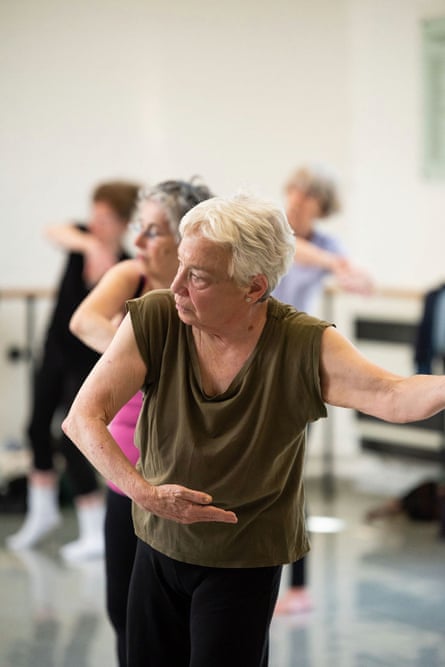
Diego Robirosa, now 72, likewise began dance classes 10 years ago. “It has been one of the best decades in my life,” he tells me from his home in Suffolk, “and a lot of that is thanks to dance and what it provided me with, on all levels.” A former merchant banker, he had loved watching dance as a young man, even trying a few classes in his 20s, though they were hard to fit into his working life; he was, too, “still confronting the prejudices about men and dance”. Yet dreams of dancing somehow remained – and much later turned into a different kind of reality. “When my daughter began classes at DanceEast in Ipswich, I noticed they had a course for older people. I wanted to join then, but she was a bit embarrassed about me being there too so I waited another four years before starting.”
Better late than never: with more time on his hands and past caring about stereotypes of masculinity, he began. “In my 20s I had some kind of fantasy that I could do something, but here I went with no expectations. I was just exploring. So I was quite relaxed, as well as very excited and very open.” He tried out ballet (“I really needed to have started earlier”) and floor work (“it put me through the paces”), but his preference remains for contemporary dance, in various shapes and forms.
He too began attending workshops and performance groups, at DanceEast and beyond. Once, he auditioned for the legendary Tanztheater Wuppertal, who were looking for some older men as extras for their production of Pina Bausch’s Viktor – “No pressure!” he told himself – and ended up performing with them on stage, in London and Antwerp. “Crazy!” he says. “But how incredibly stimulating.”
Like Tarlin, Robirosa had discovered “a new world, not only to do with physical activity, but also with creativity and exploration. On the human level, it also connected me with new people, and generated new friendships. It has been a very expansive activity.”
That’s the experience; what about the science? It is exactly this kind of “expansive activity” that Professor Daisy Fancourt investigates in her new book Art Cure, which looks at the arts as a vital part of our physical, mental and social health, not just experientially but also scientifically and economically. “When people engage in dance,” she tells me, “they experience a lot of the same beneficial processes that other art forms activate. For example, the activation of neural reward centres in the brain, increases in neurotransmitters involved in feelings of happiness and increased ability to regulate emotions, whether through diverting people from their worries or as a way of cathartically venting and giving form to their emotions. Dance, in addition, brings a lot of the benefits of exercise.” She tells me about controlled trials among middle-aged and older people that report better cardiovascular health outcomes from dance compared with other kinds of non-artistic exercise. “In other words, we know that it’s not just about the exercise.”
Fancourt wants to raise awareness about the health benefits of dance and arts among individuals – it helps them to prioritise and justify such activities – and also policymakers. “Investing in arts and dance within communities is an investment with direct health and economic benefits.” These findings are mirrored in studies by the Sport and Recreation Alliance on the social value of movement and dance in the UK, and underpin initiatives such as the national Let’s Dance day, headed by Angela Rippon and this year taking place on 8 March, which aims to get people involved in dance – for their own good, but also for ours.
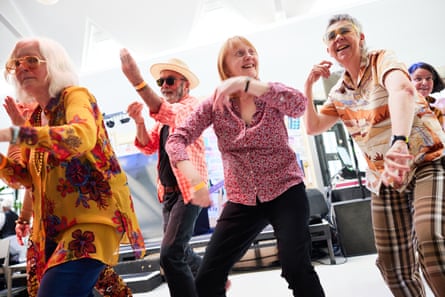
Such measurable health benefits are consequences of dancing rather than why people love doing it. Tarlin says she dances to “get into my body, and get out of my body”, while Robirosa has this year decided to take a breather from performing, to reconnect with what he most values about dancing: “the fun and spontaneity, the uniqueness that every individual can bring”.
Many people discover their motivation only in retrospect. Take Jeanette Boundy, a retired local education officer from West Yorkshire, for whom dance became an unexpected lifeline. She began four years ago at the age of 64, having chanced upon a local event, Dance On, organised by Yorkshire Dance. “Did I feel sick with nerves walking in!” she says. “But they were so welcoming.” It was a turning point. Ten years previously her husband had died suddenly from a brain haemorrhage; months later, she suffered a pulmonary embolism. “I think I felt guilty that I survived and he didn’t. If I started to sing, I felt guilty. If I laughed, I felt guilty. But I didn’t even know that, until that first dance session. It was amazing. I forgot the anxieties, straight away.”
That was four years ago. Since then, she has continued dancing and done some performing. She also joined a community choir, and volunteered as a social prescriber for the NHS, helping others through social connections and activities. “Dance is the best medication,” she declares.
I’ve heard many people say that the special ingredient in this “dance medication” is joy, but perhaps a better word is vitality – a kind of awakening towards life itself. “Nowadays, if I’m at a family party or going out socially – which I’ve started doing now – then I’m always the first up dancing,” says Boundy. “I don’t know what others think … but who cares?!”