3 months ago
167
3 months ago
167
From the Philippines cutting down to a four-day week to save electricity, to restaurants in India taking gas-intensive dishes off the menu, and rents being frozen in Spain, the economic fallout of the US-Israeli war on Iran has reverberated around the world.
Facing an existential threat, Tehran has retaliated by closing the vital Hormuz shipping lane and bombed its oil and gas-rich neighbours, compounding a deepening crisis abroad for businesses and families.
The International Energy Agency has described the situation as the largest supply disruption in the history of the global oil market.
While Europe and the Americas are bracing for impacts, billions of people elsewhere, especially in Asia, are already feeling serious repercussions.
Here is a look at how the conflict has sent out economic shocks rippling across the globe:
Sagar Daryani, president of the Restaurant Association of India, a body representing half a million restaurants, said the sector was operating under severe constraints, with businesses cutting hours, shrinking menus and relying on temporary fixes to stay open.
In Kolkata, the Arsalan restaurant chefs cook biryani in traditional cooking pots on wood fire at an open centralised kitchen amid disruptions in commercial LPG supply due to the US-Israeli conflict with Iran. Photograph: Sahiba Chawdhary/Reuters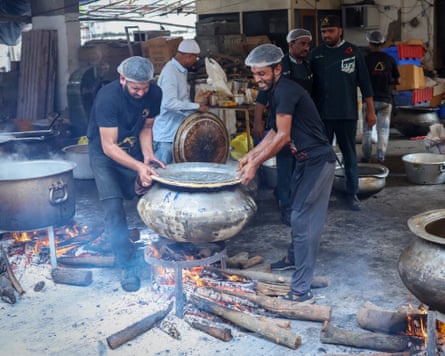
He estimated that about a third of restaurants are significantly affected. “It’s a thin line between fighting today to survive tomorrow,” he said.
There are reports that restaurants are taking slow-cooked dishes off the menu to conserve gas, while others have shut down altogether.
Campaigners who have long advocated a shift to electric cooking say the crisis should serve as a wake-up call. “This moment has made us realise how critical the cooking fuel vulnerability is,” said Neha Dhingra, of the India Program at the Collaborative Labeling and Appliance Standards Program (CLASP).
India’s rupee posted its biggest plunge in four years on Friday, crashing on worries that soaring oil and gas prices will massively drive up India’s import bill and act as a brake on economic growth. The country is seen as one of the most vulnerable to an energy shock, as it imports nearly 90% of its oil and half its gas – much of it from the Gulf, while millions of Indian workers in the region send home more than $50bn a year.
Aakash Hassan and Penelope MacRae in Delhi
2. ‘Everything has been impacted’: cancelled hotel bookings in tourism-dependent Thailand
At this time of year, Suwarin Nantaya’s company would normally get about 30 email inquiries a day from tourists wanting to book trekking tours through the mountainous jungles of northern Thailand. Since war erupted, inquiries have dropped to just three a day. Lots of pre-booked customers have cancelled.
“They are afraid that they will not find any flight back home,” said Suwarin of Chiang Mai Trekking. “Everything has been impacted – hotels, restaurants, souvenir shops, massage spas.” Usually Chiang Mai’s walking street, where tourists browse food and souvenir stalls, would still be busy at 9 or 10pm, she added, but now businesses are far more quiet.
Outside Central Festival in Chiang Mai, Thailand Photograph: Nuttapong Wannavijid/Alamy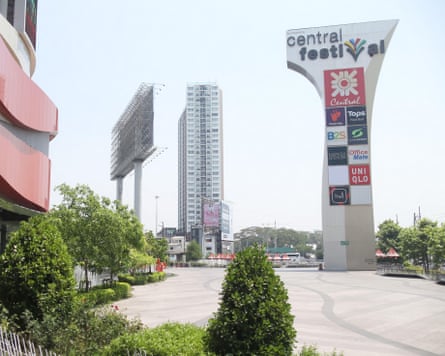
Since the war erupted, about 1,000 Thailand-bound flights have been cancelled, according to Aeronautical Radio of Thailand.
Thailand’s tourism ministry has predicted that an eight-week closure of airspace, which it considers a worst case scenario, could result in 600,000 fewer international arrivals, and losses of 41bn baht (£934.4m).
Rebecca Ratcliffe in Bangkok
3. A QR system for petrol rationing in far-away Sri Lanka as the ‘big guys’ fight
At a fuel station in Colombo, a long queue had already formed by 5.30am one morning this week, composed of three-wheeled autorickshaws, cars and motorbikes used by delivery drivers. A group of people pushed a car that had completely run out of petrol towards the fuel pumps.
The country has reverted to using a QR system for fuel rationing that was introduced during the 2022 economic crisis.
A man checks the national fuel pass at a gas station in Colombo, Sri Lanka. Photograph: Xinhua/Alamy Stock Photo/Alamy Live News.
“It is unfortunate that a small country like Sri Lanka has to go through this, when the big guys are fighting,” said A Sanka, who was waiting in line. “It is frustrating that the government had no plan for this.”
Another man, autorickshaw-driver Nissanka Lakshman, cried about having to cut down on meals. “I came to the fuel station at 4.30 in the morning. We get only 15 litres for an entire week, but I need about 6-9 liters a day to make a living. This is my sole income.”
“During Covid-19, our income was affected badly because there were no hires,” he added. “Things were really bad for us. We had to cut down on our meals. I couldn’t give my children three meals a day … We were slowly recovering from that shock.”
Aanya Wipulasena in Colombo
4. Security fears in Europe
Just over a week after the US and Israel began launching airstrikes at Iran, attacks also began on European soil.
In Norway, the US embassy in Oslo was hit by an improvised explosive device, damaging the entrance to the embassy’s consular section. Early next day, an explosion struck a synagogue in Liège, Belgium, shattering its windows. Soon after, a fire was set at a synagogue in Rotterdam, while the next day a blast damaged the outer wall of a Jewish school in Amsterdam.
There were no reported injuries in any of the attacks, and each of them resulted in minor damage. But the spate of targeted strikes sparked fear among Jewish communities already reeling from the surge in antisemitism after the Gaza war.
Dutch police officers stand guard near a Jewish school in Amsterdam on 16 March 16 2026, two days after an attack on the Jewish institution, Photograph: Jeroen Jumelet/ANP/AFP/Getty Images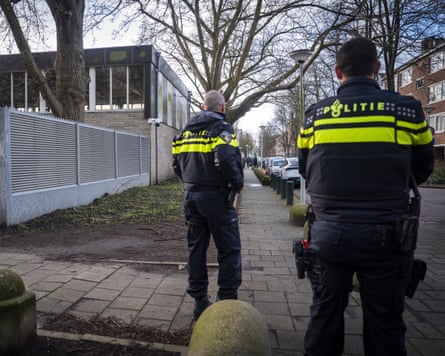
Several countries said they had stepped up security as officials said they were investigating whether the attacks were linked to the regime in Iran.
Speaking in Belgium’s parliament, the country’s prime minister, Bart De Wever, reportedly said several European countries had raised concerns about “terror cells directed by Iran”.
For the regime in Iran, attacking Europe is a means to show that it is still a force to be reckoned with, said Rebecca Schönenbach, a Swiss-based specialist on counter-terrorism. “It’s a propaganda war as much as a military war, and wherever they can score, they will.”
Ashifa Kassam in Madrid
5. Air fare surge pricing in South Africa as jet fuel costs soar
Jet fuel prices at South Africa’s coastal airports jumped 70% in one week, regional airline Fly Safair said this month. It said that amounted to an extra 35,000 rand (£1,557) in costs for every hour flown by a Boeing 737-800.
In response, the airline introduced what it called a “dynamic fuel surcharge” to last two months until 12 May. Competitor Airlink told local outlet News24 it was also increasing prices in response to the soaring fuel costs.
Passengers at the OR Tambo International airport in Johannesburg, South Africa, 12 March 2026. Photograph: KimLudbrook/EPA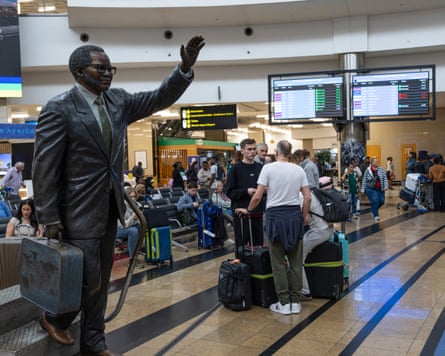
Petrol and diesel prices go up at the start of every month in South Africa, and petrol prices are predicted to increase as much as 25% and diesel up to 44% on 1 April, according to Annabel Bishop, chief economist at bank Investec. The government may temporarily absorb some of the rise.
Meanwhile, South Africa’s central bank is having to redo its projections for the year. At its January meeting, the “adverse scenario” was that oil prices would reach $75 per barrel. The assumption “is gone – it was in the past … We will come up with a completely new one” central bank governor Lesetja Kganyago said on 6 March.
Rachel Savage in Johannesburg
6. Disappointment for crisp-lovers in Japan
People in Japan are feeling the effects of oil shortages in various ways, from motorists paying record prices at the pump to crisp lovers deprived of their favourite snack.
The world’s fourth-biggest economy imports about 90% of its oil from the Middle East, 70% of which is shipped via the strait of Hormuz.
The Japanese government has started providing subsidies to petroleum suppliers, although the measure is not expected to shift prices for another week. It has also started releasing about 80m barrels of oil from its strategic reserves to mitigate disruptions.
Crisp lovers voiced anguish over the decision by snack maker Yamayoshi Seika to halt production of its main crisp lines, citing difficulties in securing enough heavy oil for boilers that heat the cooking oil used to fry crisps.
Yamayoshi Seika’s Wasabeef Wasabi Beef crisps Photograph: Yamayoshi Seika
The affected products include Wasabeef – a combination of wasabi and beef essence – prompting anger on social media.
As “Wasabeef” became the third-highest trending buzzword on Japanese X, one user wrote: “I never expected the closure of the strait of Hormuz to result in the production stoppage of Wasabeef. I can’t imagine life without Wasabeef!”
The company, which said it had no choice but to pause production, was unable to say when it would restart its fryers.
Justin McCurry in Tokyo
7. Repercussion far beyond energy, with food and vital chemicals stuck in the Gulf
Governments are scrambling to deal with the fallout, with several countries introducing emergency measures such as slashing taxes on energy. Spain’s government has gone even further by announcing a €5bn (£4.3bn) package to help Spaniards weather the economic uncertainty, and launching an effort to freeze rents.
But the congestion in the strait of Hormuz is not just hitting oil and gas. It is also affecting grain and building supplies, and chemicals used for everything from perfume and cosmetics.
AXSMarine, a maritime data specialist, says 1,541 ships were stuck on either side of the strait of Hormuz including ships returning to the Gulf for cargo. As of this week, ships stuck west of the straits including 26 vessels carrying 1.4m tonnes of bauxite (a key ore for aluminium), limestone, sand and sulphur, a raw material used in multiple industries.
According to the International Food Policy Research Institute, a prolonged closure of the strait of Hormuz could affect fertilisers and food production costs, with 30% of global fertiliser passing through the strait. Photograph: Abedin Taherkenareh/EPA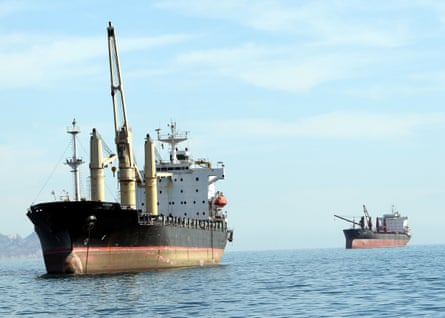
A further 18 ships were carrying grain, mostly corn, while 19 vessels are laden with fertiliser raw materials including urea and phosphates. Other cargo included steel, cement, clinker and woodpulp all vital for construction.
“Exports out of the Gulf are usually quite high value cargo and food,” said AXS.
Lisa O’Carroll, and Sam Jones in Madrid
8. ‘Shock after shock’ for Asian food production after fertiliser crisis
The war in the Middle East is disrupting fertiliser supplies, up to 30% of which normally transits through the strait of Hormuz. Supplies of gas, which some countries import and then use to produce fertiliser, have also been affected.
The Food and Agriculture Organization (FAO) – which has warned that the Middle East war poses a major shock to food systems – has estimated that global fertiliser prices could average 15-20% higher during the first half of 2026 if the crisis continues.
Intensive agricultural economies in Asia are most affected. Thailand and India, both major exporters, are heavy users of fertiliser and rely on the Gulf for about 35% off supplies, according to the FAO. Bangladesh is even more exposed, relying on the Gulf for 53% of its fertiliser.
A farmer sprays fertiliser over his rice field during sunrise in Nakhon Sawan province, north of Bangkok,Thailand. Photograph: Chaiwat Subprasom/NurPhoto/Shutterstock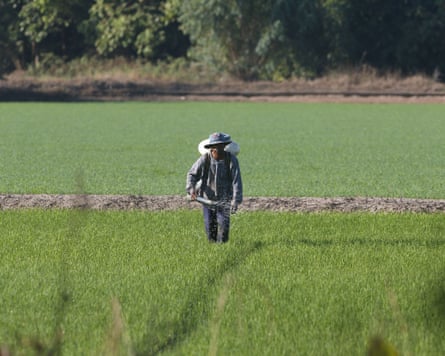
At least one Indian fertiliser plant has shut down and others are cutting production due to gas shortages and expensive inputs, according to reports, which has raised alarm for the upcoming summer planting season.
“The agri-food system didn’t collapse during Covid, it didn’t collapse due to the war in Ukraine,” says David Laborde, director of agrifood economics division at the FAO. But he adds: “We are just putting shock after shock, and that’s what is pretty bad.”
A rice seed farmer in Thailand told the Guardian she was fortunate that her land is already well fertilised, but fuel shortages are posing a major problem.
Smaller farmers may cut back on the use of fertiliser to save money, Papada said, but this will affect the amount of produce they are able to sell – and whether they feel farming is financially viable.
“It becomes a spiral,” said Papada. “Maybe they will stop being a farmer and go to Bangkok to become a labourer.”
Rebecca Ratcliffe in Bangkok
9. Claims of bus tickets price-gouging in Bangladesh
The line for buses at Dhaka’s Gabtoli terminal stretched into the heat, families clutching bags of clothes and sweets as they tried to get home for Eid, one of the biggest festivals in Bangladesh’s Muslim-majority calendar. Men stood on bags to peer over the crowd, women shaded children with scarves, and ticket counters were ringed by anxious passengers competing for the few seats still available.
“I came early morning, but the fare has doubled,” said Rahim, a garment worker trying to reach Rangpur, who asked that only his first name be used. “We are a family of four. How can we go home like this?”
Long-distance buses pick up passengers as thousands of people travel to their home towns ahead of the Muslim festival Eid al-Fitr at the Gabtoli bus terminal, Dhaka, 17 Mar 2026. Photograph: MD Mehedi Hasan/Zuma Press Wire/Shutterstock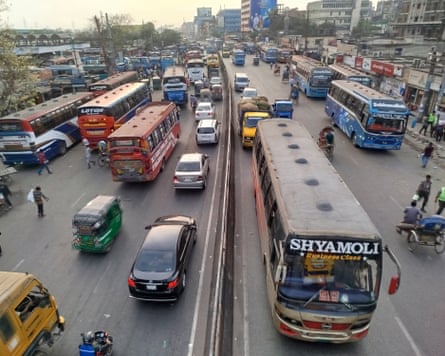
Wasim, a bus ticket operator, rejected accusations that companies were exploiting the Eid getaway. “People think we are just increasing fares for profit, but that’s not true,” he said. “Fuel costs have gone up, and we are getting fewer trips because of supply issues.”
Dhaka has responded to the crisis with a mix of rationing and reassurance. Authorities capped fuel sales, deployed troops to guard depots against hoarding, and cut electricity use by closing universities and some schools early and discouraging non-essential lighting during Eid.
For Bangladesh’s new government, the fallout is as much political as economic. Any prolonged disruption to fuel and gas supplies would threaten not only factories and industry, but also the cost of travel, food and daily life for millions. In a country where anger over prices can quickly harden into wider public frustration.
“The government has no intention of downplaying global realities,” said Saleh Shibly, press secretary to the new Bangladeshi prime minister, Tarique Rahman.
Redwan Ahmed in Dhaka
10. A benefit for net exporters of oil and gas – and Russia’s war-economy
As with every war, there will be economic winners and losers. Net energy exporters like Norway and Canada could benefit, although how much they can ramp up production is in question, and the global shock of the war will affect them, too.
Donald Trump is moving to ease sanctions on Venezuela in the hope of boosting oil production.
But one of the big economic benefits of the US-Israeli war has been reaped by Russia. Moscow received €6bn (£5bn) from selling its fossil fuels in the fortnight since the start of the war. Trump has also indicated he would ease US sanctions on Russian oil.
Alexander Kirk, a sanctions campaigner at the NGO Urgewald, said: “When markets panic, authoritarian exporters cash in.”
Moscow’s so-called shadow fleet, which seeks to avoid western sanctions, could also benefit from the global chaos.
Belgian army intercepting and boarding oil tanker Ethera, registered in Guinea, sanctioned by the EU and linked to Russa’s shadow fleet, during operation Blue Intruder in the North Sea off Zeebrugge, Belgium. Photograph: Jorn Urbain/Belgian defence ministry/ EPA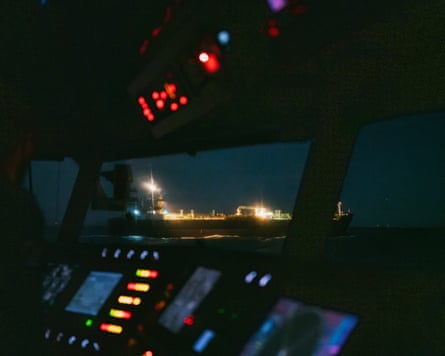
Line Falkenberg Ollestad, an adviser at the Norwegian Shipowners’ Association and an expert on the shadow fleet, said the shadow fleet is playing a part in the “splitting up of the world’s energy markets” but in light of the Iran conflict is unlikely to be a priority for world leaders. Meanwhile, the US treasury’s recent decision to temporarily allow the sale of sanctioned Russian oil stranded on tankers was, she said, “opening up for Russian oil in a broader way” as well as increasing the shadow fleet’s capacity.
“We understand that it is a priority to keep the oil price as low as possible, but at the same time it is important not to lose track of reducing the shadow fleet, mitigating the shadow fleet, and not in some ways accepting that,” said Falkenberg Ollestad.
Miranda Bryant and Oliver Holmes in London, and Tom Phillips in Rio