3 months ago
114
3 months ago
114
Italian scientists monitoring the movements of a dolphin in the Venice lagoon have said humans are the ones who need managing, rather than wildlife.
Known as Mimmo, the bottlenose dolphin has been spotted on several occasions since it made its first appearance in June last year, prompting a research team from the University of Padova to spring into action.
While the animal has delighted tourists and residents with its acrobatic leaps, animal and environmental activists began a “save Mimmo” campaign amid fears it could be killed by the propellers of boats that crisscross the busy lagoon.
The scientists have now published a study in the journal Frontiers in Ethology, outlining their monitoring activities and the dolphin’s movements over several months.
“We present the case of one of the most charismatic animals in one of the most iconic cities: a solitary dolphin in Venice,” said the article’s senior author, Guido Pietroluongo, a conservation veterinary pathologist at the University of Padova’s department of comparative biomedicine and food science.
Pietroluongo added that the team’s observations documented the animal’s “remarkable adaptation to an unusual context” while highlighting “the need to manage human behaviour to ensure its welfare”.
Bottlenoses are the most common species of dolphin in Italian waters and although they usually move around in pods, in recent years there have been several cases of solitary dolphins in the Adriatic who leave their pod and flock to coastal or urban areas.
Mimmo was first seen by Manuel Tiffi, a water-taxi driver, on 23 June 2025. He told Corriere della Sera that the dolphin often swam “right in front of the bow”. Tiffi said water-taxi drivers reported sightings to warn people to be careful. “But the animal seems to have no fear,” he added.
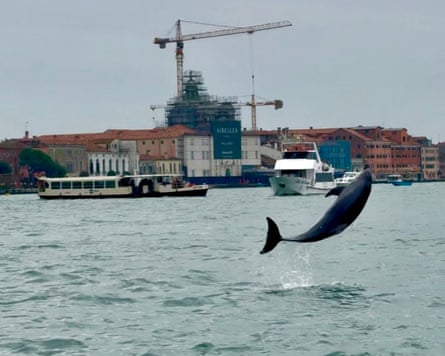
Since Tiffi’s sighting, scientists have observed the dolphin from boats each week, with support from Venice authorities and citizens, and noted its movement from the southern end of the Venetian lagoon to the northern end, where it is still present.
“Observing bottlenose dolphins in urban areas is not particularly surprising, as they are extremely adaptable and opportunistic marine mammals,” said Pietroluongo, adding that “Mimmo appears healthy and is regularly observed feeding on mullets”.
Historically, dolphins have taken up residence in the Venetian lagoon and adapted to living there.
But while Mimmo’s behaviour since its arrival has been “typical of the species”, humans present a problem, the scientists said, with the greatest risk coming from them acting inappropriately towards the animal, especially through irresponsible driving of boats.
The scientists said that measures controlling speed and keeping boats at a safe distance were required.
“What is truly unusual is not the dolphin’s presence, but the persistent difficulty humans have in respecting such animals today,” said Giovanni Bearzi, who has been studying Adriatic dolphins for four decades.
“We need to appreciate the opportunities to coexist with and enjoy wildlife. Historical and contemporary documentation clearly shows that dolphins have accompanied human maritime activities for millennia, yet we still struggle to coexist with them appropriately.”