3 months ago
121
3 months ago
121
America and Israel’s attack on Iran disrupted flights across the Middle East and beyond as countries around the region closed their airspace and three of the key airports that connect Europe, Africa and the west to Asia halted operations.
Hundreds of thousands of travellers were either stranded or diverted to other airports after Israel, Qatar, Syria, Iran, Iraq, Kuwait and Bahrain closed their airspace. There also was no flight activity over the United Arab Emirates, flight tracking website FlightRadar24 said, after the government there announced a “temporary and partial closure” of its airspace.
That led to the closure of key hub airports in Dubai, Abu Dhabi and Doha, and the cancellation of more than 1,000 flights by major Middle Eastern airlines. The three major airlines that operate at those airports – Emirates, Qatar Airways and Etihad – typically have about 90,000 passengers per day passing through those hubs and even more travellers headed to destinations in the Middle East, according to aviation analytics firm Cirium. Dubai international airport is the world’s busiest airport for international flights.
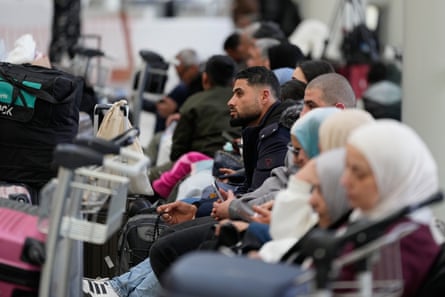
“For travellers, there’s no way to sugarcoat this,” said Henry Harteveldt, an airline industry analyst and president of Atmosphere Research Group. “You should prepare for delays or cancellations for the next few days as these attacks evolve and hopefully end.”
According to aviation analytics company Cirium, of about 4,218 flights scheduled to land in Middle Eastern countries on Saturday, 966 (22.9%) were cancelled, with the figure rising above 1,800 if also including outbound flights.
For Sunday, 716 flights out of 4,329 scheduled to the Middle East have been cancelled, Cirium said.
Flight tracking website FlightAware meanwhile said more than 18,000 flights had been delayed globally and more than 2,350 cancelled worldwide as of 10.30pm GMT on Saturday.
Airlines that are crossing the Middle East will have to reroute flights around the conflict with many flights headed south over Saudi Arabia. That will add hours to those flights and consume additional fuel, adding to the costs airlines will have to absorb. So ticket prices could quickly start to increase if the conflict lingers.
The added flights will also put pressure on air traffic controllers in Saudi Arabia who might have to slow traffic to make sure they can handle it safely. And the countries that closed their airspace will miss out on the overflight fees airlines pay for crossing overhead.
But Mike McCormick, who used to oversee air traffic control for the Federal Aviation Administration (FAA) before he retired and is now a professor at Embry-Riddle Aeronautical University, said over the next few days these countries might be able to reopen parts of their airspace once American and Israeli officials share with the airlines where military flights are operating and how capable Iran remains at firing missiles.
“Those countries then will be able to go through and say, OK, we can reopen this portion of our space but we’ll keep this portion of our airspace closed,” McCormick said. “So I think what we’ll see in the next 24 to 36 hours how the use of airspace evolves as the kinetic activity gets more well defined and as the capability of Iran to actually shoot missiles and create additional risk is diminished due to the attacks.”
But it is unclear how long the disruption to flight operations could last. For comparison, the Israeli and US attack on Iran in June 2025 lasted 12 days.
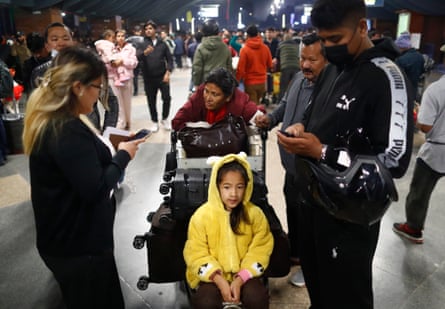
The situation was changing quickly and airlines urged passengers to check their flight status online before heading to the airport.
Some airlines issued waivers to affected travellers that will allow them to rebook their flight plans without paying extra fees or higher fares.
Jonathan Escott and his fiance had arrived at the airport in Newcastle, England, on Saturday only to find out that his direct flight to Dubai on Emirates airline was cancelled, leaving everyone on the flight stuck there.
Escott left to go back to where he was staying with family, about an hour from the airport, but has no idea when he may be able to travel. “No one knows,” Escott said. “No one really knows what’s going on with the conflict, really. Not Emirates, Emirates don’t have a clue. No one has a clue.”
At least 145 planes that were en route to destinations like Tel Aviv and Dubai early Saturday were diverted to cities including Athens, Istanbul or Rome, according to FlightAware. Others turned around and returned to where they took off from. One plane spent nearly 15 hours in the air after leaving Philadelphia and getting all the way to Spain before turning around and returning to where it started.
The cancellations
Numerous airlines cancelled international flights to Dubai through the weekend, as India’s civil aviation agency designated much of the Middle East — including skies above Jordan, Saudi Arabia and Lebanon — as a high-security risk zone at all altitudes.
-
Air India cancelled all flights to Middle East destinations.
-
Turkish Airlines said flights to Lebanon, Syria, Iraq, Iran and Jordan were suspended until Monday and flights to Qatar, Kuwait, Bahrain, the United Arab Emirates and Oman were suspended.
-
US-based Delta Air Lines and United Airlines suspended flights to Tel Aviv at least through the weekend.
-
Dutch airline KLM had already announced earlier in the week that it was suspending flights to and from Tel Aviv.
-
Airlines including Lufthansa, Air France, Transavia and Pegasus cancelled all flights to Lebanon, while American Airlines suspended flights from Philadelphia to Doha.
-
Virgin Atlantic said it would avoid flying over Iraq, meaning flights to and from India, the Maldives and Riyadh could take slightly longer. The airline already was not flying over Iran and said all flights would carry appropriate fuel in case they need to reroute on short notice.
-
British Airways said flights to Tel Aviv and Bahrain will be suspended until next week, and flights to Amman, Jordan, were canceled Saturday.
Airspace closures
-
Iran swiftly closed its airspace as the strikes began “until further notice”, said the spokesperson of Iran’s Civil Aviation Organisation, quoted by the Tasnim news agency.
-
Israel also closed its airspace to civilian flights, Transport Minister Miri Regev announced.
-
Qatar’s civil aviation authority said it had temporarily closed the Gulf state’s airspace.
-
Iraq shut down airspace, state media said.
-
The United Arab Emirates said it was closing its skies “partially and temporarily”.
-
Syria closed part of its airspace in the south along the border with Israel for 12 hours, the Civil Aviation Authority said.
-
Jordan’s air force was conducting drills to “defend the kingdom’s skies”, its military said.
-
Kuwait closed its airspace.
With Associated Press and Agence France-Presse