3 months ago
129
3 months ago
129
A woman who took her own life after being subjected to a campaign of “physical and sexual violence” by her husband told her family “I am so sorry but I just couldn’t take it any more”, a court has heard.
Tarryn Baird, 34, was found dead at her home in Swindon, Wiltshire, on 28 November 2017.
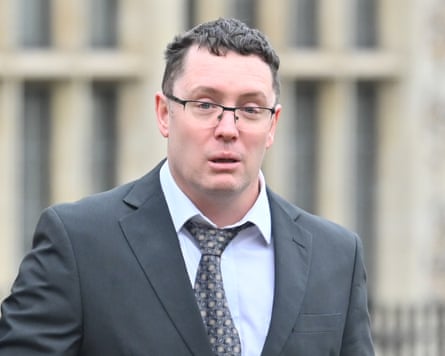
Christopher Trybus, 43, is charged with his wife’s manslaughter as well as two counts of rape and coercive and controlling behaviour. He denies all the charges.
Opening the trial at Winchester crown court on Tuesday, prosecutors said Trybus’s behaviour towards Baird had escalated in the two years before her death and that he was alleged to have raped her twice in late 2016.
The jury was read some of Baird’s diary entries, in which she appeared to note a change in her relationship with Trybus, whom she married in 2009. The couple had moved to the UK from their native South Africa two years earlier.
One read: “One night, during sex, I felt his hands around my neck. Something was unleashed that night. Progressively, sex got rougher. The more I fight back, the more he enjoys it.” In her diary, Baird added that this was “a side” of her husband “that has been hidden all these years”.
It is alleged that one of the rapes took place after an argument over whether Trybus would pay school fees for Baird’s cousin. Tom Little KC, prosecuting, said Trybus had tried to strangle his wife before forcing himself on her.
The court heard that Trybus had installed an app on his wife’s mobile phone so he could monitor her whereabouts and, on one occasion, queried how long she had spent at a GP surgery.
Little said Baird had visited her doctor on numerous occasions in the months before her death, eventually alleging that Trybus had been violent to her.
In October 2016, she told her doctor and a domestic abuse charity that her husband had tied a rope around her neck. “We ask you not to lose sight in this case of how she would eventually take her own life by hanging,” Little said.
In November 2016, Baird told her doctor that she had tried to leave Trybus but he had hit her with a metal pole.
The court heard that Baird did not “know how many more beatings she could take” but was “scared to leave”.
She made “detailed plans” to escape to a women’s refuge a few weeks later, Little said. He said these were foiled when Trybus, a software developer, returned early from a business trip.
Trybus allegedly threatened to tell Baird’s parents she was addicted to drugs and alcohol “and that would prevent them from believing her if she told them about domestic abuse”.
In another incident, alleged to have taken place in January 2017, Baird told her doctor that Trybus had attacked her with a metal bar and punched, kicked and dragged her along the ground. She also said he had strangled her with a belt. Her doctor noticed she had bruising and friction burns on her body.
Baird, however, was concerned that any involvement of police “would make things worse, not better”.
Little said: “Here, as always, it is important to be realistic to the catch-22 position that she must have felt in. Stay and the violence and control would continue, or leave and make a complaint to the police which might not go anywhere and she would be at greater risk.
Baird took several drug overdoses in the months before her death. The court heard her mental health had already been compromised by violence she had witnessed before leaving South Africa. In April 2016 she was admitted to hospital and seen by a mental health worker.
She said she was “surprised she was alive” and had been trying to obtain a refuge space as she needed to leave Trybus. She expressed fears that her movements were being tracked and cameras had been installed in her home, the jury was told.
Baird also spoke to mental health workers on the morning of her death and expressed suicidal thoughts. Later that morning she called the police, asking for someone to come to her home to recover her body. Shortly after, officers attended and found her dead.
Little said: “It was the control and physical violence meted out to her, including sexual violence and the threat of and fear of physical and sexual violence on his part towards her and over time, which led to a deterioration in her already weakened mental state and was, we say, a cause of her deciding that she should take her own life.”
The trial, before Judge Linden, continues. It is expected to last seven weeks.