3 months ago
138
3 months ago
138
Last month, on the same day that Revolution+1 – a fictionalised account of the life of Tetsuya Yamagami, the man who assassinated the former Japanese prime minister Shinzo Abe in July 2022 – screened at London’s ICA, during a season on the radical film-maker Masao Adachi, a court in Japan sentenced Yamagami to life imprisonment.
Whether the programming was a result of foresight or sheer coincidence, the dismantling of boundaries that would otherwise keep movies hemmed inside a screen and removed from the world outside are characteristic of Adachi’s lifelong practice.
As part of the ICA’s In Focus strand spotlighting political cinema, the retrospective also included his 1969 film AKA Serial Killer, which established the director as a pioneer of “landscape theory”, and the UK premiere of his latest movie, Escape.
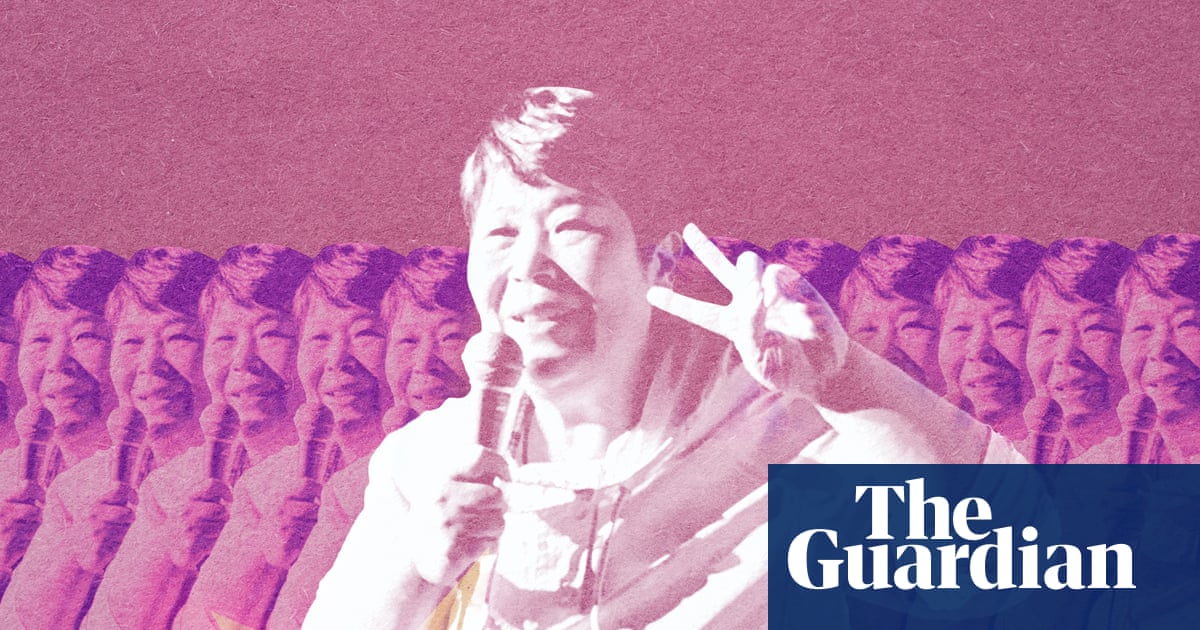
The feature-length film addresses the peculiar case of Satoshi Kirishima, an anarchist whose youthful 1970s mug shot adorned police stations across Japan – until he emerged from hiding shortly before his death two years ago. It was something that “lingered as a strange fact” for the 86-year-old film-maker.
Speaking via an interpreter from his home in Japan, Adachi said that “this film was made as soon as his death was pronounced and I wanted to explore the truth behind it”.
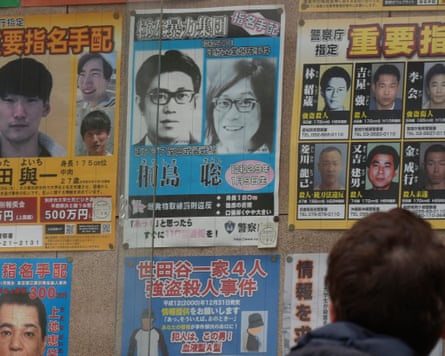
“The fact I want to point out is that there was a certain idea and myth around Kirishima, a certain image was kind of wrapped into people’s minds. There was a contrast between this image of Kirishima as a fugitive … and his smiley face.”
Using the cinematic medium to invert Kirishima’s reduction to an image – a spectacle of the past – Escape sought to tackle “this question of why Kirishima decided to reveal his identity … [but without] any explicitly clear answer”.
A brief look at Adachi’s early resume suggests that his interest in Kirishima’s life is hardly coincidental: he was a politically engaged student who later cut his teeth within the subversive “pink film” genre, before helping to produce a propaganda newsreel for Palestinian Marxist guerrilla fighters and then leaving Japan for Lebanon in 1974 to join those same fighters. It is, however, an interest that reflects broader reappraisals of Japan’s pre- and postwar history.
Adachi was born in 1939, and the Japan of his youth was in the throes of a violent and transformative rupture. Defeat in the second world war paved the way for US military occupation and a political settlement that rehabilitated suspected war criminals such as Nobusuke Kishi – a founding father of both the Liberal Democratic party (LDP) and a rightwing dynasty that would later include his grandson, Abe.
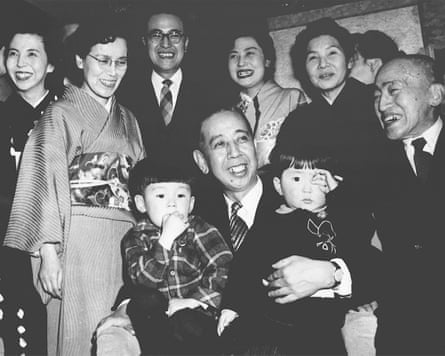
It was during Kishi’s premiership in the late 1950s that Adachi enrolled at Nihon University and became a member of its Film Study Club, one of a number of collectives at the time that sought to take avant garde theory and give it celluloid form. Ideas that began with removing the hierarchy of roles within the film production process and subverting commercialism would soon, however, spill out on to the streets.
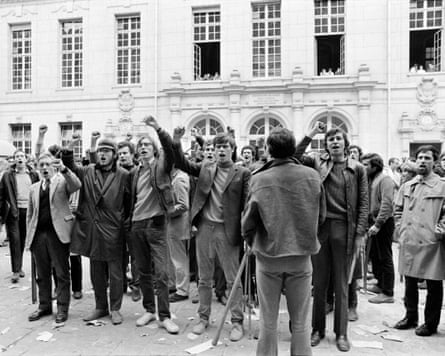
When millions joined the Anpo demonstrations against the renewal of the US-Japan security treaty in 1960, students from the club both documented and took part in sustained protest actions that became known as the Anpo struggle.
Gō Hirasawa, a film researcher and co-editor of a recent book that explores artistic movements at the time, said: “Avant garde cinema was deeply intertwined, not only with cinematic and aesthetic experimentation, but also with the Anpo struggle and political thought.”
Kishi was forced to resign, but not before pushing through the treaty’s renewal and engendering a sense of disillusionment among those who had pinned their hopes on the potential of popular pressure. Having participated in the struggle daily for nearly six months, Adachi “was left stunned, resentful of the evils of a sham democratic system, and overwhelmed by a sense of defeat” and found himself at a point of introspection.
“I also came to feel keenly the powerlessness of the independently produced films I had been making, and I even considered returning to my home town to start over by becoming a farmer.”
The Anpo struggle was a watershed moment for the immediate postwar generation that “tried to do revolution” but were confronted with repression, co-option and the resilience of the Japanese state. “Japan was going through a transformation after the second world war”, said Adachi, and “because of the strengthened power of the police, most people who were involved as student activists were either caught or forced to cease their activities. They were trying to change the whole society and, temporarily, were leading [a] mass political movement”.
He credited Nagisa Ōshima’s 1960 film Night and Fog in Japan for showing how “film could confront political issues and the conditions of the time head-on” and ultimately reaffirming his faith in film-making. According to Gō, “the creation of new forms of film and art was, for many, almost synonymous with the creation of new forms of politics”.
Meanwhile, other activists channelled their frustrations into various New Left factions – of which Kirishima’s East Asia Anti-Japan Armed Front (EAAJAF) was a descendant – that would later pursue the propaganda of the deed, at the expense of mass movements. Adachi estimated that “there were at least two to three thousand – maybe even more – young people who were involved in [far-left] activism, and they were largely influenced by activism in other countries” such as May ’68 in Paris, but that “the basis that led to these radical activities was the fact that during the second world war, Japan was oppressing other east Asian countries”.
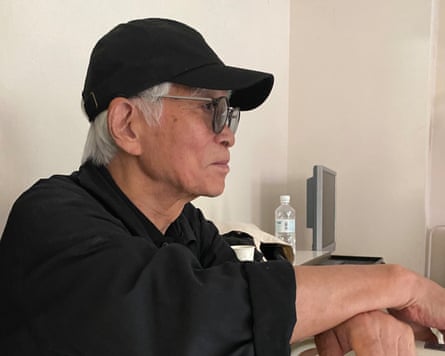
Attacking corporations that had been involved in Japanese imperialism, as EAAJAF did, was perceived to be a way to “make people start to wonder and realise … this hidden inconvenient fact”. Adachi says that the youth in Japan today are starting to realise that they haven’t studied history properly and that there is “a trend among young people” to revisit aspects of the country’s past.
Since his release from prison after being extradited to Japan in 2000, the ex-Japanese Red Army member has refused to play the role of prodigal son. His more recent films have centred on individuals who have undertaken drastic acts of violence in pursuit of goals that are not always well-defined, or even ideological, and are left facing the consequences that society imposes on them. Adachi attended the trial hearings of Yamagami, who garnered a considerable amount of popular sympathy – perhaps comparable to the reaction generated by Luigi Mangione’s alleged killing of the UnitedHealthcare CEO Brian Thompson in the US – owing to the circumstances that motivated his homicidal attack on Abe.
Are there parallels to be drawn between Yamagami and the youth of the 1960s and 70s who turned to political violence? “What [Yamagami] did was not linked to something that can be described as collectivism. He made it clear that he was doing the assassination for very personal reasons. If Yamagami had been born and had been put in the situation in a different era, I think he might not have needed to kill Abe, actually.”
Adachi argues that the atomisation of present-day Japan meant that Yamagami “couldn’t acquire comrades to organise a campaign with” alongside other shūkyō nisei (a phrase used to refer to children coerced into following their parents’ strong religious beliefs). His act of revenge was, in effect, an ironic outcome of “what Abe and the Unification Church were doing … [to make] collective activism very difficult”.
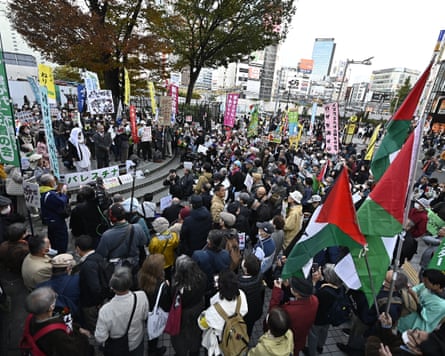
It also “links to the poor and meagre state of the political left” as “people nowadays just simply don’t know how to break through, to turn these individual thoughts to collective activism”. As someone who has “been involved in supporting Palestine for the past 60 years” to the extent of “living day after day amid gunfire” during the Lebanese civil war, Adachi viewed his experience as “not very successful” compared with the solidarity movement that has grown in response to the horrors in Gaza.
Japan’s current prime minister, Sanae Takaichi, had not yet succeeded in securing a landslide victory for the LDP when Adachi spoke to the Guardian, but in response to her calling a snap poll in January and prompting the country’s shortest-ever general election campaign – no more than 12 days – the 86-year old film-maker issued a cautionary warning for outside observers.
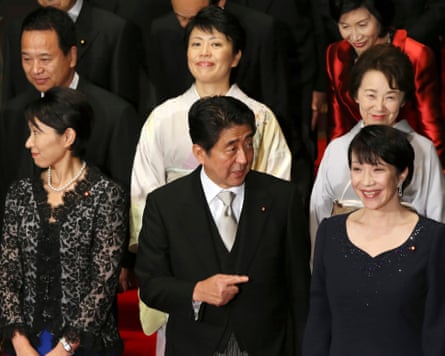
“It may seem [that] Japan is becoming more and more rightwing, [but] actually not many people support this direction. Essentially, what she’s asking is whether we, the Japanese people, [are] happy to leave decisions to her. Would you trust me to decide the direction of the country? And what she’s doing is the same as what Hitler did.”
Much has been made of the PM’s handbag and musical skills, but with a new supermajority in parliament, along with the increased presence of the extreme-right party Sanseitō, Takaichi has a strong chance to achieve one of the Kishi-Abe dynasty’s long-sought goals: the removal of the pacifist clause in Japan’s constitution, which prohibits the country from using military force for reasons other than self-defence. The extent to which that can be achieved without exacerbating the country’s social and economic malaise is yet to be seen.
While naturalism appears to be in vogue among some contemporary Japanese film-makers, there have been recent signs of a return of the political – Neo Sora’s Happyend drew on themes of student rebellion and ethnic diversity to openly critique an ascendant discourse of rightwing nationalism.
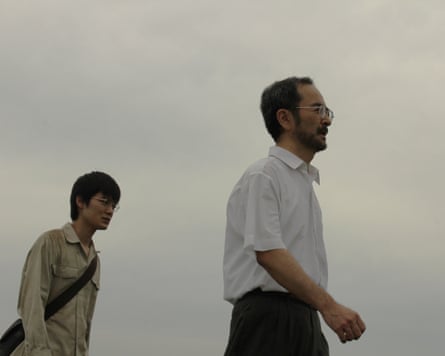
“I don’t see a lot of radical expression or [a] direct, very clear conclusion in recent films … in that regard, I’m not very satisfied but I want to support 100% what young film-makers are trying to do.
“I see clear signs in the visual work that many people are trying to respond to this [state of the] world through political and radical film-making.”