2 months ago
59
2 months ago
59
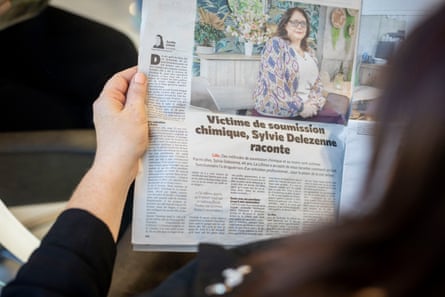
When Sylvie Delezenne, a marketing expert from Lille, was job-hunting in 2015, she was delighted to be contacted on LinkedIn by a human resources manager at the French culture ministry, inviting her to Paris for an interview.
“It was my dream to work at the culture ministry,” she said.
But instead of finding a job, Delezenne, 45, is now one of more than 240 women at the centre of a criminal investigation into the alleged drugging of women without their knowledge in a place they never expected to be targeted: a job interview.
An investigating judge is examining allegations that, over a nine-year period, dozens of women interviewed for jobs by a senior civil servant, Christian Nègre, were offered coffees or teas by him that had been mixed with a powerful and illegal diuretic, which he knew would make them need to urinate.
Nègre often suggested continuing the interviews outside, on lengthy strolls far from toilets, the women say. Many of the women recall struggling with the need to go to the toilet and feeling increasingly ill. Some, in desperation, say they urinated in public, or didn’t reach a bathroom in time, wetting their clothes. Some felt a sense of shame and failure that has had an impact on their lives, they say.
“At the time, I didn’t even know this type of attack existed,” Delezenne said.
The alleged assaults came to light in 2018, after a colleague reported Nègre allegedly attempting to photograph the legs of a senior official, prompting police to open an investigation. Officers found a computer spreadsheet titled “Experiments”, where he had allegedly noted the times of druggings and the women’s reactions.
In 2019, removed from the ministry and the civil service, Nègre was placed under formal investigation on several charges ranging from drugging to sexual assault. His lawyer, Vanessa Stein, said he would not comment while the investigation continues. Awaiting trial, Nègre has been able to continue working in the private sector.
Louise Beriot, a lawyer for several of the women, said of the alleged druggings: “Under the pretext of a sexual fantasy, this is about power and domination over women’s bodies … through humiliation and control.”
Six years on, the case is the latest in France to cast a spotlight on drug-facilitated abuse, known in the country as “chemical submission”. The term became prominent last year when Gisèle Pelicot waived her anonymity in the trial of dozens of men who were found guilty of raping her after she had been drugged unconscious by her ex-husband.
But several women in the job interview drugging investigation said their case was taking too many years to come to trial, only increasing their trauma. “Six years later, we’re still waiting for a trial, which is mind-blowing,” said one of the women, known by the pseudonym Émilie. “It’s taking too long. The justice process is bringing more trauma than healing. That’s not what justice is supposed to be about.”
Delezenne was 35 when she was invited to the prestigious culture ministry building near Paris’s Louvre museum and was shown by Nègre to a meeting room. Out of politeness, she said, she accepted a coffee. “In an interview situation, I’d never say no,” she said.
The vending machine was in a busy corridor, and Delezenne said she pressed the button herself for a lightly sweetened coffee. She said Nègre had picked up her cup, turned to greet a colleague, then moved across the corridor, before returning and handing her the drink. He allegedly suggested going outside to view some monuments, adding: “The weather’s marvellous; shall we keep walking?”
Delezenne said she was led around the Tuileries gardens answering questions for a long time, with the entire interview process lasting several hours. She focused on her need for a job, having left her previous position for health reasons and knowing that her savings were dwindling.
“But I felt an increasing need to urinate,” she said. “My hands were trembling, my heart was palpitating, beads of sweat ran down my forehead and I was turning red. I said: ‘I’m going to need a technical break.’ But he kept on walking.”

Eventually, she couldn’t hold on: “I wasn’t well; I thought what can I do?” She had to crouch down at the side of a tunnel leading to a footbridge across the Seine. She said: “He approached, took off his jacket and said: ‘I’ll shield you.’ I thought that was strange.”
She was devastated. “I thought: ‘I’ve wrecked my interview.’” On the way home she was abnormally thirsty, quickly downing litres of water. “My feet were so swollen they were bleeding from rubbing my shoes.”
In the months and years that followed, Delezenne blamed herself for “messing up”. She avoided going to Paris and stopped applying for jobs. “I had nightmares, angry outbursts. I didn’t look for work; I thought I was useless,” she said.
Four years later, in 2019, police contacted her. She said she discovered her details had been entered into a spreadsheet, along with photographs of her lower legs. She has since been diagnosed with post-traumatic stress disorder. “The time this is taking to come to trial is weighing on me,” she said. “The anger is not going away.”
Another woman to have been contacted by police is Anaïs de Vos, who was 28 when she applied for a job as a managerial assistant at the culture ministry in 2011. She doesn’t habitually drink coffee. “But in an interview when someone offers coffee, especially the manager, you say yes,” she said. Nègre went to a corner of the meeting room to prepare it himself, she said.
He suggested they walk outside, but de Vos started to need the toilet, and asked to head back because she was cold. Instead, she said, he crossed the road in the other direction, to the banks of the Seine.
She said: “He looked me in the eye and said: ‘Do you need a wee?’ It was like an adult talking to a child. I found it bizarre, so I replied quite coldly.” He gestured to a storage unit under a bridge as a place to urinate, but she refused. “I had a warning light in my head telling me there was something wrong.”
Nègre suggested going towards the Louvre. But the toilet that de Vos found cost €1 and Nègre had told her to leave her bag behind at the ministry. She had no money, and he said he had none to lend her.
Eventually, unable to cope, she entered a cafe. The toilet was upstairs, and as soon as she saw the door, she began to wet her clothes, but managed to dry herself. On the train home later, she said she had felt “really ill and as if I was about to faint”.
She wasn’t surprised to be contacted by police in 2019. “I always thought something was strange,” she said. “The justice system has taken too long … For us, it feels like we’re being victimised a second time.”
Émilie, whose lawyer advised she use a pseudonym because the investigation is ongoing, was 29 and established in the arts world when she began looking for a new job in 2017. She was contacted by Nègre on LinkedIn and invited to the regional culture office in Strasbourg, where he then worked. He offered her tea and left the room to make it himself, before continuing the interview on a river walk and cathedral visit, which lasted two hours, she said.
She said: “I wanted to go to the bathroom, but he said: ‘There are no toilets here. Let’s just carry on.’ He was walking very, very slowly, stopping to ask questions. I was feeling dizzy; I thought I might pass out.” She made it back, and he showed her straight to a private toilet directly adjoining his office. “It felt really weird,” she said.
Two years later, she heard about a media report on an investigation into alleged drugging with diuretics by an unnamed figure at the culture ministry. “Suddenly everything made sense, but it was an immense shock,” she said. She filed a complaint with police. She left her Strasbourg job, and later left France.
Beriot said the case was on an “extraordinary scale” and the unusually long investigation amounted in legal terms to “secondary victimisation” of the women by the justice system. She said: “The Pelicot trial was a very important first step and chemical submission remains a vast issue.”
Some women have won compensation in a civil case against the state, where the culture ministry itself was not found to be at fault. A culture ministry official said it was committed to preventing harassment and sexual violence and providing support to survivors.
The CGT culture trade union said: “We want the ministry to recognise its responsibility as an employer – there is a systemic problem, which enabled a senior civil servant to act like this for a decade.” The union said other staff had previously made allegations against him, accusing him of taking pictures of women’s legs in meetings.
Delezenne, who now works in marketing for a hairdresser in Lille, said: “My priority is that this never happens to anyone else again.”