6 hours ago
13
6 hours ago
13
After his fall from grace, media’s former enfant terrible is now sober and helping others with his addiction recovery newsletter and podcast, The Small Bow
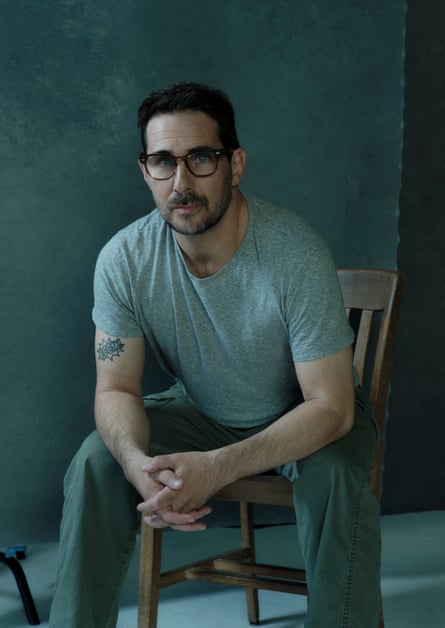
Every other Tuesday, AJ Daulerio wakes up at 5.30am and meditates for five to 20 minutes before beginning his multistep daily journaling protocol: reading a selection from a poetry anthology, then a passage from one of his daily wisdom readers (his go-to is a heavily annotated copy of Leo Tolstoy’s A Calendar of Wisdom); writing his Fear of the Day and gratitude list, then sharing his spiritual takeaway in a note to his three kids.
After a banana and coffee, Daulerio trains Brazilian jujitsu before hitting a 9.45am meditation at Besant Lodge – a community center just below the Hollywood sign that once served as a meeting place for mid-century mystics – immediately followed by him leading a recovery meeting of his own through Zoom.
He goes to personal therapy at 11.15am, picks up his kids in the afternoon and spends the rest of the evening with them and his wife, giving him just a few hours at night to work on his advice column for Slate and the two books he’s writing.
This is in addition to emotional sobriety step work (cultivating inner peace after the drinking stops) on Zoom on Wednesday nights, an Adult Children of Alcoholics meeting every Friday morning, Alcoholics Anonymous on Sundays, couples therapy every other week, and a quarterly meeting with his psychiatrist to refine his cocktail of psychotropic medications, including a mood stabilizer (Lamictal) and an antipsychotic (Zyprexa), to treat his bipolar disorder.
“I have an ego that needs to be put in check all the time,” Daulerio tells me. “Half of my recovery is dedicated to that.”
Daulerio celebrated 10 years of sobriety this July, a joyous capstone to a tumultuous decade-plus that saw Daulerio go from digital media visionary as editor of Gawker to broke, disgraced and the man most responsible for the site’s demise.
Daulerio has re-emerged in recent years, again as a media innovator – not as the cutthroat, traffic-obsessed editor reputation he garnered at Gawker, but as the gentle, deeply pensive and contrite author of The Small Bow, the newsletter he created in 2018 to chronicle his recovery from drug and alcohol addiction, and his attempts to reclaim his life as a changed man.
Today Daulerio maintains a rigorous recovery regimen to battle the twin demons that once fueled his self-destructive impulses: the lonesomeness that led him to seek companionship in dive bars among other strange drunks, and the ego that convinced him he had it all under control, despite signs to the opposite.
Daulerio has built a devout following by writing about his recovery program in unsparingly honest, vulnerable first-person essays in The Small Bow, and he now wants to grow the company into a multiplatform media company that provides wisdom and guidance to people struggling with addictions of all kinds.
But therein lies Daulerio’s existential dilemma: how to build a successful media business without sacrificing the spiritual practice that made his second act possible.
“It’s something I have to get comfortable with and better at, because I do believe in what we’re doing,” Daulerio says between bites of his cheeseburger. “I know there’s a good way of self-promoting, I’m just wary of my intentions a lot of the time.”
One needs a certain amount of irrational self-confidence to start any business, especially in print media, an industry that has been in steady decline since Daulerio first became a journalist in 2000. Then there’s the self-promotion required to grow a business, even as it risks inflating the ego that fueled his fall from grace and that he’s worked so hard to keep in check.
That The Small Bow is built almost entirely around Daulerio’s personal experience makes this all the more difficult.
In Daulerio’s favor is his unmatched skill at growing digital media properties. It’s what propelled him to success as the editor of the now defunct Gawker Media – and also what led to his and the company’s downfall.
The Small Bow uses lots of religious iconography in its branding: pen and colored pencil illustrations of demons and angels drawn by Edith Zimmerman, a writer and artist who has also found sobriety – and they serve as an easy metaphor for the tension between Daulerio’s professional ambitions and his personal recovery: the demon whispering in one ear to revert to his old tricks and grow The Small Bow by any means necessary, and the angel whispering in the other to preserve what’s made The Small Bow so resonant with readers undergoing their own struggles.
“How do you sell something that is supposed to be genuine?” he asks me rhetorically. As with his sobriety, all he can do is forge ahead and attempt to achieve this seemingly irreconcilable balancing act, one day at a time. “What are the other options?”
The last 10 years of Daulerio’s life have been an exercise in being humbled. Few figures in recent history have had their rise and fall scrutinized as intensely by the media. His exploits have been the subject of two Netflix documentaries, glossy magazine profiles, and countless reports and thought pieces on sound journalistic practice and the limits of first amendment freedoms.
But long before he was media’s enfant terrible, he was one of the most promising young talents in 2000s digital journalism.
Daulerio started in journalism in 1998, covering city council meetings for the East Brunswick Sentinel in New Jersey. His initial dream was to be a music producer – he was simultaneously interning at a recording studio – or, saving that, a music critic. But he quickly exhibited a preternatural talent for landing scoops, a skill that would become his MO as he ascended the highest echelons of the digital publishing industry.
“I had the ability to get people to tell me things they weren’t supposed to,” Daulerio says. “Because I didn’t have strict deadlines, I could hang out with the council members.” A former college classmate of Daulerio’s worked the same beat for a competing newspaper, and Daulerio delighted in beating him to stories. “I loved it. I was weirdly competitive in a way that’s good for reporting. I’ve never been competitive in anything else.”
Despite being a diehard Philly sports fan, Daulerio was a feckless athlete himself, much to the embarrassment of his father (a topic Daulerio frequently visits in his Small Bow columns). “I grew up playing sports, but I never knew how to win. In the journalism world, I knew how to win.”
Daulerio shuffled through writing and editing gigs in New York and Philadelphia – including stints at the trade publications Bond Buyer and American Lawyer Media; men’s lifestyle newsletter Thrillist; and Philadelphia magazine – before landing a senior editor job at Deadspin, Gawker’s sports vertical, in 2008. Just months later, he was promoted to editor for the entire site.
Then Daulerio published photos of former New York Jets quarterback Brett Favre’s penis, and his life trajectory was forever altered.
In August 2010, Daulerio published a Deadspin post alleging that Favre had sent lewd voicemails and pictures of his penis to the Jets sideline reporter Jenn Sterger. Two months later, Daulerio published the illicit photos, purportedly from Favre, in a video montage, with Favre’s voicemails providing the soundtrack.
The story generated millions of page views for Deadspin and months of headlines across the wider sports media ecosystem, cementing the three-person sports blog as a player on the national stage and Daulerio as a fearless journalist on the vanguard of a new era of digital journalism. “So many NFL reporters had known about [Favre’s behavior] the whole time and wouldn’t cover it,” Daulerio says. (Favre admitted to leaving the voicemails but denied sending lewd photos.)
Professional and personal accolades showered over Daulerio. He did the Today show (while drunk, stoned and on Adderall). Nick Denton, Gawker Media’s founder and CEO, rewarded Daulerio with a raise, three more Deadspin staff writers and a freelance budget.
Daulerio was spotlighted in a GQ profile and became a star of the New York City media scene. “A friend of mine from high school came to a Gawker office rooftop party,” Daulerio recalls. “He watched me walk into this place and he was like, ‘I feel like I’m with Don Corleone.’”
It was the success and recognition Daulerio had always coveted. He had dreamed about having his glossy portrait photo featured in Forbes’ 30 Under 30 list. And yet all the attention – and criticism – made him uncomfortable. “I did not like my full-time job to be a punching bag for all the heels on the internet,” he says. “On the other hand, I had been treading water for 10 years in online journalism, and now I had attention and career options.” After the GQ story, “there was no reversing who I was.”
As he climbed the ranks of the media industry, Daulerio was also feeding a drinking habit that would land him in rehab. He drank six nights a week, rotating through a familiar circuit of bars near work in the Bowery (Congee Village, Professor Thom’s) and, on weekends, in Williamsburg (Dardy Bar). Some Saturdays he would post up at a bar at 11am, down 10 beers and five shots, stay until close and then do cocaine with his newly formed friends. “I would just live in these places,” Daulerio says. “I was a binger. I would go to a bar on Thursday and come out of it on Monday … There was never really a plan other than to stay for as long as I possibly could.”
Drinking was a way to treat the “free-floating loneliness” Daulerio had lived with since he was a child, he says. “It was fun to do cocaine with strangers until 4.30 in the morning. That felt like home to me … It would be silly to blame [my addiction] on anything other than I never felt normal or at ease, and I’m always battling that and probably always will.”
He was one of the most successful editors in the burgeoning digital publishing industry, but he couldn’t afford an apartment because his credit was so bad. He bounced between friends’ couches.
His cavalier editorial philosophy came under fire at the same time. To critics, Gawker became emblematic of a new wave of digital journalists who prioritized the almighty click and page view without any consideration for journalistic ethics or basic human decency.
Publishing the Favre story, for instance, meant burning Sterger, the recipient of the reportedly unsolicited “dong shots” (Daulerio’s words), who had explicitly asked to not be included in the story. (Daulerio bought the photos and voicemails from a third party for $12,000.) He even published Sterger’s request to leave her out of it.
Daulerio now says he wishes he had broken the Favre scoop without mentioning her.
Later, when the Gawker empire imploded, a narrative emerged that Daulerio’s alcohol and drug use was largely to blame for the editorial decisions that led to its collapse, a premise Daulerio wholly rejects. “A lot of good things were happening when things were bad,” he says.
Such as Deadspin’s immense growth. In just three years under Daulerio’s tenure, Deadspin’s traffic tripled, as the site continued to break raunchy, irreverent scoops – former New York Jets head coach Rex Ryan filming foot fetish videos starring his wife; photos of Texas Rangers outfielder Josh Hamilton drunk and shirtless, licking whipped cream off a woman’s breasts in a Tempe, Arizona, bar, despite supposedly being sober; and ESPN Horndog Dossier, a collection of unconfirmed rumors about rampant illicit sexual behavior at “the Worldwide Leader in Sports”.
There was even some genuine investigative reporting mixed in with the scuzzy gossip, such as leaked financial documents exposing the creative accounting techniques that Major League Baseball franchises employ to boost profits.
Denton named Daulerio editor of Gawker.com, Gawker Media’s flagship site, in late 2011. The following fall, Daulerio approved publication of a sex tape starring the professional wrestler Hulk Hogan. Hogan filed an invasion of privacy lawsuit against Gawker just two weeks later, a legal action that would bankrupt Gawker and force its sale, and temporarily ruin Daulerio’s life and career. (It was later revealed that Hogan’s suit was financed by the billionaire venture capitalist Peter Thiel, who harbored a grudge against Gawker Media ever since it outed him as gay in 2007.)
Hogan won a $140m judgment in March 2016 against Gawker, including $100,000 in punitive damages for Daulerio, a verdict that was largely blamed on Daulerio and his callous editorial ethos. (Gawker settled with Hogan for $31m, and Daulerio didn’t have to pay the $100,000.)
During the trial, Hogan’s attorneys brought up how Daulerio once published a separate sex tape of two people who were not public figures, and how Daulerio initially dismissed the woman in the video when she requested its removal. (Daulerio implored her to “not make a big deal out of this”.)
The post was eventually deleted, and Daulerio says publishing it was the most regrettable moment of his career.
The most damning moment in the trial was when Hogan’s attorneys showed the courtroom a videotaped deposition of Daulerio from October 2013, in which a Hogan attorney asked Daulerio: “Can you imagine a situation where a celebrity sex tape would not be newsworthy?”
“If they were a child,” Daulerio replied.
The lawyer pushed: “Under what age?”
“Four.”
The exchange sent “a palpable sense of shock” through the courtroom, according to the New York Times. There were audible gasps and groans. Daulerio says the comment was a sarcastic joke, “a defense mechanism” after getting frustrated with the interrogation, but it supported the plaintiff’s portrayal of Daulerio as a heartless gossip-peddler who trafficked in the sordid details of people’s personal lives, even when they had zero news value.
Adding to Daulerio’s embarrassment, the trial revealed he had a net worth of negative $35,000. The court froze the $1,500 he had in his bank account. The 2017 Netflix documentary Nobody Speak: Trials of the Free Press about the Hogan trial opens with Daulerio laughing as he reads a bank email informing him a $230m hold had been placed on his bank account.
Daulerio can’t recall how he felt during the trial. He dissociated. “It was so big and overwhelming, I just felt like I was a character in this thing,” he says. The only part of the experience he can latch on to is the photo of him from the New York Times article. “I feel like I know what that expression is: really helpless, but also in trouble.”
As Daulerio’s professional life was put on trial, he was also trying to get sober. He first entered rehab in August 2015, seven months before the trial began, but quickly relapsed. “Two months later, I was back at it pretty hardcore,” he says.
Daulerio fully committed to sobriety on 15 July 2016, a month after Gawker filed for bankruptcy and put itself up for sale. “July 15, 2016, was simply the day I decided to stop resisting and give up the warped idea that I could do my own modified version of sobriety, something akin to what I liked to call ‘advanced moderation’,” he wrote in a recent Small Bow essay about his 10th anniversary of sobriety.
What Daulerio still longed for in his early days of recovery was a way to process the experience the best way he knew how: through writing.
The first piece Daulerio published after the trial was a 2017 first-person essay about his fraught relationship with his father for the now shuttered men’s publication Mel.
The piece had the pugnacious writing that made Deadspin so popular; Daulerio opens the essay recounting a physical fight with his father. But it also had the emotional vulnerability of an adult man trying to heal his daddy issues, told through the prism of past Father’s Days. (I was a staff writer at Mel at that time, but did not work with Daulerio).
“The piece was masculinity and neuroses laid bare, not in a self-pitying, ‘woe is me’ way, but in a curious way,” former Mel editor-in-chief Josh Schollmeyer says. “If there’s any difference between the pre- and post-trial AJ, it’s AJ falling in love with his own mythology versus being who he really is, which is a master storyteller. That humility was apparent from the jump.”
The naked confessional style would become The Small Bow’s signature. In the newsletter, Daulerio recounts his various sobriety efforts – AA meetings, therapy, meditation, psychiatry, stoicism, Buddhism – in oftentimes painful, but always heartfelt honesty.
Earlier this year, he wrote about moving his elderly mother into an assisted living facility in Florida near where he went to rehab. He also frequently writes about the spiritual blessings of being a family man; Daulerio and screenwriter Julieanne Smolinski married in 2018, and they have three children together in Los Angeles.
Some of the most powerful Small Bow entries are about Daulerio making amends – steps eight and nine in 12-step programs – to those he wronged during his years actively in addiction, such as making peace with Sterger.
In a January 2020 essay, Daulerio revealed he and Sterger incidentally reconnected when he adopted a dog for his growing family. Sterger just so happened to work at the dog shelter Smolinski emailed, resulting in Daulerio and Sterger meeting at the LA diner House of Pies.
She admitted that there are still uncomfortable days and awkward moments stemming from the Favre ordeal. There’s still a version of her that exists in the internet’s memory hole where she will never be a real person; she’s just a plot point without context, without skin. But the thing that I did was more vicious. You see, I knew she was a real person – and I did what I did anyway. I didn’t care if I destroyed her. That’s just the type of person I was back then.
I don’t remember how long we actually talked, but I remember we both walked out of there a little relieved like we’d both just found a therapist who finally understood the excavation tools required to break new ground. Some hurts were still unreachable, though. Time takes time.
Sterger agreed to meet him out of curiosity: she wanted to understand why Daulerio betrayed her wishes and upended her life. “I found a guy that had looked at himself in the mirror and really done a lot of hard work on himself – really examined why he had done the things that he had done, and realized the hurt that he had caused people,” Sterger says.
The two got along so well that they developed the unlikeliest of friendships. “He has been through the level of public shame that I have,” Sterger says. “Few people have experienced that.” Sterger later appeared on The Small Bow podcast, where she and Daulerio publicly buried the hatchet.
“There’s a concept in recovery of a living amends,” Daulerio says. When a direct amends might inflict even more pain on the injured party, addicts in recovery are instructed to atone by simply living a good life. “The Small Bow is a living amends for whatever version of me came before on the internet.”
The newsletter has amassed 20,000 subscribers – about 2,000 of them paid, making him $72,000 a year – including some celebrities that have embraced the publication as a platform to discuss their own sobriety.
Fans of the CBS talkshow The Talk and the Barstool Sports podcast Pardon My Take know Jerry O’Connell as a happy-go-lucky actor with a goofy sense of humor, but on The Small Bow podcast in April, O’Connell revealed he’s been in recovery from alcoholism for 13 years.
Going public about his sobriety took some convincing. O’Connell got sober under the old-school AA mentality that treats anonymity as sacrosanct – “it’s right there in the title,” he says – but made an exception because Daulerio had been so important to his own recovery. The two connected during the pandemic over their shared sobriety after O’Connell, a longtime Deadspin fan, reached out.
“AJ has a new-school way of thinking, and that’s why this venture is interesting,” O’Connell says of Daulerio’s willingness to bare it all. “This is all uncharted territory.”
“I was publicly drunk, so being publicly sober makes sense to me, and I like to talk about the many methods I go about to stay that way,” Daulerio recently wrote in The Small Bow. “But recovery is a personal thing – how someone chooses to do it isn’t my business.”
Actor and documentarian Alex Winter has a routine meetup with Daulerio at House of Pies, where they discuss recovery and fatherhood. Winter, too, discussed his recovery on an episode of The Small Bow, the only time he has appeared on a recovery podcast.
“I’ve always bristled a little bit at these kinds of recovery-forward podcasts,” Winter says. “I always worry about people getting very enthusiastic about getting sober. … Recovery is delicate. It’s fragile. So I just feel for the people who expose themselves that way and hope that they’re OK.” What separates Daulerio, Winter says, is his radical candor. “He’s very self-effacing in a way that is honest, not trying to win brownie points by being self-effacing.”
The day after Hogan died last July, Daulerio penned a Small Bow essay partially thanking the Hulkster for body-slamming his life and career. “Without that experience, there is no Small Bow, probably,” Daulerio says. “That’s how I choose to think about it.”
“I forgot to brush my teeth,” Daulerio announces to The Small Bow production team, as he prepares to tape a new episode.
Between fatherhood and his recovery routine, Daulerio’s is more structured than ever, but chaos seeps in at times. After nearly three decades as a writer, he still gets bothered by commenters. He recently sent a snarky email response to a reader who criticized one of his Slate advice columns.
A current focus in his recovery is on improving his sleep. A night owl, Daulerio typically gets only five hours of sleep a night, staying up until the wee hours to watch violent action movies, often starring Jason Statham. He has started using a sleep mask and soothing ASMR sounds to help lull him into slumber.
The podcast is integral to Daulerio’s strategy for growing The Small Bow. His larger vision is something akin to a trade magazine for the recovery industry. He wants to sell subscriptions to recovery facilities – hospitals, clinics, rehabs, halfway houses – whose patients would then be able to access, and even contribute to, The Small Bow’s archive of addiction-related content. “A farm system for The Small Bow,” he says, not unlike how Gawker recruited the wittiest contributors in its comments section to become paid staff writers.
Daulerio piloted such a program with Divided Sky, the Ludlow, Vermont, drug rehab facility co-founded by the Phish frontman Trey Anastasio, whose appearance on The Small Bow podcast is the show’s most popular to date.
As The Small Bow has attracted more contributors, its scope has widened to include a broader array of addictions and mental health issues: sex, shopping, gambling, weed, depression, bipolar disorder. The internet itself.
Today’s podcast taping is with writer Ryan O’Connell, who’s promoting his essay collection, Inspiration Porn – a welcome development for Daulerio, who wants The Small Bow to be a requisite stop on the memoir promotion circuit. Daulerio’s own books, a compilation of essays about recovery called The Small Book, a play on AA’s Big Book, and a memoir about his life post-Gawker trial, are scheduled to publish in 2027.
Ryan O’Connell’s relationship with alcohol falls into the expanded definition of sobriety. He never hit “rock bottom” because he quit before he could get there. “It’s the only substance you get shamed for quitting,” he says. “What I want to create a dialogue about is: you can stop drinking just because you don’t like it. AJ is expanding recovery conversations to be about so much more.”
I ask Daulerio what success looks like to him now. On a personal level, it’s spending quality time with his family, the spiritual opposite of when he would stay out all night to avoid going home.
Professionally, success means rediscovering his love of writing, doing it consistently, and serving the recovery community he’s cultivated.
“I’m never going to have the notoriety I had, but I really enjoy what I do know and learning how to write again,” he says. “It’s the best work I’ve ever done.”