3 months ago
107
3 months ago
107
Joe Rogan, the world’s most popular podcaster, is struggling to sleep. In an interview last week, he complained that the “madness” of the news cycle – from the release of the Epstein library, to US military strikes on Iran – has him “overwhelmed”. For some, this admission is just the latest sign that the world’s most popular podcaster might be regretting his role in cheerleading Donald Trump back into office.
It follows seemingly scathing criticism of ICE after the killing of Renee Nicole Good. Rogan compared ICE to the Gestapo in a short clip that quickly went viral. It led this newspaper to reasonably ask “Has Joe Rogan fully soured on Trump’s presidency?”, with ABC, Bloomberg and CNN all recently reporting on Rogan’s apparent disapproval of ICE.
Seeing Rogan lose faith in the political leader he championed into the White House would represent a significant blow to Trump, given how influential Rogan’s support has been since their interview during 2024 election campaign.
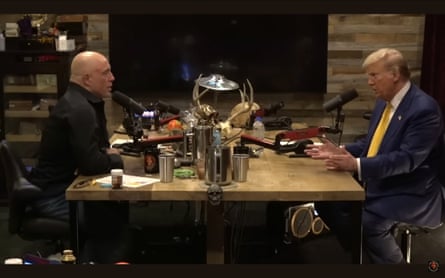
But the “gestapo” clip was taken from Rogan’s three-hour interview with Senator Rand Paul on 13 January, and it doesn’t reflect the tenor of their whole conversation. Rogan frames the presence of ICE as a direct response to mass “fraud” in Minnesota, justifies ICE’s need for total anonymity to carry out their work, warns “one of the real problems” is that ICE might wrongly be seen as villains, and expresses sympathy for ICE agents.
While lamenting Good’s shooting as “unfortunate”, Rogan says she “seemed crazy” and “out of her fucking mind”, speculating she was a deliberate agitator. Hardly the sentiments of someone whose horror at the use of deadly force against an innocent civilian is giving him sleeplessness nights.
I know all this because I have listened to more than 170 hours of Joe Rogan, for the Know Rogan Experience podcast. There, we try to understand and explain the prolific misinformation platform.
On that same episode, Rogan does say he dislikes seeing people snatched off the street, but justifies the need for it, given the Democrats are flooding swing states with illegal immigrants in order “hijack” the democratic system.
The idea that illegal immigration is being used to subvert democracy has been a recurrent theme on Rogan’s podcast. In October 2024, a week after Rogan’s influential Trump interview, he sat down with then vice-president hopeful JD Vance, who warned that the US was heading for a one-party system with Democrats “taking away congressional representation from American citizens and giving it to illegal aliens”. And in February 2025, Elon Musk told him it was an explicit plan by senior Democrats to create a permanent one-party socialist state.
In August 2025, the White House called for the census to exclude undocumented immigrants, with deputy chief of staff Stephen Miller accusing the Democrats of counting “tens of millions of illegals” to “[steal] house seats for sanctuary cities”.
Right on cue, Rogan began raising it as a talking point on his show, including in interviews with Ed Calderon, Mariana van Zeller, Andrew Schulz, Theo Von, James McCann, Andrew Doyle, and Ehsan Ahmad, as well as during an MMA watch-along. Just last month he told actor Cheryl Hines that 10 million “illegal” immigrants had been let into the country to create “a built-in voter base” in order to “rig the election”.
Whether Rogan realises or not, this repetition closely resembles the “great replacement” conspiracy theory – a narrative usually associated with the far right. According to believers, wealthy elites deliberately engineer mass immigration of people of colour into white-majority democracies in order to disenfranchise the local population and rob them of political power. These ideas were once discussed on fringe message boards and in hushed tones at far-right gatherings. Now Rogan is presenting a similar-sounding theory on the most popular podcasts on the planet.
For the avoidance of doubt, the 2020 census redistricting saw red states gain congressional seats at the expense of blue states – continuing the trend from the 2010 and 2000 censuses. Rogan needn’t fret: if Democrats were trying to subvert democracy through mass migration, they’re doing it badly.
A month on from the Minnesota killings, Rogan has cemented his narrative on how to process those events. On 19 February he told podcaster Michael Malice:
They’ve done an amazing job in Minnesota of distracting people from the Somali fraud by organising protests against ICE … It’s heavily funded, organized … They knew what they were doing and they did it because they wanted to distract from the fact that this fraud was being exposed. They totally shifted the narrative. Nobody’s talking about the fraud any more, everybody’s talking about ICE being murderers. It worked.
In a lengthy conversation with far-right podcaster Andrew Wilson, he also called the idea that protests against ICE are organic “provably nonsense” – instead, they are a “colour revolution” organised by the Minnesota state government to distract from the “ungodly amount of fraud that has been discovered [in Minneapolis]”.
Far from breaking with Trump or “souring” on the administration, Rogan has rationalised the administration’s violence as an understandable response to a deliberate and coordinated provocation, orchestrated in consort with Democratic politicians in order to cover up for alleged fraud – a narrative that was echoed in Trump’s State of the Union address and is subsequently informing policies announced by the White House.
Having spent a year getting to know Rogan, it’s clear that it will take more than the gunning down of two American citizens to shake the faith he has in the man he championed into office. What’s also clear is Rogan’s value in repeating and amplifying narratives friendly to the Trump administration’s goals – even those that soft-peddle far-right conspiracy theories like the great replacement.
Not even Trump’s association with Jeffrey Epstein can rock the foundations of Rogan’s trust – despite the out of context clips making media headlines with claims Rogan has “once again ripped into the Trump administration”. In fact, across seven recent shows in which Rogan reacted to the publishing of 3.5m documents from the Epstein library, Trump’s involvement came up on just two occasions: firstly, when Rogan told Evan Hafer that Trump’s initial dismissal of the files as “a hoax” was a bad look (speculating that Trump may not have known how bad Epstein was), and then a week later telling Malice that Trump had thanked the FBI for arresting Epstein, hence his appearance in the documents.
Rogan seems characteristically uncurious that Trump is mentioned more than 5,000 times in the documents, with reporting suggesting further documents pertaining to Trump have been withheld. In fact, the only time Rogan has ever paused to consider the extent of Trump’s friendship with Epstein was after the September 2025 revelation of Trump’s infamous birthday book message to Epstein, which even Rogan had to admit sounded creepy – though he has never once mentioned it since.
Whether he likes it or not, Rogan has influence, and he has power – and whether he means it or not, he is using that power to sanitise the reputation and actions of Trump and his administration. If we want to understand the oversized impact of the world’s largest podcast platform, we can’t rely on consuming out of context clips that appear to tell us what we’d like to be true – we need to pay attention to what Joe Rogan actually says. Millions of people already do.
-
Michael Marshall is project director of the Good Thinking Society and co-host of The Know Rogan Experience podcast