3 months ago
163
3 months ago
163
Penelope Farmer via the Cure
I first heard the Cure’s Charlotte Sometimes as a teenager, and it was like waking up from a dream. With dissonant guitar chiming like church bells and opaque lyrics about preparing for bed, it unburied a childhood memory of reading Penelope Farmer’s ghostly 1969 book of the same name. As a child I’d found it fantastical: on Charlotte’s first night at boarding school, she wakes to find herself 40 years in the past, in the body of someone else, with an unfamiliar moon in the sky. But as a teen, re-reading the story on Robert Smith’s recommendation, it held a mirror to my increasingly uncertain sense of self. To hear Charlotte’s disorientation play out through uneasy bass and Smith’s dizzying, doubled-up vocals was strangely comforting; confirmation that growing up has always felt like time-travelling. Learning that the band recorded it exactly 10 years, to the day, before I was born was further proof: my own cosmic link to a past life. Katie Hawthorne
Oscar Wilde via the Smiths
I bought Oscar Wilde’s The Picture of Dorian Gray in my youth because Morrissey had mentioned him in the Smiths’ Cemetry Gates (“Keats and Yeats are on your side / While Wilde is on mine”). Also, I desperately wanted to impress a Morrissey obsessive in Hull with whom I’d been corresponding, who was coming to visit. I’d acquired Alan Sillitoe’s glorious Saturday Night, Sunday Morning – referenced in Vicar in a Tutu – for similar reasons and hoped that my combination of a vintage cardigan and a 1930s typewriter from Leeds market would convince her that I was a Yorkshire Mozzer. Sadly, we were both so nervous on the day that our initial interactions involved leaving messages for each other on the typewriter, but she eventually felt confident enough to dance around the living room to Oscillate Wildly. The mostly long-distance romance ended not long after the Smiths split up, but we’re still friends on Facebook and I still have both books. Dave Simpson
Joe Orton via Adam Ant
I was in my final year at university, writing a dissertation on Joe Orton, ploughing through a load of terrible plays from the 1940s and 50s that, if nothing else, gave you an idea of how gay men were depicted on stage before Orton unleashed Entertaining Mr Sloane. I was suddenly struck by the thought that I was basically doing all this because of Adam Ant. At the height of his teenybop fame, he’d seldom missed an opportunity to talk about Orton. A devoted 10-year-old fan, I’d filed the name away; years after Adam’s star waned, I saw a paperback of Orton’s diaries and bought it, belatedly on his recommendation. They were hilarious and genuinely shocking and led me to his plays and John Lahr’s biography Prick Up Your Ears. Unlike a lot of books I loved in my teens, I still adore Orton’s work, still find it funny and startling and thought-provoking: I can lift even the grimmest mood a little by flicking through his diaries for the umpteenth time. A 40-year passion, for which I owe Adam Ant a debt of thanks. Alexis Petridis
John Berryman via Nick Cave
While Charles Bukowski was a refreshing, late-bloomer working-class literary voice, capturing the grime of everyday LA amid Hollywood glitz and glam, he was also a difficult figure with undeniable issues around women. Even my young naive brain, in a period of romanticising the starving artist barfly cliche, couldn’t shake off watching footage of him drunkenly kicking his wife in a documentary. Then Nick Cave suggested another troubled alternative. “Bukowski was a jerk,” he declared on the rousing 2008 song We Call Upon the Author. “Berryman was best. He wrote like wet papier-mache.” I’d never heard of John Berryman so sought him out. He and Bukowski had many similarities: deeply traumatic upbringings, alcoholics, both had ravenous alter egos called Henry. But stylistically they parted, and Berryman’s 77 Dream Songs was a revelation. A beautiful, blurring whirlwind of words and voices that hazily yet lucidly unfurled – dreamlike – and contained all the simmering pain, anguish and darkness a young man could crave. Daniel Dylan Wray
Samuel Taylor Coleridge via Iron Maiden
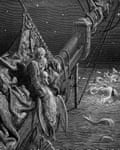
I owe Iron Maiden my English A-level. I was 14 when I picked up a copy of their album The Number of the Beast, understanding that it was a must-hear for blossoming metalheads, and I didn’t anticipate how much its attention-demanding grandeur would soothe my anxious mind. It launched a lifelong obsession, especially with the most flamboyant end of Maiden’s canon – and they seldom got more flamboyant than on Powerslave’s 13-minute The Rime of the Ancient Mariner, which stringently retold the epic Coleridge poem. I studied the song as if I had to take a test on it, from its marching verses to the creaking bridge and hallucinatory lyrics. It has no chorus and I can still recite it word-for-word. Coincidentally, the original Romantic masterpiece, about a sailor who learns to treasure nature after being cursed to live forever, was on my college curriculum not long after. I barely attended a class and I aced the exam. Thanks, boys! Matt Mills
Grace Paley via the National

With somewhat thudding inevitability, I discovered a lot of books through the National, who are by default almost always described as “literary”. It was through singer Matt Berninger (whose wife is a former literary editor at the New Yorker) mentioning Play It As It Lays that I first heard of Joan Didion; I think he’s also how I discovered Richard Yates. When Berninger sat for the Guardian’s reader interview three years ago, numerous people aware of his good taste asked what he was reading: I picked up Amy Bloom’s great White Houses as a result. But my favourite Berninger-led discovery was a little different from those strains of melancholia. The lyrics to Boxer, he’s said, were partially inspired by Grace Paley’s interconnected short story collection Enormous Changes at the Last Minute, about working-class New Yorkers who tumble in and out of the same tenement buildings and beds. Her use of language is vernacular, bracing, hilarious, telling unvarnished stories of domestic life. If I ever started over, I could see myself committing a lifetime of study to her words. Laura Snapes
Saul Bellow via Fionn Regan
Conditioned, like most people, to believe that describing a band or artist as “literary” is the most brutal backhanded compliment you can give – typecasting them as a sexless, pseudy enemy to pop’s primal delights – I usually flinch whenever I hear a song that name-drops a book title. So I should have run a mile upon hearing Irish singer-songwriter Fionn Regan’s debut single, Put a Penny in the Slot, which commits the sin not once but twice. But because the song is a gem – a wry ode to a lost love written from the perspective of a lovesick, nostalgic, slightly pretentious ex, and an absolutely lovely piece of fingerpicked folk to boot – and I was in the middle of a modern American fiction module at university at the time, I even followed one of its recommendations, picking up a copy of The Adventures of Augie March, Saul Bellow’s picaresque novel about a young Jewish man’s misadventures in Depression-era Chicago. It was a great entry point into one of the 20th century’s greatest authors, a technician who seems to manage a tiny magic trick of prose with every sentence. Strangely though, I’ve never followed the other book recommendation from the song: Paul Auster’s Timbuktu. I really should, given Regan hasn’t steered me wrong so far. Gwilym Mumford
Antonio Gramsci via Scritti Politti
It took a while for me to fully warm up to what Scritti Politti singer Green Gartside has described as the Peel Sessions EP’s “scratchy-collapsey” sound, but there was much going on inside the splintering racket – and the fiercely oblique words beckoned to new worlds of ideas. Messthetics, particularly, lodged deep: “At your university, the pages are in French / It helps you find your way around in any English town”. This genuinely equipped me with a primitive notion of cultural capital. And Hegemony, which leads explosively with Italian anarchist Antonio Gramsci’s framing of dominant culture – “such here is the splendour of popular control” – basically introduced me to radical politics, even while its foundation in English folk sailed over my ears. The arrival of The “Sweetest Girl” not long after was a sonic shock but Scritti’s dancing ideas – with clear signposts to Derrida, Foucault, more – began my route to an MA in continental philosophy. Gartside has said that he has met a few men (always men!) after gigs bearing academic volumes they confide were inspired by his records. I haven’t written a book, but Scritti did help me find my way. Lindesay Irvine