2 months ago
102
2 months ago
102
A little while ago, I was interviewed for a forthcoming book about reparations by a black British comedian and his co-writer. I approached it with modest expectations. It is a serious subject for me as a Caribbean man, and I wondered whether the complexity might be flattened or trivialised in the process.
I got to read the book this week. In The Big Payback, Lenny Henry and Marcus Ryder take a complex, controversial and deeply contested subject and do something both rare and necessary: they break it down into its constituent parts and explain – debunking and demystifying along the way – why so many of the stock objections to reparations are intellectually incoherent, historically illiterate or politically evasive.
They manage this without sacrificing rigour or warmth, weaving careful analysis with Henry’s trademark humour, a red pea soup recipe and even a short play – reminding the reader that moral seriousness and creative generosity are not mutually exclusive.
As 2025 draws to a close, the book has landed at a moment when the subject of reparations, long treated as a fringe or rhetorical issue in Europe, has caught fire elsewhere. It is difficult to deny that this has been a pivotal year for the global reparations movement – not because any consensus has been reached, but because the question itself has been mobilised.
On one side, Caribbean states, African governments and diaspora movements are consolidating claims. On the other, Britain continues to blithely bat the issue away. The gap between the two positions is now the story.
In November, the Caricom Reparations Commission, led by Sir Hilary Beckles, visited the UK. The delegation met civil society groups, academics, churches, activists and some parliamentarians. The reception at Westminster was distinctly underwhelming. There were no senior ministers available, no commitment to talks and no indication that reparations would be treated as a live policy question by the British government.
It would be easy to read this as a snub – and many in the Caribbean do. But it is important to recognise what the visit achieved: dialogue was opened; reparations were discussed not as an abstract moral plea but as a concrete political claim rooted in law, economics and history. Even limited access helped mobilise the call. Silence, after all, is not the same as stasis.
When asked previously about reparations, Keir Starmer made it clear that his government would not be drawn into what he described as “long, endless discussions about reparations on the past”. The prime minister’s phrasing matters. It frames reparations as indulgent and backward-looking rather than as a claim arising from the foundations of the modern British state.

This is precisely the framing that The Big Payback examines. Henry and Ryder insist reparations are not about guilt or inherited blame, but about historical responsibility and contemporary advantage. Slavery was not an unfortunate moral aberration. It was an economic system that financially catapulted Britain’s rise and shaped its institutions but left enduring inequalities in its wake throughout the global south. Inequalities that still exist today manifesting within a broader spectrum of racism. To deny reparations is to deny historical causality.
The tired refrain that “no one alive today owned slaves” is beside the point when states, corporations, financial institutions and landed estates persist as legal and economic entities that directly benefited from enslavement. The claim that reparations would be too complex collapses under the weight of historical precedents – from Holocaust reparations to post-colonial compensation schemes – while the fear that reparations would be socially destabilising is exposed as a projection rooted more in political discomfort than empirical evidence.
Reparations cannot remain an emotional argument and are not a single cheque, but a long-term process aimed at repairing systems as much as compensating people. At last there are signs of the issue being taken seriously, with some looking at how reparations might work: through investment in education and health, institutional reform, wealth-building mechanisms, cultural repair and apologies backed by material commitments.
The African Union (AU) declared 2025 to be the Year of Reparations, putting the issue at the centre of its collective agenda for the first time. Leaders, civil society organisations and diaspora movements came together to affirm that this was not a symbolic demand, but a matter of justice, dignity and development.
African leaders quickly recognised that one year was not enough. In July 2025, the AU formally endorsed 2026–36 as the Decade of Reparations. This 10-year commitment builds on decades of intellectual and political groundwork – from the Abuja proclamation of 1993, through the Durban declaration and programme of action in 2001, to the Accra declarations of 2022 and 2023.
Over the next decade, the AU has committed to mobilising global support, working with civil society and the diaspora, promoting education and research and developing policies around the lasting impacts of slavery, colonialism and exploitation.
In this context, Britain’s insistence on “moving forward” begins to look out of step. While Africa and the Caribbean are institutionalising reparations as a development and justice agenda, the former colonial metropoles remain stuck at the level of avoidance. The result is an asymmetry: one side is building frameworks while the other is offering silence.
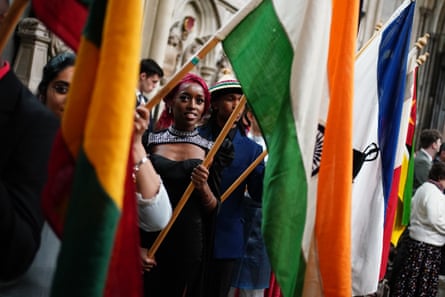
This asymmetry is reinforced by the hollowing out of the Commonwealth itself. Once imagined as a forum for post-colonial dialogue and shared responsibility, it now struggles to even define post-colonial relations. That the issue of reparations has not secured a place on the Commonwealth agenda speaks volumes about the institution’s limits when confronted with issues that challenge historical power hierarchies.
Immigration policy further exposes these contradictions. In recent years, the UK and parts of Europe – taking cues from the hardening of immigration regimes in the US – have allowed increasingly punitive approaches to migration, disproportionately affecting African, Caribbean and Latin American countries.
The rise of far-right politics has helped push immigration policy towards restriction and deterrence, fostering division at home while eroding the moral language of partnership and shared history that once underpinned relations with former colonies.
Many African and Caribbean countries continue to face stringent UK visa requirements despite shared histories and Commonwealth ties. This feels like a bitter irony: descendants of enslaved and colonised peoples encounter fortress borders from the very state that once claimed unrestricted access to their lands, labour and resources. Set against the disgraceful unresolved legacy of the Windrush scandal, visa restrictions deepen the sense that Britain’s post-imperial relationship with the Caribbean and Africa is increasingly transactional.
None of this means reparations are inevitable, or that agreement is imminent. The UK and Europe’s concerns – about fiscal precedent, political backlash and legal exposure – are real and will shape how the debate unfolds. But what 2025 has made clear is that reparations are no longer a marginal or episodic demand. They are being organised, internationalised and normalised as part of a broader reckoning with slavery, colonialism and global inequality.
The Caricom visit, the African Union’s Decade of Reparations and the growing alignment between Caribbean, African and diaspora voices all point in the same direction. Reparations or restorative justice, as The Big Payback makes clear, are not about dwelling in the past. They are about deciding what kind of future relationship Britain, as a former colonial power, is willing to create – one built on selective memory and managed silence, or one grounded in truth, repair and a willingness to confront the foundations on which modern Britain still stands.
Britain’s leaders say they want to look forward. The Caribbean and Africa are asking a more honest question: forward from where, and on whose terms?