3 months ago
130
3 months ago
130
Like many US hospitals, Pittsburgh Trauma Medical Center (PTMC) is a place where time melts away. Rain or shine, 1am or 1pm, everything is bathed in the same retina-frying fluorescent light. Wait times often exceed several hours; in the lobby is a barrage of all-caps warnings (“aggressive behavior will NOT be tolerated”), while several TVs play clips of a Deadliest Catch-style show in two-minute loops. Purgatory, it seems, looks a lot like an American hospital … as recreated on a soundstage in Burbank, California.
On the day I visit PTMC, the 52-bed ER on the Warner Bros lot, the hold-up is some babies. The infant actors are here to film a second season scene for The Pitt, the HBO Max medical drama that singlehandedly resuscitated the genre back from its Grey’s Anatomy flatline, swept almost every television award in the US and is now, finally, heading for the UK. (No bad blood, though: on set, I glimpse a flyer for a Pitt softball game against the crew of Seattle Grace.) Developed by the team behind 90s hospital hit ER, The Pitt follows a melange of hospital workers – the doctors, nurses, social workers, security and administrative staff of a cash-strapped emergency room in Pittsburgh – as they deal with everything from gunshot wounds to burnout, fentanyl overdoses to dreaded note-taking, with all the emotional trauma in between.
The show, which premiered in the US in January 2025, became a rare word-of-mouth hit on the strength of its dramatic hyperrealism: hour by hour, viewers endured the unvarnished chaos of a US hospital. A fast-paced, first-principles TV drama – what if, radical concept, you kept costs down by following the old broadcast model of single set and relatively unknown cast? – The Pitt pulled double hero duty: an economically viable show in a contracting Hollywood that believably celebrated healthcare workers. At once gritty and relentless, dissecting American social woes with many a bloody scalpel, the show “breaks through the cynicism of the sophisticated viewer”, says series lead Noah Wyle, as we meet under those glaring PTMC lights. With his travel mug of black coffee and a stethoscope round his neck, wearily explaining the pride of hiring a 400-plus crew in post-fires, post-strikes Los Angeles, the former ER star has the grizzled bearing of a tested paterfamilias; the line between the three-decade TV veteran and Dr Michael “Robby” Robinavitch, the Pitt’s beloved seen-it-all attending physician, appears vanishingly thin.
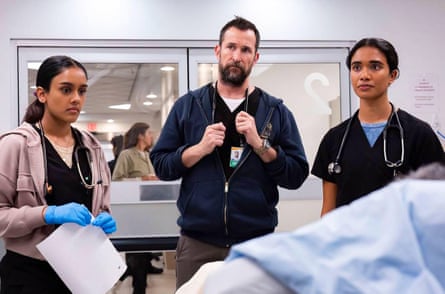
Once the babies are safely escorted out, I get to inspect the set: every drawer is fully stocked, every walkway realistically cluttered with beds, every drug bottle individually labelled (though filled with saline rather than morphine). “Everything we say, everything we touch, is done as authentically as possible,” Patrick Ball, a formerly unknown theatre actor now recognisable as the alarmingly handsome chief resident Frank Langdon, tells me of the set’s prodigious label-maker and real scrubs-cleaning machine. “That is a philosophy and a priority.”
Hollywood sets are generally surreal, but The Pitt has turned the blurring of reality and fiction into addictive healthcare agitprop. The set, modelled on the real Allegheny General in Pittsburgh, is an optical illusion of endless hallways with no dead ends; by lunch, I assume there is no way out. The show’s concept, one that rooted millions of US viewers to their couches, is that each season takes place across a single ER shift, every episode an hour in real time. My visit coincides with a particularly brutal one for Dana Evans, the sweet-and-salty charge nurse played to Emmy-winning effect by Katherine LaNasa. During this hour, Dana, like many healthcare professionals, is forced to restrain a physically aggressive patient – a commotion that forces Dr Robby and co to sprint across the set.
In between takes, LaNasa jogs on the spot to stay breathless (“It’s an exercise in respect for the profession, to try to do it accurately,” she says), while numerous extras, languishing as patients, scroll their phones. Cast and crew on The Pitt are nearly indistinguishable; everyone, including myself, wears scrubs. This is both a necessity for filming on a set full of reflective surfaces and a way to build, Wyle tells me, an “esprit de corps”: a sense that “we’re all in this together to tell this story and we’re going to commit to being here for the next nine months.”
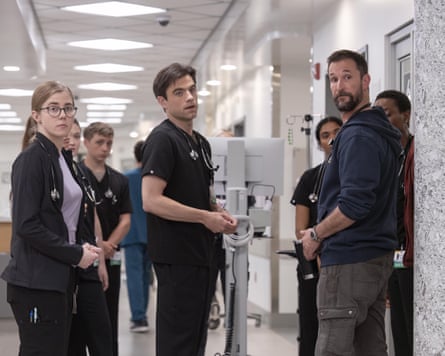
That sense of camaraderie and decency in the face of systemic decay is a large part of what has made The Pitt a surprise sensation in the country it so unglamorously depicts. The workers in the basement emergency room at PTMC (hence, “the Pitt”) may swear, spar, flirt, misjudge, tangle with belligerent patients or lose their cool. They may, in the case of Dr Robby, experience debilitating flashbacks to Covid. They may very relatably pass out at the sight of a “degloved foot” (don’t Google). They may be horrified by rats in the ER or furious with a vaccine sceptic. But they’re all trying their best to care for people – to keep, as Wyle puts it, “the light of humanity and decency and caring alive in what seem to be very dark times”.
The response has been largely ecstatic. Viewers, myself included, have gleefully strapped into the show’s rollercoaster rhythm, collage of American social ills – state abortion bans! medical racism! hospital profit motives! – and voyeuristic pleasures of, as LaNasa puts it, “the heartbreaking, disgusting and funny.” (People are even being challenged online to watch the 15-episode seasons in one sitting, as if living the worst ER shift of all time in solidarity.) Medical professionals such as my mother have heralded its accuracy and competency. The Emmys awarded it best drama over far more expensive, ambitious entries such as Severance, Andor and The White Lotus.
Now, both the newly launched second season and its first air for the first time in the UK (as part of the launch of streaming service HBO Max) – a country perhaps unfamiliar and understandably baffled by the capriciousness of privatised US healthcare, though no stranger to an overstretched health system struggling to cope. “These are really confusing times,” says Wyle. “And when you can tune in to something that feels vetted and representative of some semblance of reality, it’s like: ‘Oh, there’s a North Star.’ You can start to orient in a time where it’s very difficult to find your orientation.’”
“We don’t come at it from having read the headlines,” exec producer John Wells tells me. It comes, they say, from real-world experience and expertise. The writers’ room boasts two emergency room physicians, plus another four on set, as well as eight to 10 full-time nurses. “We’ve listened to what they say,” says Wells. “What are they concerned about? What are their worries? What are their fears?” Hence, a show that deals as sensitively with the methods for relieving impaction (Google, if you dare) as the very American problem of mass shootings. (The most eerie part of the set tour are the “blood mats” – plasticised rugs that mimic puddles of blood – to keep mass casualty filming mess to a minimum.)
One thing that healthcare providers in the US and UK do share? Lingering trauma from the Covid-19 pandemic, whose ripple effects are what inspired its creator R Scott Gemmill, Wells and Wyle to take a stab at a long-desired ER reboot. “I didn’t want to do [a medical drama]. John didn’t want to do it,” Gemmill tells me. But during Covid, when healthcare misinformation went, well, viral, “we started to talk to medical professionals, and a lot of them felt unheard. There wasn’t a show that was realistic.”
“The idea of messing up our own legacy [with ER] scared us enough that we went our separate ways for a full year,” Wyle recalls. “A lot of shows try to come back and reinvent themselves. There were a lot of reboots at that time. That wasn’t what we were interested in.” The first idea, catching up with Wyle’s ER character John Carter, fell apart in a dispute with Sherri Crichton, the wife of late creator Michael Crichton and executor of his estate. Crichton has since sued Warner Bros TV, Wells, Gemmill and Wyle on copyright grounds, claiming The Pitt is essentially a reboot of the 90s show – prompting Warner Bros to shoot back: “The lawsuit is baseless: The Pitt is no more a ‘derivative work’ of ER than is any other hospital drama.”
When I ask for an update, Wyle replies that “once I realised it wasn’t going to impede the ability to produce and do this show, I kind of stopped caring and let the Warner Brothers lawyers work all that out.” Still, he adds, “the most gratifying reviews we got were the ones that blasted in the headline: ‘This is not an ER reboot.’”
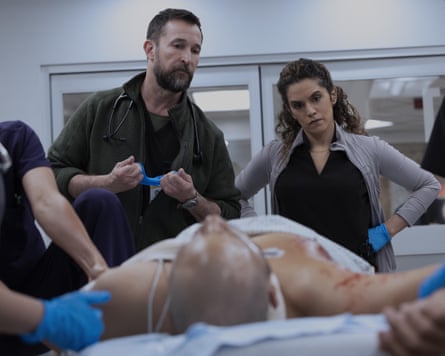
For what it’s worth, The Pitt has entirely new ground to cover – the encroachment of AI, the lingering trauma of Covid and, of course, the ongoing US political turmoil that has destabilised an already unwieldy healthcare system. I visit PTMC at the tail-end of a record government shutdown over health insurance subsidies that ended with premiums skyrocketing for more than 20 million people. The issue of insurance, the unaffordability of a single ER visit for most people in the richest and most medicalised country on Earth, underpins the second season. So, too, does anti-science scepticism and fractious relations between patients and providers, families and neighbours. But the makers of The Pitt insist this is a not a political statement.
“What we’ve tried to do is not be polemical. We’ve tried to be representational,” says Wyle. “It’s not about the issues as they get debated on television. It’s about the issues as they get borne out, in the reality of an emergency room in Pittsburgh.” You will see patients forced to make impossible choices between an exorbitant ER bill or forgoing care; you will not hear mentions of the president. “We’re trying not to be biased,” Wyle says. “We don’t want to turn viewers off by giving them the easy red meat of saying: ‘There you go, I knew they had to go there.’”
Back in the waiting room, I peruse the set’s ample literature: on patients’ rights, antibiotics and privacy, on “what to expect during your emergency stay” – the many small reassurances common to ERs and so rarely seen on TV. “We’re in an age with a lot of scepticism, and we’re cynical about the people who actually dedicate their lives to these kinds of jobs,” Wells later says. Nurses, doctors, social workers, janitors could all make more money or have less stress elsewhere, but they don’t. “They’re there” – and at PTMC, we’re there with them – “because they actually care about helping people.”
Season one of The Pitt is on HBO Max from 26 March, with season two episodes available weekly.