2 months ago
58
2 months ago
58
Soccer unites. This is what we are told. It swoops in, majestic in the players’ grace, and gives a people – any people – a thing to rally around in good times and bad. It’s true, that does happen on occasion. But other times, as in Monday’s 2-2 draw between Iran and New Zealand here in southern California, the magic of this ridiculously simple game lies in its power to make one, or several, or several thousand, forget.
Before the game, Iranians worldwide had been divided by decades of political and cultural difficulty and the Iran team were hamstrung by interrupted preparations for what should be the pinnacle of any players’ career.
After the final whistle, those same divisions and problems still existed. Perhaps, in some cases, they had become worse. But then there were those glorious intervening minutes, featuring four goals and numerous big chances, crunching tackles and passionate play, in front of a heaving, heavily partisan crowd in the city with the largest Iranian expat population in the United States. You got the sense that most within the stadium’s confines, to say nothing of the millions watching, were given a welcome dose of temporary amnesia.
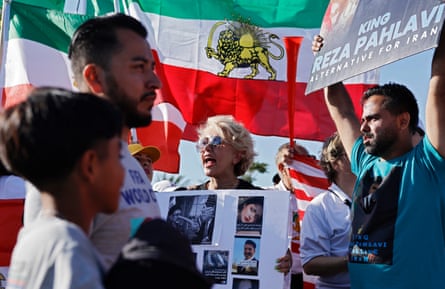
Several hours before that point, though, those deep and bitter divisions running through the country’s diaspora were obvious around the perimeter of the stadium. In their shirts and accessories, fans heading inside declared which Iran they were there to support.
Did they don the lion and sun flag, closely associated with the shah, or the modern version, with a stylized “Allah” written in script in the middle? Or did they do neither, obscuring the central element one way or another, writing over it, or simply choosing a clothing item that omitted the flag in favour of more neutral imagery? All could be seen in numbers.
A protester with a megaphone outside a western entrance spent hours telling passersby that the team was an instrument of the Iranian Revolutionary Guards, that they represented terrorists. On the east side, a larger group, reportedly numbering about 200 or so, shouted similar slogans at those entering. Behind them flew lion-and-sun Iran flags from pre-revolution times, with one adorned with “MAKE IRAN GREAT AGAIN”. Others nearby flew a combined US/Israel flag. There were arguments and some small scuffles were captured on phones.
That geopolitical conflict made buildup to the match more fraught than perhaps any other in World Cup history. Iran had planned to train for the tournament in Tucson, Arizona before group games in Los Angeles and Seattle. The outbreak of hostilities threw their participation in the tournament into doubt. Iran changed their training plan’s viability once it was determined they would play on.
After a hasty switch to Tijuana, Mexico, 15 members of Iran’s delegation were denied visas to enter the United States. That number was reduced to 11 before their opening game, but still included their entire media relations staff, some analysts and the federation president, Mehdi Taj. US officials said the visas were denied to ensure the Iranian team did not “sneak terrorists into the United States”.
“This kind of tension undermines that joy [of a World Cup],” said the striker and captain Mehdi Taremi. “This World Cup could have provided a better atmosphere than it has.”
But then the stadium filled and soon provided among the best atmospheres of the tournament. While boos and jeers during Iran’s national anthem were loud enough to obscure the audio track as players sang along, there was no such conflict when Ramin Rezaiean scored Iran’s opening goal. It elicited a single cacophonous roar, trailing for several minutes after the strike and raising the intensity level considerably.
It was the first of two huge moments in a man-of-the-match performance for Rezaiean, who can now be considered something of a World Cup hero for the country, having scored the game-sealing goal in 2022’s group-stage win against Wales.
Afterwards, though, the questions were about what came before – the anthem, the booing and how Rezaiean felt. “Everyone in the world now knows about my people,” he said. “If there is any problem between us? This is our business, is none of your business. I respect you, but this is something between us, and we’re going to settle it.”
With a few hours to go before the match, a local court upheld Fifa’s ban on displaying Iran’s pre-revolutionary flag at the game. Videos on social media showed a few instances of stadium security confiscating lion-and-sun insignias, but they remained numerous and obvious. In pockets of the crowd, some were waved after each of New Zealand’s two well-taken goals.
But the vast majority, including some of those same pockets, waved them in the air exuberantly after goals; Mohammad Mohebi’s well-placed header off a pinpoint Rezaiean cross to equalize for the second time in the 64th minute set off wild celebrations on the field.
“We are enjoying [celebrating goals], just like since we were six years old, seven years old, 10 years old,” Taremi said. “We just follow the football and we’re always looking for the football, which is so important for us, more than everything. When you score, when your team scores, you celebrate and it’s a lot of joy, and we want to bring this joy for our supporters too.”
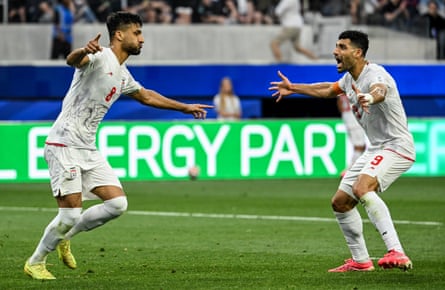
Despite a game that had provided joy for large portions, Taremi’s thoughts were elsewhere. In the locker room was the Fifa president, Gianni Infantino, telling them they had performed well and reminding them that their circumstances had been difficult.
Then another reality check: the team was told that instead of staying in Los Angeles that night, as expected, they would be heading back to Tijuana. “They are making the situation more and more difficult, more hurdles, but we’re not going to let that stop us from doing our best,” the head coach, Amir Ghalenoei said. “Everything is like disaster for us,” said Taremi.
Iran has continued to thrive despite periods of political and cultural unrest at home and sanctions damaging the economy from abroad. They have qualified for four consecutive World Cups, usually with some comfort. But on the big stage they have often wilted, or fallen agonizingly short of a first appearance in the knockout round.
Monday’s game offered the best chance they have had to put that run behind them. Three points would have given them a solid foothold for a spot as one of the eight best third-place teams.
On Monday, Iran indulged in that hope and allowed others to forget anything else.