3 months ago
138
3 months ago
138
Israel is running a parallel system of controls for shipments into Gaza, allowing commercial traders to bring goods into the territory that are barred for humanitarian organisations.
Basic life-saving supplies including generators and tent poles are on a long Israeli blacklist of “dual-use” items. The Israeli government says entry of these items must be severely restricted because they could be exploited by Hamas or other armed groups for military ends.
However, for at least a month, Israeli authorities have allowed businesses to transport multiple dual-use items into Gaza, including generators and metal pallets, which are more durable in winter rains and mud than wooden alternatives.
These are now on sale in the open market in Gaza, according to military, diplomatic and humanitarian sources. They must pass through the same three tightly controlled Israeli checkpoints that currently bar shipments of these goods for aid organisations.
“It seems highly improbable that the Israelis don’t know about them,” said one diplomatic source. “It’s very shocking that these things are able to enter through commercial channels.”
The disparity limits the work of humanitarian organisations supporting Palestinians at a time of desperate need, while providing lucrative opportunities to commercial traders who can secure import permits from Israeli authorities.
The American commander of a new US base in southern Israel has been briefed on such dual-use restrictions. Lt Gen Patrick Frank has discussed the controls with diplomats and humanitarians at the Civil-Military Coordination Center (CMCC), which was established in October to monitor the Donald Trump-brokered ceasefire and plan for Gaza’s future. His views on the matter are not known.
Israel has a long track record of exploiting access to Gaza to further its political goals, said Tania Hary, executive director of Gisha, an Israeli human rights group that has been monitoring controls for 20 years.
“On the surface the private sector [shipments of items on the dual-use list] can appear to be very confusing and an inconsistency,” she said. “But I see it as very consistent with their policy of trying to strengthen the hand of certain actors and weaken the hand of others.”
Entry controls on items such as generators did not reflect “the inherent risk or danger of the item itself”, she said. “It’s a question of: whose hands is it in? Where is it? How is it being used?”
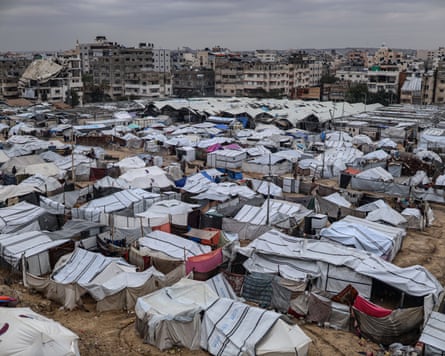
Israeli restrictions have long made trade into Gaza particularly lucrative for those Palestinians and Israelis who can secure permits. Items on the dual-use list now sell for huge premiums inside Gaza.
“The only way to get a generator right now is on the private sector,” said Sam Rose, acting director for Gaza for Unrwa, the UN agency for Palestinian refugees. “There’s a mark up on that.”
“My understanding is that it is the business interests on all sides – Israeli, Egyptian, Palestinian – with some of the security companies that enjoy Israeli protection also taking a cut alongside other criminal elements, all in all supporting the growth of an illegal economy,” Rose added. “What’s not clear to me is whether Hamas is getting a cut. I would assume so but have not seen any confirmation of this.”
Ahmed Alkhatib, a resident fellow at the Atlantic Council, said that when it came to commercial deliveries into Gaza, “You’re not just paying fees and taxes to Hamas in Gaza, you’re paying fees and taxes to merchants on the Israeli side. We all know that Gaza was and will always be a massive market for the Israeli economy.”
Cogat, the Israeli defence ministry unit that controls access to Gaza, denied “preventing or delaying” aid shipments into Gaza or applying looser restrictions for commercial traders.
“The policy governing the entry of aid into the Gaza Strip is approved by the political echelon in Israel and implemented by Cogat in a uniform manner vis-a-vis the UN, international organisations, donor countries, and the private sector,” a spokesperson said in a statement.
For dual-use items, Israel “offers international organisations alternatives that allow and facilitate a humanitarian response”, the statement said, without providing any details. Spokesperson Shimi Zuaretz also said medical aid organisations had been given permits to bring generators into Gaza “over the last month”.
The Israeli military referred questions about aid shipments into Gaza to Cogat. The US military declined to comment.
The shipment controls are the latest instance of Israel weaponising aid for political and military goals in Gaza. Over the summer Israel caused a famine in parts of the territory by blocking food shipments for weeks, then allowing only a trickle of aid to enter, killing hundreds of people.
Israel this week told 37 NGOs active in Gaza they would have to cease all operations within 60 days, unless they hand over detailed information on their Palestinian staff.
Diplomats and humanitarian officials have said that stopping the work of the NGOs listed would have catastrophic consequences and put Palestinian lives at risk.
“The EU has been clear: the NGO registration law cannot be implemented in its current form,” the EU humanitarian chief, Hadja Lahbib, posted on social media. “IHL [international humanitarian law] leaves no room for doubt: aid must reach those in need.”
“The reality is that the commercial sector can bring in what it wants [now],” said Rose. “Items not approved for humanitarian organisations, such as generators, are available commercially. So we have a two-tier system, which is undermining the UN-led system, which Israel is required to support as per international law.”
US forces deployed to the CMCC arrived in October prepared to launch a major logistics effort to get aid supplies into Gaza.
They were surprised and confused to find the biggest challenge was political, and began clashing with Israeli counterparts over some of the restrictions almost immediately, said multiple sources briefed on meetings at the base.
An early confrontation was over tent poles. Shelter is a critical need as winter sets in because Israeli attacks have destroyed nine out of 10 Palestinian homes, but Israel deems metal tent poles needed for sturdy winter-proof tents “dual use”.
US officers at the CMCC rapidly drew up a list of at least a dozen key humanitarian items they wanted removed from the dual-use list, with tent poles near the top. Weeks later Israel has not lifted restrictions on any of them.
“It is clearly not security interests that are driving decision-making here,” said one western source. “The dual-use list is just another way to control what enters Gaza.”
Restrictions on the type and quantity of goods allowed into Gaza long preceded the current war. Israel withdrew troops and settlers from the territory in 2005 but maintained effective control of the borders and used that to impose a blockade.
“It has always been a form of control over the wellbeing of the population,” said the Gisha director, Hary. “Whether that’s the bare minimum of humanitarian standards we are looking at now, or in previous years in terms of economic life, construction, industry, development in technology and agriculture and innovation.”
The dual-use list, which requires a security assessment and permits to import items to Gaza, has been a particular concern since it was introduced.
It is sweeping in its scope, secret until an item is rejected and has been imposed arbitrarily. Older versions obtained by Gisha through legal action include categories such as “communications equipment” – so broad it could cover most modern electronics.
Items barred on dual-use grounds over the last two years include solar panels, smoke detectors, crutches, wheelchairs and walkers.
Aid groups have collaborated to compile an unofficial list of rejected items in an effort to limit the amount of time and money spent applying to import things that are unlikely to get approval. But it is time consuming.
International pressure on Israel over the dual-use list has also flagged over the last two years, and even with the creation of the CMCC.
Diplomats are concerned about spiralling violence in the West Bank and uncertainty about long-term plans for Gaza’s reconstruction, as aid groups are negotiating possible de-registration by Israel.
The dual-use list is not the only bureaucratic obstacle limiting the flow of humanitarian aid into Gaza. Some items are banned because Israel has decided they don’t address urgent humanitarian needs.
This category includes paper and pencils to restart schools after two years without education for 600,000 children, and frozen beef and mutton to feed a malnourished population. Aid organisations have been limited to chicken while commercial traders have been able to bring in all kinds of meat.
The limited number of crossings into Gaza and their hours of operation, as well as delays approving routes for convoys inside the territory – which is vital to ensuring they do not come under Israeli attack – all serve to slow the entry of vital supplies.
Overall flows of aid into Gaza are well below levels agreed under the ceasefire, data provided by the Israeli military and analysed by the Associated Press showed.
Food shipments have increased enough to stave off famine, but hunger is still widespread, UN-backed food security experts said last week. About 1.6 million people were expected to face “crisis” levels of hunger in the next four months and if the ceasefire broke down, the territory could slip back into famine.
Winter weather and lack of shelter are exacerbating the impact of long-term malnutrition, particularly on young children. At least three have been killed by hypothermia this month, the UN said.