2 months ago
93
2 months ago
93
I’ll admit to being a bit of a wine cooler sceptic – at home, at least. Don’t get me wrong: I love a crisp, cool glass as much as the next summer rosé guzzler. The temperature at which we serve wine is important, but I’m wary of any inessential gadgetry that threatens to take up prime real estate in my already cluttered kitchen.
What’s more, wine coolers are misleadingly named. In most cases, they don’t actually cool a bottle of wine – ie, bring down its temperature – but maintain it. This is the point of one on a restaurant table; for those who order a bottle (admittedly a dying breed), it can be kept at a relatively consistent temperature for the duration of their meal. For everyday drinking at home indoors, however, there isn’t much need for a cooler – we can keep returning the bottle to the fridge in between pours. But as picnic season approaches, coolers can come into their own. No one wants to ruin the romance of alfresco dining with warm wine. And bringing a wine cooler to a picnic definitely shows you mean business.
With all that in mind, I spent a few weeks using and testing a dozen different wine coolers on a bottle of fridge-cold wine. They come in all shapes and sizes – some championing style, others substance; some do both, others neither. Which one of the 12, if any, could change my opinion of coolers? Which do the best job of maintaining temperature? And which are attractive enough as objects in their own right?
As a cooler doubter, who tends to drink wine with people who will see off a bottle pretty quickly (arguably making a cooler unnecessary), I like to think I was well placed to assess not just which performs the best, but whether you need one at all. I’ve assessed their efficacy (whether they kept wine at a consistent temperature and, if not, how quickly they warmed up), practicality, aesthetic appeal and, where relevant, their ability to do more than keep wine cool – doubling up as an ice bucket, for example.
At a glance
-
Best wine cooler for hosting and overall:
Peugeot Equilibreur
-
Best wine cooler for a picnic:
Le Creuset sleeve
-
Best wine cooler for garden dining:
Yeti Rambler
-
Best cooler for wine nerds:
Caso Design VinoCase
Why you should trust me
The short answer? I drink a lot of wine. The longer answer is that I’m a food and drink writer with more than 15 years and this paper’s wine columnist; I’ve also written wine lists for a couple of restaurants and have my Wine & Spirit Education Trust qualifications up to level 3. There aren’t many things I love more than a glass of something perfectly chilled, particularly on a summer’s day, and although I can’t say that I’m exacting about temperature (I don’t generally carry a wine thermometer in my bag like Beyoncé carries hot sauce), I would rather not drink than have a glass of wine that’s lukewarm and flabby. I deserve better, and so does the wine.
How I tested
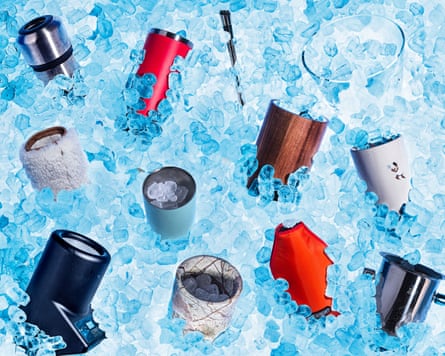
I tested 12 coolers that not only looked very different, but also used different “technologies” to keep the wine’s temperature down, from vacuum insulation systems to good old-fashioned sheepskin. As someone who invariably avoids superfluous, overcomplicated kitchen kit, the lo-fi options appealed to me most aesthetically – the simple marble number from H&M or that irresistibly cute woollen pouch.
That said, I wouldn’t bother owning a cooler unless it really worked, so my testing was an exercise in weighing up form against function. I was inclined to like anything that looked thoughtfully designed yet sturdy and practical – such as the Yeti – but already had, and loved, the Le Creuset sleeve (and knew it would take a lot to convince me to buy anything else).
Beyond aesthetics, a wine cooler clearly has to keep wine cool. I tested the temperature of a glass of wine straight from the refrigerated bottle, then again after one and two hours in the cooler (surely the longest anyone would have any wine left in a bottle). My benchmark for effectiveness was the rate at which a “control” bottle of fridge-cold wine warmed up without any cooler: 7C in two hours.
I tested the coolers on wines that (1) I hanker for in warm weather and (2) I like to be served well chilled, between 8 and 10C. (Coincidentally, they were all Spanish, such as a Basque txakoli and a Catalan rosé.)
Because the wine didn’t always come out of the fridge at exactly the same temperature (I keep my fridge at 8C, but wine kept in the door tends to emerge closer to 9 to 10C), I measured the interval at which the wine temperature increased rather than comparing the temperatures like for like.
The major limitation to my testing was that I did it all in mercurial mid-April, during which the weather swung from chilly and layer-demanding days to blue sky and 25C temperatures. To keep the testing conditions as consistent as possible, I did it all inside my kitchen, where the temperature sits at roughly 18C.
The best wine coolers
Best wine cooler for hosting and overall:
Peugeot Equilibreur temperature-balancing wine cooler
Peugeot
Equilibreur temperature-balancing wine cooler
from £47
What we love
Pretty as a peach. Keeps wine cool – sometimes even cools it
What we don’t love
Scraping the barrel here … but might need polishing
★★★★★
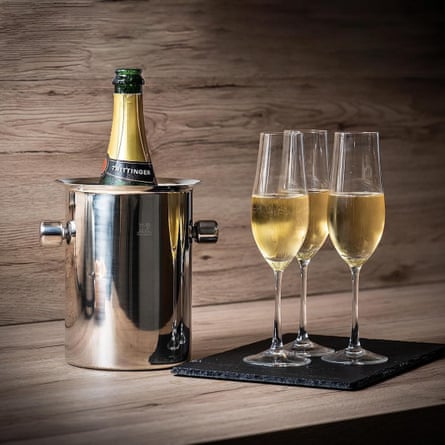
Not just a pretty face, this elegant cooler is secretly very clever, and it did a great job of keeping the temperature down. It’s safe to say that Peugeot – yes, that Peugeot – is stronger on kitchenware aesthetics than those of cars (with apologies to my first car, a Peugeot 306: Audrey, you were lovely).
Why we love it
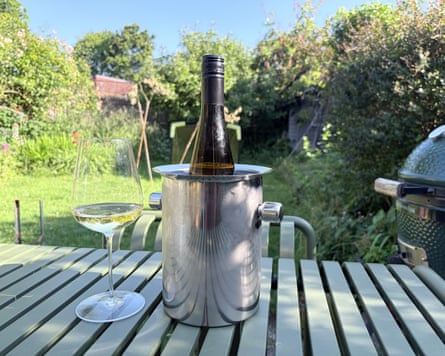
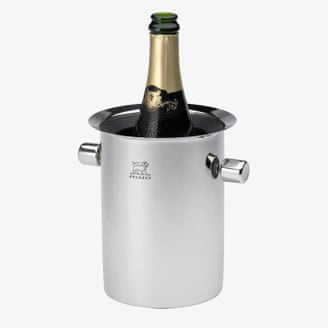
It might look like a fairly classic silver ice bucket – elegant and chrome-plated, gleaming in candlelight and with pleasingly ergonomic handles – but this cooler in fact has four hidden (and removable) ice packs built into the walls, which cool the wine indirectly. Between those ice packs and your bottle, there’s a liner, meaning the cooling is gentler.
This was the most consistent lo-fi cooler of the bunch (by “lo-fi”, I mean those that don’t use power). While testing in my cool-ish home kitchen, it actually made my wine 2C cooler during the first hour. This gives me confidence that, if it were taken outside into warm sunshine, it would have held a more consistent temperature.
Lastly, to my taste, it’s the looker of the bunch – a beautiful, timeless cooler, which is easy to clean.
It’s a shame that … you have to think ahead to freezing those inserts.
Peugeot
Equilibreur temperature-balancing wine cooler
from £47
What we love
Pretty as a peach. Keeps wine cool – sometimes even cools it
What we don’t love
Scraping the barrel here … but might need polishing
Best wine cooler for a picnic:
Le Creuset wine cooler sleeve
Le Creuset
Wine cooler sleeve
from £21
What we love
Affordable, easily stored and actively cools wine
What we don’t love
Wine cooling’s answer to a face for radio
★★★★★
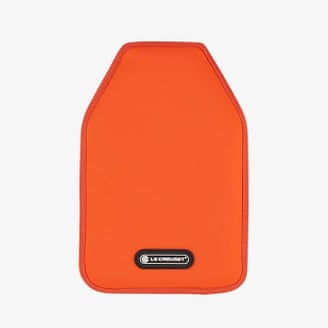
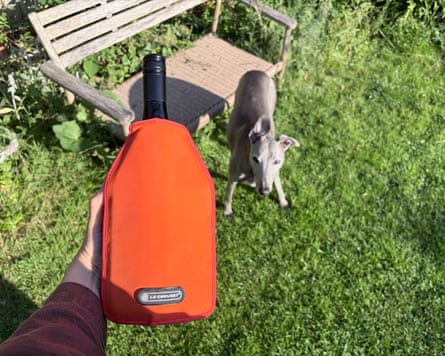
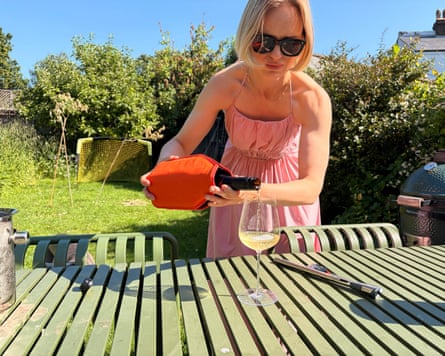
This was the only “cooler” I owned before this test. It’s light, easily stored and carried, and keeps wine cool for hours. It’s also a natty little number to keep in your freezer for the times you need to rapidly chill a room-temp bottle.
Why we love it
Much like me, this one is padded and practical. Like my penchant for Crocs, it’s one of those things that heralds my move into motherhood and middle age, and I’m fine with that. If you’re unwilling to compromise on cool wine, and are looking for a no-nonsense cooler that (1) doesn’t take up loads of space, (2) doesn’t involve much planning (beyond shoving it in the freezer), and (3) reduces the temperature rather than just maintaining it, this one’s for you.
I had perfectly chilled wine for two hours – and my bet is that it would’ve stayed acceptably cool for at least another hour. The sleeve is stored in the freezer, where its “active cooling gel and tapered insulation” gets super cold and ready to impart chill to bottles of most shapes and sizes, made possible by elastic panels between the two main gel sections.
Like the Peugeot cooler, it actively cooled down the wine in my kitchen (dropping 2C in the first hour), but stayed well within the recommended serving temperature range for txakoli. And again, if used outside on a warm day, this may not have happened at all. During the two-hour testing window, the temperature of my wine increased by only 0.6C while in the sleeve.
This sleeve is also a multitasker: in my “real”, non-testing life, I’ll often pop it over a room-temperature bottle to speed up cooling in the fridge – I tested this again and can verify that a warm bottle of wine gets to the perfect temperature after 30-40 minutes.
It’s a shame that … it’s not more of a looker. If you’re into tablescaping, this is probably not the one for you. But if properly chilled wine – or making room-temp wine cold, fast – is your priority, you’ll be thrilled. I still think it’s the only cooler I need.
Le Creuset
Wine cooler sleeve
from £21
What we love
Affordable, easily stored and actively cools wine
What we don’t love
Wine cooling’s answer to a face for radio
Best wine cooler for garden dining:
Yeti Rambler wine chiller
Yeti
Rambler wine chiller
from £70
What we love
Robust and could double as an enormous drinking vessel
What we don’t love
On the spenny side and a bit chunky

★★★★☆
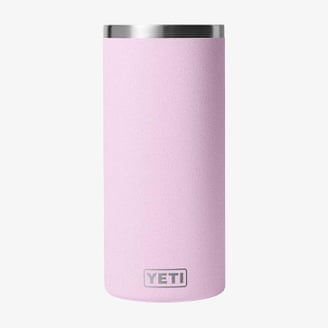
As someone who avoids bells and whistles in the realm of kitchen kit, I appreciated this straightforwardly effective, durable and good-looking vacuum cooler. It’s also dishwasher safe.
Why we love it
Consistent with my experience of Yeti products, this is really outdoors-friendly. Despite the deceptively simple design, there’s a lot of attention to detail, such as the “silicone landing pad” that sits on its interior base and avoids wine bottle clatter and insulation that minimises condensation (and avoids a wet table). It also comes in various smart colours.
Like the majority of coolers I tested, this one works on the same principle as Thermos flasks: double-wall vacuum insulation. Because there is so little air in the vacuum, there is minimal heat transfer: heat from outside can’t easily get in, and cold from inside can’t easily escape. This mechanism isn’t unique to Yeti, but of all the vacuum insulators, this one slowed temperature rise the most in my tests. Over two hours, I saw only a 2.5C rise. It’s possible to prechill this cooler in the fridge; I didn’t do this, but if I had, I’d anticipate even better results.
It’s a shame that … it’s rather big, so hard to store – especially as outdoorsy coolers like this are hardly everyday pieces of kit. Yeti also commands hefty prices.
Yeti
Rambler wine chiller
from £70
What we love
Robust and could double as an enormous drinking vessel
What we don’t love
On the spenny side and a bit chunky
Best cooler for wine nerds:
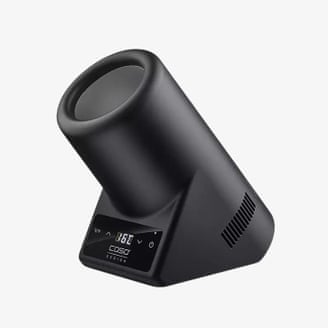
Caso Design VinoCase tabletop wine cooler
Caso Design
VinoCase tabletop wine cooler
from £109.99
What we love
Extremely effective at keeping wine cool
What we don’t love
Ugly; noisy; expensive
★★★☆☆
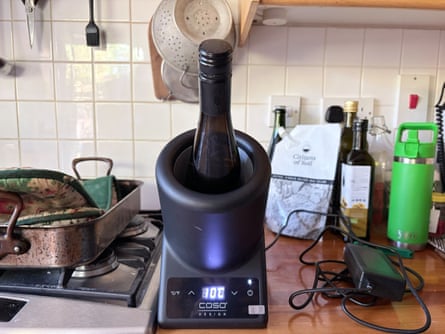
I’m not 100% comfortable with choosing this as one of the best, because I kind of hate it. A plug-in, noisy monstrosity – but in my tests, it did the best job of maintaining wine at a consistent temperature of any other cooler I tried.
Why we love it
It’s easy to use: you plug it into the wall, switch it on and set the temperature to the one you want. This is a great option if you take an exacting approach to wine serving temperature – champagne at 8C, say, or burgundy at 11C – and want to maintain those bottles at those temperatures for the duration of drinking. The electronic nature of it probably precludes having the bottle on the dining table, however, and you may want to have a muzak playlist at the ready to drown out the cooling din.
The numbers speak for themselves. The wine started at 10C. An hour later, it was 10.2C. After another hour, it was 10.1C. There’s no doubt that it works. But it’s a bit Patrick Bateman for my liking. At a stretch, it could double up as a white noise machine for any sleepless small children in your life.
It’s a shame that … it looks awful, needs to be plugged in, and it’s noisy.
Caso Design
VinoCase tabletop wine cooler
from £109.99
What we love
Extremely effective at keeping wine cool
What we don’t love
Ugly; noisy; expensive
The rest of the test (from best to worst)

The Dartmoor Shepherd sheepskin wine cooler
The Dartmoor Shepherd
Sheepskin wine cooler
£28
★★★☆☆
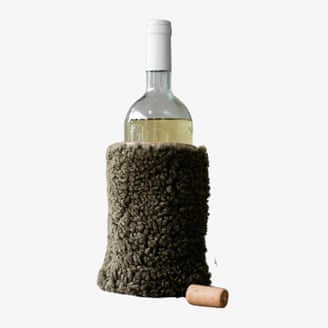
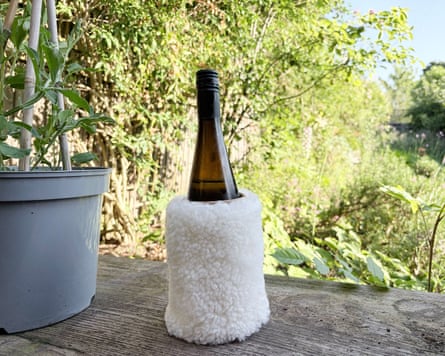
My children are out of cute baby clothes now – and fully into their KPop Demon Hunters merch era – but no matter! I can dress my wine in adorable sheepskin instead! The sight of this little woollen pouch made me coo, and I was really interested to test it, knowing that wool – as the website promises – “is a natural bio-insulation and retains the cold air in the cooler”.
Dartmoor Shepherd promises that its cooler keeps a chilled bottle of wine cool for up to four hours. I’m afraid that wasn’t the case in my tests: it jumped up by 2.7C in the first hour and 3.3C in the second. Breaking news: wool is cosy. I do think this cooler is adorable, though. It’s not offensively priced, and it will also help keep wine bottles safe in transport – while slowing temperature rise somewhat.
The Dartmoor Shepherd
Sheepskin wine cooler
£28
Nude glacier wine cooler
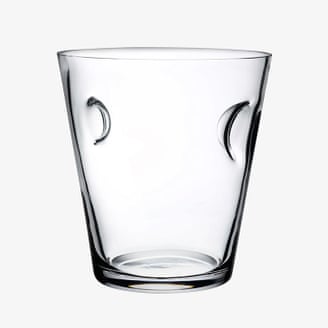
Nude
Glacier wine cooler
£65
★★★☆☆
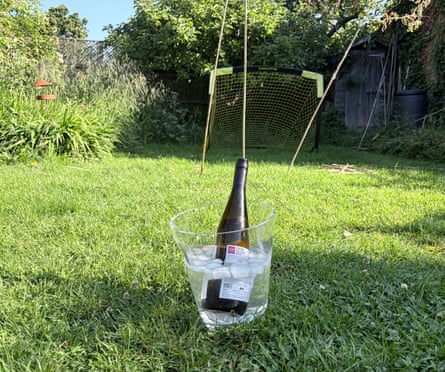
This is, in essence, a classic, bog-standard wine bucket, but made of glass with curved indentations on either side to make it easier to carry. My test revealed that this mode of chilling wine actually makes it too cold. I half-filled the cooler with iced water before adding the wine bottle. It dropped wine that was already at the lower end of the recommended serving temperature (8C) by a further 2C in the first hour of my test – too chilly.
For the record, I really like the Nude brand – it makes fabulous glassware and drinking vessels – but if you want to shock-chill your wine in this way, you don’t need to spend £65 on a pretty basic piece of chunky glass.
Nude
Glacier wine cooler
£65
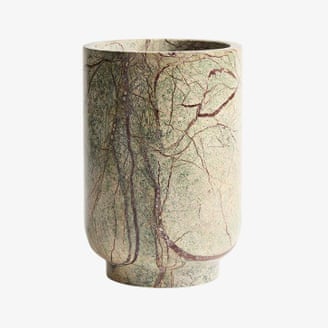
H&M marble wine cooler
H&M
Marble wine cooler
£39.99
★★★☆☆
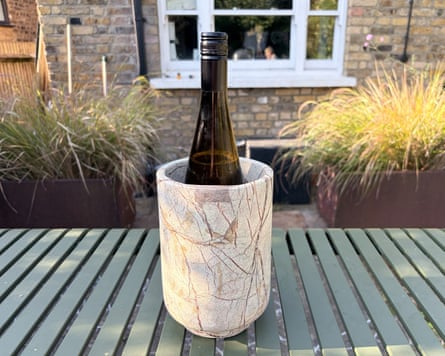
This looks gorgeous – a piece of beautifully curved, dark green and neutral-toned heavy marble – and is a great price. I recommend it if you’re embarrassed by the wine you’re serving! But it did little to slow the temperature rise in my tests. I found it a little more effective than the Alexandra Browne ceramic number, confirming that marble is a marginally better material for these purposes – particularly if you’re able to prechill it in the fridge. Because marble is more conductive, it will transfer chill to your bottle a little quicker. For testing, I relied on the marble’s natural “stone cellar effect” and used it from room temperature – as I did with all the coolers that didn’t involve ice packs.
H&M
Marble wine cooler
£39.99
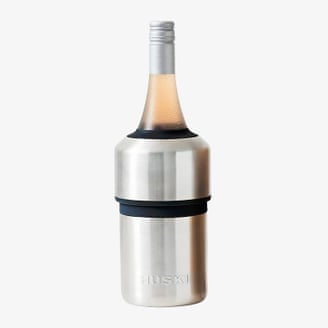
Huski wine cooler
Huski
Wine cooler
from £44.99
★★★☆☆
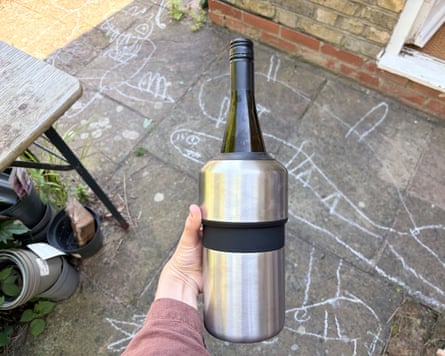
I had high hopes for this one. I was expecting it to be like the Yeti on steroids – practical, sleek and robust but with superior functionality (see below), and also a lid that, in theory, minimises heat entering from above. It has “triple insulation” – as well as the double-wall vacuum, there is a copper layer that reflects radiant heat, so there’s another barrier to heat transfer. On this basis, I was genuinely surprised by the results in my tests: in two hours, its Yeti competitor kept the wine almost a whole degree cooler. After two hours, my txakoli was nearly 3.5C warmer than when it went into the cooler, which was disappointing given all those layers of insulation.
Huski
Wine cooler
from £44.99
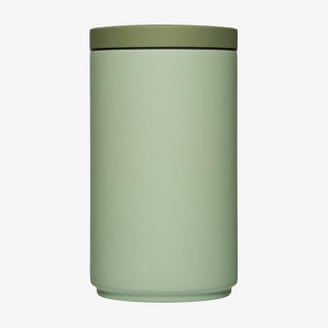
Design Letters wine cooler
Design Letters
Ice bucket/wine cooler
£41.90
★★☆☆☆
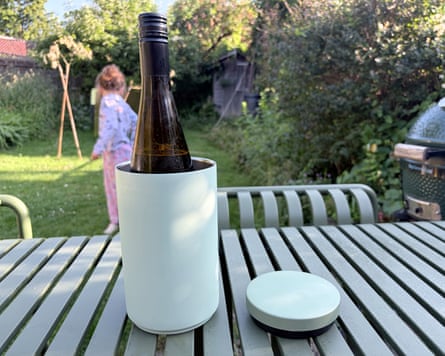
To look at, this has something of a posh biscuit tin about it, giving snazzy airtight storage in two tones of green. I was primed to like this because it doubles up as an ice box, and your girl loves a multitasker. I didn’t test its ice box functionality, but it’s fairly underwhelming as a wine cooler. It works on the vacuum insulation premise, but had nothing like the efficacy of the Yeti in my test: my wine’s temperature increased by 4.6C in two hours.
Design Letters
Ice bucket/wine cooler
£41.90
AdHoc wine cooler
AdHoc
Wine cooler
from £39.99
★★☆☆☆
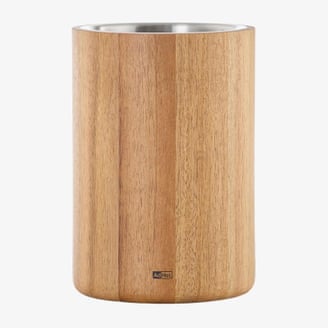
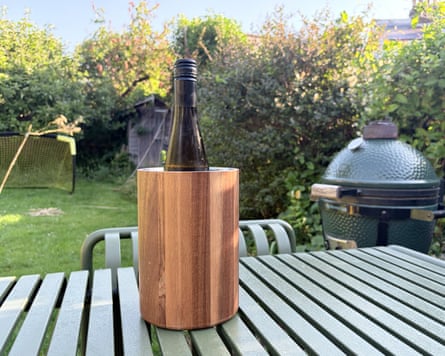
This would look as lovely as the H&M marble number on a beautifully laid table. It’s carved from acacia wood and lined with stainless steel, which also makes it double-walled – there’s no vacuum here. It’s elegant to look at, but it was pretty ineffective in my tests: the wine came out of the fridge at 10C and emerged two hours later at more than 14.5C. Meh.
AdHoc
Wine cooler
from £39.99
Alexandra Browne Wimbledon wine cooler
Alexandra Browne
Wimbledon wine cooler
£84
★☆☆☆☆
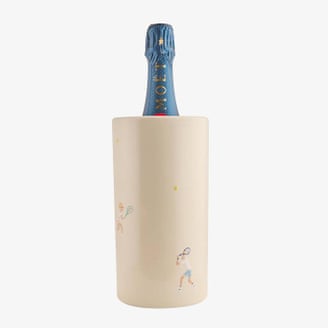
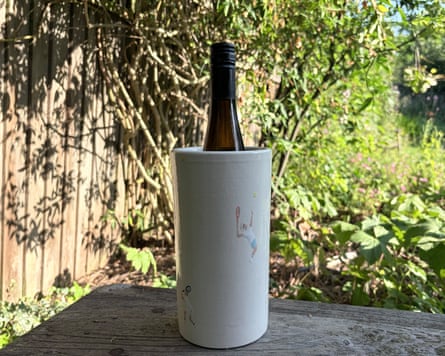
Sweet, twee and eminently breakable, this ceramic cooler is tastefully adorned with miniature images of tennis players. Make sure you have a good (cool) first serve, because it didn’t keep wine cool for long in my tests. To be fair, nowhere on Glassette’s website does it make any promise to maintain the temperature of your wine (beyond its name). Which is a good thing, because in my tests the wine increased by more than 7C in two hours. Game, set, match to the elements.
Alexandra Browne
Wimbledon wine cooler
£84
Uberstar wine chill stick
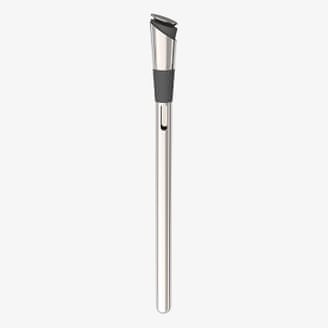
Uberstar
Stainless steel wine chill stick
from £22.99

★☆☆☆☆
This was the last of three frozen coolers here, and I was amazed by how useless it was in my tests. It didn’t appeal to my aesthetic sensibilities from the off, but I gave it the time of day – and was curious about its claim to be a three-in-one tool: a cooler, a bottle stopper and a pourer. You detach the cooling stick from the bottle stop/pourer attachment and freeze it for two hours. You then reunite them and put them in your wine, which – the website says – you can do from room temperature. I was testing from fridge temperature and saw an increase of more than 7C in two hours. This is stuff I don’t need.
Uberstar
Stainless steel wine chill stick
from £22.99
What you need to know
What is the ideal temperature for serving wine?
I’ve spent quite a bit of time talking about wine being cold. The aspiration of this process was, after all, to find coolers that maintained a desirably low temperature for wines we generally like to drink cool. But I’d briefly like to confuse matters by saying that, often, we drink them cooler than strictly necessary.
It is typically recommended that txakoli – the northern Spanish wine I used for this test – should be served somewhere between 7 and 10C. The same goes for other light white wines – say, vinho verde, pinot grigio or sauvignon blanc – and any that, quite frankly, aren’t fantastic. Sometimes a very cool temperature goes some way to mask flavour. That is why it’s often better to enjoy more complex wines a little warmer – say, somewhere between 10 and 13C; I’d recommend this for the likes of white burgundy, for example, or if you’re lucky, vintage champagnes. I’d also recommend it for fuller-bodied wines – rosé, skin contact, blouge, chilled reds or white wines with a bit of oak.
I took all of this into account with my testing. None of the coolers that allowed my wine to increase beyond 13C over two hours made the cut as one of the best.
Looking for some great low-alcohol alternatives? Read our guides to the best no-alcohol wines and the best mid-strength wines, beers and spirits
Mina Holland is a London-based food and drink writer and editor (@minaholland)