3 months ago
202
3 months ago
202
When it last changed hands, in 2020, 2-8A Rutland Gate was Britain’s most expensive house, selling for £210m. The word “house” hardly does it justice; palace is probably more accurate. It is in Knightsbridge, one of the most glamorous parts of London, and has 45 rooms, four lifts, an indoor pool and 116 windows, 68 of which overlook Hyde Park.
But no one is enjoying those views. This palace has been empty for years.
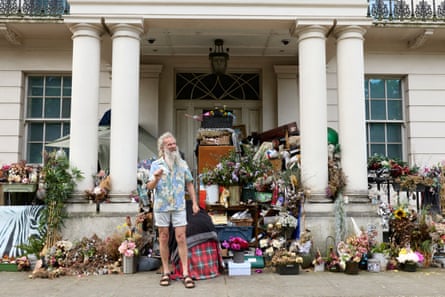
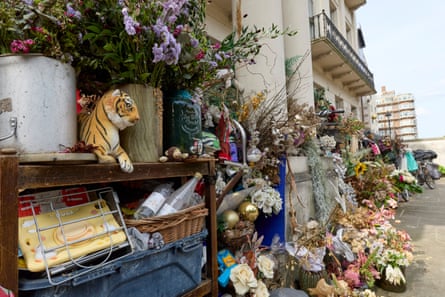
There may not be anyone inside, but there is someone outside – just outside – and I’m afraid I’ve woken him up. On the porch is a makeshift tent, made mostly from umbrellas. A bearded head emerges, a little bleary, but cheerful. The porch is filled with stuff, which spills out along the railings: baskets, books and newspapers, pictures, teddy bears, games, a couple of bicycles, lots of flowers in vases, pots and bins.
Through the grand door on the porch, the 24 marble bathrooms were once decorated with semi-precious stones. Now, Anders Fernstedt, who has lived on this porch for three years, has to pee into a plastic bottle. “Everest base camp problems,” he says. “One has to be clever enough so as not to get out of the bloody tent every time.” I give him some privacy, so he can prepare to tell me more about his life.
The property looks not so much like a house, but a row of houses. The address sounds like a row of houses, too. Indeed, it was a row of houses, until the early 1980s, when they were bought by the billionaire Rafik Hariri, who was soon to be the prime minister of Lebanon. Hariri, who had made his fortune building palaces for the royal family in Saudi Arabia, knocked the Rutland Gate houses together to make his own London palace. Here, he lived like a king – even the wastepaper bins were covered in 24-carat gold leaf – until his assassination by a truck bomb in Beirut in 2005.
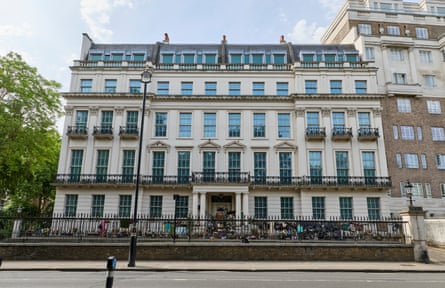
My former colleague Rupert Neate researched and wrote an authoritative piece about 2-8A Rutland Gate in 2023, when he was the Guardian’s wealth correspondent. He dug deep into the history of the building and the site on which it stands, going back to the 1750s, when the landed gentry were moving in to the area and the Duke of Rutland built a Palladian-style mansion here.
Rutland House was pulled down in 1836 and replaced by a row of terrace houses as London’s property boom was beginning in earnest, fuelled by ill-gotten colonial wealth. That boom has continued to the present, although these days the serious money – and real estate – is no longer in the hands of the English aristocracy, but rather an international jet set of oligarchs, oil sheikhs and tech barons.
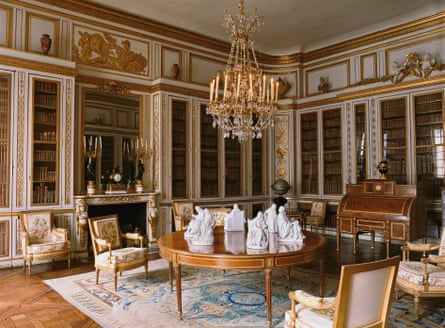
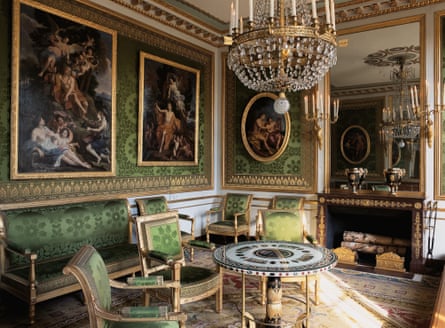
After Hariri’s death, 2-8A Rutland Gate was given to Sultan bin Abdul Aziz, the crown prince of Saudi Arabia. When he died, in 2011, those of us outside this rarefied world caught a glimpse of the lifestyle he and Hariri had enjoyed here. In 2015, the entire contents of the house – including those jewel-encrusted bathroom suites and gold bins, plus Murano glass chandeliers and Lalique crystal perfume bottles – were put up for auction. Since then, even after the record-breaking sale in 2020, 2-8A Rutland Gate has seemingly stood empty.

Although the house was purportedly bought by a billionaire based in Hong Kong, Cheung Chung-kiu (CK to his friends), the Financial Times reported in 2022 that the new owner was in fact one of those friends, Hui Ka Yan, the founder of the aptly named property empire Evergrande and China’s richest man at the time. Evergrande began defaulting on its debts in 2021, which is probably why the house was put up for sale again, in 2022, for a knockdown £200m. It came with planning permission to make it bigger still – to dig below the existing two-storey basement, so that any new owner could build a larger pool and an underground car park for a fleet of luxury cars, and to design a three-storey ballroom upstairs.
The ownership of properties like this is not always obvious or transparent. “Often, companies in tax or secrecy havens are used as the vehicle for these investments, making understanding this property class challenging,” wrote Jonathan Bourne, a researcher at University College London, in a paper published in April. Bourne and his colleagues found that, over the past decade, the value of offshore residential property in England and Wales had increased from £64bn to £80bn. London is the hub, with 47,000 overseas-owned residential properties – 45% of the total and 81% by value.
Zooming in, 50% of the total value lies in just two of the 318 local authorities in England and Wales: Westminster (34%) and Kensington and Chelsea (16%). Rutland Gate is in the former, very close to the border with the latter.
The Land Registry shows that the last time the house changed hands was the sale in 2020, when it was bought using a company called Vision Perfect Global Limited, registered in the British Virgin Islands, an offshore haven. When the house went on the market in 2022, it failed to sell. When changes to transparency laws meant the company’s ultimate beneficiary had to be identified, the name on the documents turned out not to be that of Hui, but his wife, Ding Yumei. They have since divorced.
Evergrande collapsed in 2024 with huge debts. In April, Hui pleaded guilty to charges including fraud, misuse of funds and illegally taking public deposits; he awaits sentencing. Evergrande’s liquidators are unable to seize 2-8A Rutland Gate, as it is in his ex-wife’s name. Ding, a Canadian citizen, can’t sell up, as her assets have been frozen. The future of the house remains uncertain.
Even if the personnel have changed, the story sounds familiar – urban palaces bought often seemingly using dubiously obtained fortunes. “The sense that criminal money, tax evading money, money from politically exposed persons is wrapped up in the story of the city’s effort to provide a wonderful kind of party central for the world’s rich is an important one,” says Rowland Atkinson, a professor of urban studies at the University of Sheffield, and the author of the book Alpha City: How London Was Captured By the Super-rich.
In the Duke of Rutland’s day and then in the Victorian era, the reason the super-rich came to London was because the city was “a place of court as well as commerce”, says Atkinson. “That brought aristocrats looking to buy homes that were walkable to other people like themselves and walkable to the key centres of power. That kind of geography has subtly changed over time. With internationalisation, some of that’s about a dinner-party circuit, rather than being close to the king or queen.”
On the global stage, London continues to matter. Atkinson says this is because of “its history, its livability, its connection to a really important social circuit – in political terms and in terms of corporate and finance capital sectors – which means it’s a more or less unrivalled location. Of course, if you’ve got that much money, you can have another pad in New York, Geneva, Paris or wherever, but you’ve got to be in London.”
Too much scrutiny of offshore purchases, and certainly too much taxation, would scare off these buyers. According to the argument that the wealthy generate wealth, this would be a problem. Atkinson doesn’t buy this trickle-down theory: “I’ve written about how the methods underlying that are completely crap.”
Even in the olden days, aristocrats had some sort of social engagement with their surroundings. Now, the owners of these properties fly in, get chauffeured to underground car parks and are then whisked up to their anonymous apartments, where bespoke services may well be provided by the five-star hotel next door. “The wealthy elite can insulate themselves – the city around them appears safe, malleable, something that gives them a sense of control over their lives,” says Atkinson.
He admits he is talking more about places like One Hyde Park, a luxury residential development a few hundred metres up the road from Rutland Gate, but the underlying issues are the same. “It’s bizarre and perverse that, in the middle of a housing crisis and a social crisis more broadly, you can find a magnificent home like that lying empty for years, homes that are not functioning as homes but as assets, part of a portfolio to be traded, or as a temporary residence for a small number of weeks a year.”
The story of Anders Fernstedt is at least as interesting as the story of the building attached to the porch he occupies. Born in Sweden in 1968, he grew up near Gothenburg with his mother, a librarian. Although he had no training, he worked as a journalist, writing technology articles for business publications.
When Fernstedt’s mum inherited a summer house with an overgrown garden, she asked for his help and he became interested in gardens and plants. In 2009, he enrolled as a mature student at the Royal Botanic Garden Edinburgh, studying horticulture and plantsmanship. “Plantsmanship, it’s such a sweet little word,” he says, repeating it with relish. “That’s why I have my pretend garden here,” he says, indicating the containers of cut flowers. “If we get bad rain, they might get knocked down, soggy and mouldy, so I chuck them away. But otherwise I like to let them go to seed.”
He says he aced his horticultural tests, but didn’t finish the course, instead going to work at a garden in the Mull of Galloway and becoming friends with Emily Dalrymple, the Countess of Stair. Then he went to the US, where he got run over in South Carolina, fracturing his spine in three places; he made a full recovery. He used to be an amateur gymnast and is accomplished at table tennis, he says: “More a spinner than a smasher.”
“Here comes the king!” he announces abruptly. Two police motorcyclists – the monarch’s special protection officers, he says – are speeding along Kensington Road, blowing whistles and gesturing to people to get out of the way of the black Range Rover behind them. Fernstedt once met Prince William, when the royal came to help out at a day centre for homeless people run by the charity The Passage. Fernstedt enjoys visiting the swans on the Serpentine in Hyde Park and says he showed William “a little video of his swans and how they conduct themselves with me”. Fernstedt says William told him to look after them for him.
He has been in trouble with the law. Last June, he appeared at Southwark crown court after an altercation with two people. The disagreement was about how he was interacting with the swans, touching and stroking them. Fernstedt, who represented himself in court, was found guilty of assault occasioning actual bodily harm and sentenced to a 15-month community order with a 15-day rehabilitation activity requirement. He was banned from Kensington Gardens, next to Hyde Park, and from contacting the two people for two years.
Back to his story. In 2013, Fernstedt was living in the San Francisco Bay Area when he met the New York Times technology writer John Markoff, later helping him to research and edit a book about robots. “I was his sidekick and, in the intensive part, he and his wife put me up in their San Francisco house, where they would have dinners for the netocracy or the cyberati, or whatever you want to call it.”
Markoff introduced him to the Economist’s Silicon Valley correspondent, who mentioned that the magazine was hiring in the UK. So Fernstedt came to London and worked briefly, part-time and remotely, as a freelance factchecker at the Economist. “I thoroughly enjoyed it, because it was the first job I ever had where there was no homework.”
Fernstedt lived on an estuary in Essex in a distressed 25ft (7.6‑metre) sailboat he bought on eBay with Markoff’s help, commuting into London on a Vespa he got from a Florentine banker. After his short spell at the Economist, he became “a freelancer whose commission never arrived. I had a press card, so I spent probably a couple of years going to events. I was exceptionally well informed, kept a finger on a million things – but without a desk, without a commission and so without an income.”
He worked at the marina in lieu of paying for his berth and spent almost a year painting the crane used to lift the boats out of the water. Then his boat was damaged in a storm. In terms of life stability, too, Fernstedt was beginning to drag his anchor. People began to turn against him, he says. “The community had a choice: is he our boy, or is he a fox to hunt? And I think they decided I was a fox to hunt.”
By 2019, Fernstedt was in north London, living in a tent on the Walker cricket ground in Southgate, next to the cemetery. Someone called StreetLink, which connects people who are sleeping rough with support services. That was the start of Fernstedt’s adventure in temporary accommodation, one he didn’t enjoy. His first place was a flat in Tottenham. “Hell has many layers, as Dante would have it. I started in the upper crust of hell; not too bad.”
Then came his first no-fault eviction, so he moved to Finchley. “We had arson – complete burnout in one flat. I was assaulted by an ex-convict with an asbo ankle tag thing, a proper piece of work.” They made up, but Fernstedt received another no-fault eviction. Finally, he was put in a flat in Brent Cross, “where for a year and a half I was basically hostage to a crack dealer with tattoos on his face. I mean, a bad piece of news.”
The landlord sold the place and Fernstedt was subjected to no-fault eviction No 3. As he was moving out, the crack dealer attacked him, unprovoked. “Maybe he was drunk, hungover, a cocktail of other stuff, but he came in and gave me a sucker punch while I was lying down – ruptured my eardrum.” While Fernstedt was in hospital, all his possessions were stolen; they had been in the corridor at the block of flats, ready for him to move out. He had nothing and nowhere to go. The next chapter – rough sleeping – began. “This is still the next chapter,” he says, laughing.
It’s also where the two stories – his and the story of 2-8A Rutland Gate – come together. Fernstedt had been coming to this part of town to spend time with the swans. He didn’t know anything about the building across the road, but it seemed to be empty and it had a big porch – a portico, even – which provided shelter. He moved in and has lived here ever since, gradually accumulating stuff.
As we talk, a woman stops and asks about the flowers and other paraphernalia: what does it all mean? “We’re trying to find out. I have lived here for three years and every day I think surely tomorrow I’ll be rescued,” Fernstedt replies, cryptically. “So it’s one more flower every day, mainly to make my neighbours’ children happy.”
The woman, who is Russian, lives nearby and is taking her young son to the park. Her son is standing not far from us and is a bit shy, or scared, to come over. It turns out they go to the same Russian Orthodox church as Fernstedt, around the corner. For Fernstedt, it’s less about God, more about the music: “It’s like having a season ticket to Covent Garden!” Plus, the church gives him food and clothes.
The Russian woman goes on her way with her son after congratulating Fernstedt on his choice of location. He knows many of his neighbours, such as the retired Azerbaijani ambassador who lives a few doors down; they sometimes go for walks together. Fernstedt has always been well connected and homelessness hasn’t changed that.

He didn’t expect to end up on the streets, he says: “Not in a million years. This is not me.” He knows he is not typical of a street sleeper – healthy, he says, physically and mentally, with no addictions. He is dismissive of trauma: “Trauma to me is when all your blood pours out on the streets. That’s what the trauma unit in the hospital deals with, not when my sensibility is a bit …” He makes a hand gesture that suggests “not so good”.
He has learned how to survive. He knows where to go for food, water, the toilet and power – he has a phone and some power banks. A local Lebanese restaurant allows him to charge them and use the wifi; in the winter, there are patio heaters. He has no ID – he says the Home Office lost his passport – which makes a lot of things difficult. He is less fussed about having no money. “No money is better than a little money. A little money, you don’t have enough. Once I know what I don’t have, it’s easy sailing.”
Sleeping on the streets was scary to begin with. “If you’re an itinerant rough sleeper, then you always have to have one eye open,” he says. Now that he is settled in one place, he feels more secure. He is comfortable enough – he shows me the mattress he sleeps on, plus additional squishy things, such as a fluffy octopus toy someone won at the Winter Wonderland fair in Hyde Park and gave to him. “I’m like the princess and the pea,” he says. On top, he has a Hungarian goose down duvet that keeps him warm in winter, but isn’t too hot in summer. He generally sleeps well, although sometimes he’s woken by a loud Lamborghini.
Fernstedt has one working bicycle and another that is out of action with “multiple organ failure”. A third bike got stolen.
In 2025, there were more than 300,000 long-term empty homes in England alone, up nearly 15% on the previous year. On top of that, the number of second homes out of residential use is north of 268,000. In London, the number of empty homes is high and rising, with some boroughs particularly bad. The City of London is the worst, with one in four homes not in residential use (this includes second homes). Next is Kensington and Chelsea, with one in nine homes empty, and Westminster with one in 10. It’s top when it comes to offshore-owned property, too, remember? It may not be a coincidence.
London also has the most pressing housing needs; of the 1.34m households in England waiting for somewhere to live, 340,000 are here. If you live in the capital, you might think: hang on, new buildings are going up constantly. “The places building the most housing have mysteriously managed to produce the highest level of vacancy,” says Chris Bailey of the charity Action on Empty Homes, pointing out that building houses doesn’t necessarily solve the housing crisis. “We’re building the wrong housing, it’s that simple. Towers of luxury apartments don’t house poor or homeless people.”
Some of what is called residential housing isn’t even that, he says: “It’s basically a piece of London that’s been sold to an overseas entity that’s now sitting on it.” He’s talking about overseas-owned residential property, 45% of which is in London, and much of which is empty.
The government estimates that the number of people sleeping rough in London on a single night is 1,277. “Empty homes are a really visible and visceral sign of the housing emergency and the inequality in our housing system,” says Charlie Trew, the head of policy at the housing charity Shelter. “The fact you’ve got thousands of empty properties and hundreds of thousands of homeless households absolutely needs to be addressed.”
In April 2024, Shelter published a plan for converting empty homes into social rent homes, which are subsidised properties owned by councils or housing associations to provide affordable housing for people on low incomes or in vulnerable circumstances. The plan includes strengthening compulsory purchase powers, whereby a council can force the sale of an empty property, as well as ways to disincentivise homes being left empty. (Premiums on long-term empty and second homes were brought in by the Levelling-up and Regeneration Act 2023.) Councils would require more funding – and new powers – to bring empty homes back into use. “It’s unlikely to end homelessness in its totality,” Trew says. You still need to build a lot of the right kind of homes. “But it’s an important part of the puzzle.”
“I am so close,” says Fernstedt, holding his fingers apart to show the thickness of the front door that lies between him and the second-most expensive shelter in Britain (in April, it was reported that a mansion in Chelsea, Providence House, had been sold for £275m). He has a novel coping strategy. “What I’ve said to myself is it’s my pretend reality. I’m a child, my parents are in the house. I just asked them: ‘Can I camp in the treehouse?’” He adopts a stern parental voice. “‘Do you want to sleep in your room, son, or in the treehouse?’” He switches to the voice of an excited child. “‘Treehouse! Treehouse! Treehouse!’” Somehow, Fernstedt manages to be cheerful.
Of course, 2-8A Rutland Gate isn’t going to be turned into social housing. Even Westminster council isn’t going to find £200m to transfer to the British Virgin Islands in order to get the key. But as a sign of the housing emergency and the inequality in the system, it doesn’t get more visible or visceral – a homeless man with no money sleeping on the doorstep of a £200m house with 45 rooms that has been empty for years and belongs to a billionaire who doesn’t seem to have occupied it much, if ever, and lives thousands of miles away.