3 hours ago
5
3 hours ago
5
In February, turbulent scenes inside a German theatre made headlines around the globe. During the final act of a play at Schauspielhaus theatre in Bochum, the audience first jeered and whistled at a performer in the role of a far-right politician. An orange lobbed from the auditorium narrowly missed its target; eventually, two spectators climbed on to the stage and tried to wrestle the actor off. News of the incident travelled around the world: it seemed a bizarre throwback to a world in which people were not able to tell the difference between art and real life, like 19th-century Parisians stampeding out of a cinema after watching a train hurtle towards the camera.
For the man who wrote the play, however, it was nothing unusual. “I was not surprised by the reaction,” says Portuguese playwright Tiago Rodrigues. “I was surprised by the fact that it was so surprising for so many people.” He describes the audience’s reaction to his play Catarina and the Beauty of Killing Fascists as “very intense”, but also “typical”.
The play, which visits London’s National Theatre next month, tells the story of a macabre family tradition: once every year, a group of relatives gather over a feast of wild boar and asparagus in the southern Portuguese countryside to kill a fascist they have kidnapped. Their ritual is designed to avenge the real-life murder of Catarina Eufémia, a harvester in revolt who was killed at the hands of the Salazar regime’s police force in 1954. But this year the family member tasked with the execution voices some doubts about the ritual’s righteousness, and things go awry: in the play’s last half hour, the freed fascist gives a victory speech that is uninterrupted by the rest of the cast. Ever since its September 2020 premiere in Guimarães, audiences have stepped in to intervene.
In Portugal, spectators chanted Grândola, Vila Morena, José Afonso’s song of the 1974 Carnation revolution, to drown out the actor’s words. In Italy, they sang anti-fascist resistance anthem Bella Ciao. In Austria, spectators stood up and walked out. There were attempts to storm the stage and hit the actor impersonating the fascist politician at performances in Lisbon, Paris, Marseille and in Montreal. In other places, it was the far right that expressed its indignation: the Rome premiere of Catarina and the Beauty of Killing Fascists was met with protests from the local branch prime minister Giorgia Meloni’s Brothers of Italy party, which asked for the play to be removed from the programme.
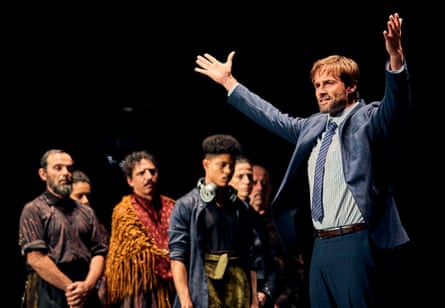
“We always get these reactions, whether we’re in Switzerland or in Norway,” Rodrigues says, matter-of-factly. “In around 200 performances, we’ve had perhaps a handful of shows where the audience just listened to the final speech in silence.”
What is it about his play that has made it a 21st-century equivalent of Stravinsky’s The Rite of Spring, triggering mini-riots wherever it is shown? One answer may be that Catarina and the Beauty of Killing Fascists is essentially two plays in one, each of which annuls the answers offered by the other: an anti-fascist play that asks difficult questions of both liberal and militant anti-fascists.
For the first two hours, Rodrigues’s play is a reflection on what the philosopher Karl Popper called the “paradox of tolerance”: to preserve an open and tolerant society, must we be intolerant towards those who advocate intolerance? Or does our society cease to be a tolerant one when we do so? The second question carries particular weight in Rodrigues’s staging, for the anti-fascist tradition that the family at the heart of the play represents is one that comes across as self-absorbed, self-regarding and, in its own way, reactionary. “Our family killed fascists during the dictatorship, we killed fascists during the democracy and will continue to kill fascists,” says one of the characters, Pedro. “You shouldn’t ask yourself ‘Why?’ or ‘Why also me?’. The real ‘why’ is in the ‘how’. There’s a method, a ritual, a tradition, a beauty.”
It’s hard not to side with Sara, the young woman who has been chosen to kill her first fascist this year but instead of duty feels only doubt. Is killing not like imposing a dictatorship, she asks: “Death, where you don’t think, don’t argue, where you can’t change your mind, is that not the greatest dictatorship of all?” And if the end supposedly justifies the means, why has their ritual not managed to fend off fascism for good (in the play, the extreme right has recently gained power over Portugal again)? “Why don’t we have a revolution, a coup d’état, a guerrilla campaign, a war? Why don’t we kill all the fascists once and for all and get this thing sorted?”
Rodrigues, who has been artistic director of the D’Avignon theatre festival since 2022, does not hide his sympathies with Sara’s inner conflict. “My own views are quite simple,” he says. “I consider the far right an enemy that has to be fought, but we should fight them in a democratic way, and if that doesn’t work, you keep on playing it democratic. I think most of the audience usually position themselves in a similar way: they feel Sara is right.
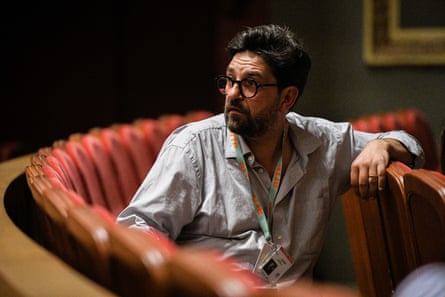
“Nevertheless, there have been moments in history where violence was considered a legitimate response to fascism. Where I live today, in the south of France, I don’t think it’s controversial to say that armed resistance was a legitimate answer to the Nazi occupation.”
With the family of anti-fascists unable to come to a collective decision on how to address their problem, the fascist politician is freed and gives a victory speech straight out of the modern far right’s rulebook, decrying the dictatorship of “minorities” over “the people”, the biased mainstream media, the intolerant liberal left. If you overthink your anti-fascism, Rodrigues seems to be saying in response to the first part of the play, this is what you get.
The playwright says he wrote the final monologue during the rehearsals. “We had this problem: how do we finish? If Sara’s side won, it would be very didactic and politically correct. And I realised the victory of the far right would be the most troubling, the most dystopian and also the most thought-provoking.” His own cast’s response to the ending foreshadowed the reactions the play has received around the globe. “Some people felt sick, others were in tears and left the room or thought about quitting the project altogether. There were a lot of debates about whether we have the right to put such a speech on stage today.”
He condemns those who have tried to assault members of his cast, but says it’s not for him to judge spectators shouting down a fascist speech: “It’s not something that we find to be a mistake.” Some viewers, he believes, feel the play is inviting them to react in a visceral way: “They feel they have to show emotion because the actor is addressing them, and if they don’t protest they are accomplices of his speech. For them, it’s a kind of game they’ve been invited to play.”
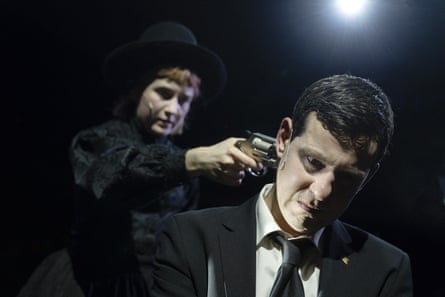
In other cases, he suggests, the outrage may also cloak a deeper feeling of helplessness: “The audience have spent two hours following a complex debate and worked out their own position within it, and suddenly that choice is not there any more. That’s very disturbing. Some of the same people who agreed most strongly with Sara that the left should not use violence are the loudest to scream ‘kill him’ at the end of the play.”
Rodrigues decided to tackle the question of how societies can protect themselves from fascism after André Ventura, the founder of anti-immigration party Chega, in 2019 became the first far-right politician to be elected as a member of Portugal’s parliament since the end of the Salazar regime. Until that point, the Iberian country had looked immune to the brand of rightwing populism that was rattling most countries in Europe.
“I remember when I mentioned in rehearsals that the story would be about a victory for the far right in 2028. Everybody laughed: yeah, that’s never going to happen, eight years is too short. And I agreed with it. My defence was that we needed to exaggerate to focus the audience’s mind.” Today, Chega is the second largest party in Portuguese politics; earlier this year, Ventura came second in a rare runoff vote for the presidency.
“As a playwright, you are sometimes dystopian because you don’t want to be prophetic,” he adds. “Unfortunately, reality keeps making this piece more relevant.”