2 months ago
90
2 months ago
90
Arms are spread, hands are grasping, lips are puckered: everything in Jonathan Baldock’s eerie, uncomfortable, strange exhibition of tapestries and ceramics at Bristol’s Arnolfini is reaching out to you. The whole exhibition is an invitation to be held, or maybe its cuddliness is a threat, a violent trap.
The English artist has created a tense world of folkloric psychedelia and pagan aesthetics here. Don’t read any of the bumf on the wall, it’s couched in gentle, therapy-lite language about “radical gestures” and “holding space for queer and working-class stories”. It doesn’t fit the show. Not that this isn’t about queerness and the working class, because it absolutely is. It’s just that this isn’t gentle and soft art, it’s weird and threatening and menacing – that’s why it’s so good.
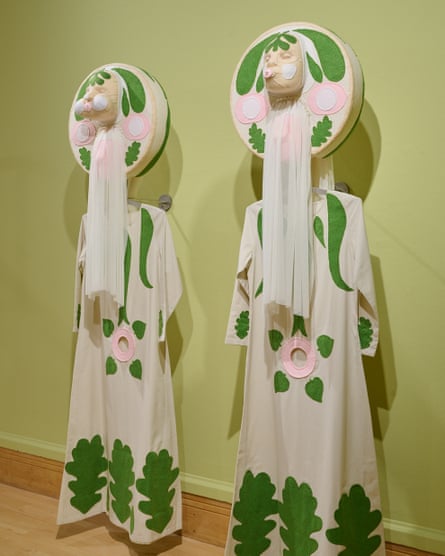
You walk in and it’s as if you’ve stumbled on some messed-up rural ritual, a rite where you might get invited to put on one of the wheat masks on the wall and take part, or find yourself trussed up as sacrifice. Two lifesize felt figures greet you as you enter, their robes decorated with leaves and greenery. Pink holes at crotch level hint that these robes serve other purposes too. On the walls, ceramic flowers have grown noses and ears, a tongue pokes out of the centre of a grey poppy, trying to lick you as you walk past. Hands reach desperately out of ceramic pots on the floor, as if bodies have been trapped inside, or they’re trying to pull you in.
You have to get out, to escape this magical pagan world where nature has come alive. But you flee to the next room and then the smell hits you: a pungent odour of fur and wood and damp moss. A deep bass rumble echoes in the space, the sound of twigs snapping and some creature breathing. It could all be coming from that giant bear on a platform in the middle of the room. It could be its breath you’re hearing, its musk you’re breathing in. You’re invited to climb up and cuddle with it, to be embraced by its huge arms. Kick your shoes off, wrap yourself in its limbs. It doesn’t feel comfortable, it doesn’t feel safe. Will it hold you, or will it rip you limb from limb?
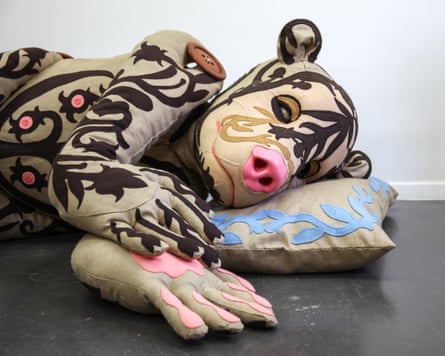
That’s the central tension of the show: it’s all about the rub between care and violence, between love and rejection. All this pagan imagery and rural psychedelia comes down to Baldock trying to make sense of an England that he is from – genetically, ancestrally – but can’t truly feel a part of culturally, sexually.
That’s the thing about tribalism, about communities. You’re either in or you’re out, accepted or rejected, and everything here feels like it’s about being torn between the two.
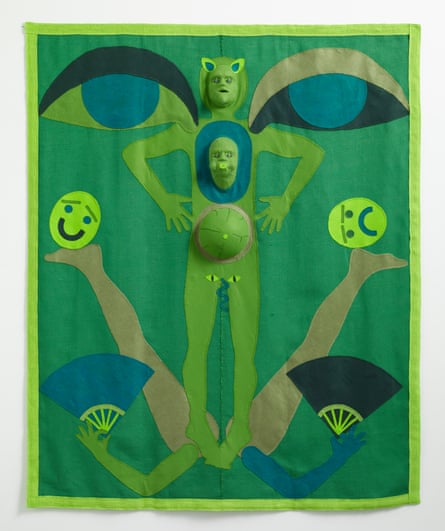
It’s great. Really great. Baldock’s work is hugely personal, there are references to his mother everywhere, to her support for his career, to her pleasant English garden. There are nods to sexuality and bodies, to English history and Japanese culture. Faces grimace out of pots, flowers grow out of anuses. The walls are covered in tapestries filled with geometric patterns, images of bodies and teeth, trees of life, Celtic knots, English roses, ancient inscriptions and green men. It’s dizzying, surreal, aggressive.
This is such an unsettling, threatening exhibition, helped no end by the weird ambient soundtrack, which makes you feel like you’re about to be pounced on by some mythical beast in a deep dark forest. There’s a sense here of ancient rites seen through the lens of 1960s hippy love, and churned through the mill of millennial malaise. It’s as if the Wicker Man wasn’t set on an island off the coast of north-west Scotland, but in early 2000s semi-rural Kent. A somehow infinitely more terrifying, uncomfortable and sinister prospect.