3 months ago
89
3 months ago
89
Reminder: Q&A with Shaun Walker on Ukraine at 2pm UK, 3pm Europe
Jakub Krupa
Just a reminder that we will have our correspondent Shaun Walker join me here at 2pm UK (3pm Europe) to answer your questions on Ukraine.
Make sure you post yours in the comments section at the bottom of the page, which we are actively monitoring to pick the most interesting questions.
Key events 34m ago Four years of war in Ukraine – in pictures 51m ago Four years into Ukraine invasion, Russia’s gains are small, while Kyiv remains resilient 1h ago Reminder: Q&A with Shaun Walker on Ukraine at 2pm UK, 3pm Europe 1h ago No Time to Heal - Guardian documentary on psychological rehabilitation of Ukrainian soldier after Russian captivity 2h ago Kyiv marks fourth anniversary of full-scale aggression - in pictures 2h ago 'Russia is not winning,' Germany's Merz says, as he calls for more pressure on Moscow 2h ago Macron 'very sceptical' about short-term peace as 'no willingness' on Russia's side 2h ago 'We need peace, but have to prepare' for other scenarios, Zelenskyy says, hinting at further talks with Russia in 7-10 days 2h ago Coalition of the Willing's meeting on fourth anniversary gets under way 3h ago Over 200,000 Russian soldiers killed in Ukraine identified 3h ago Russia will press ahead with its war aims in Ukraine, Kremlin says 4h ago Ask your questions about Ukraine war for our live Q&A at 2pm UK, 3pm CET 4h ago Putin is standing in way of peace, Starmer says, as he says Ukraine is 'frontline of our freedom' and marks its resilience 4h ago Ukraine needs 'ammunition today and every day' in its fight against 'Russian terror,' Nato's Rutte says 4h ago Russia shows contempt for Europe, Zelenskyy warns 4h ago We must be as determined as when invasion began, Zelenskyy says, as he pushes for EU accession date 4h ago Ukraine never chose this war, Zelenskyy says 4h ago Ukrainian people 'stand defiant in face of almost unimaginable daily hardship,' EP president says 4h ago Zelenskyy urges Trump to visit Ukraine in first speech marking invasion anniversary 4h ago European Parliament sits to mark fourth anniversary of war 5h ago Russia accuses Britain, France of preparing to arm Kyiv with nuclear bomb without any evidence 5h ago European leaders arrive in Kyiv to mark the fourth anniversary 5h ago Nato's Rutte marks fourth anniversary of war 5h ago Morning opening: Four long years Show key events only Please turn on JavaScript to use this feature
Jakub Krupa
Final reminder: our correspondent Shaun Walker will be joining us here on Europe Live to answer your questions on Ukraine at 2pm UK (3pm CET).
Post your questions to him in the comments section at the bottom of the page.
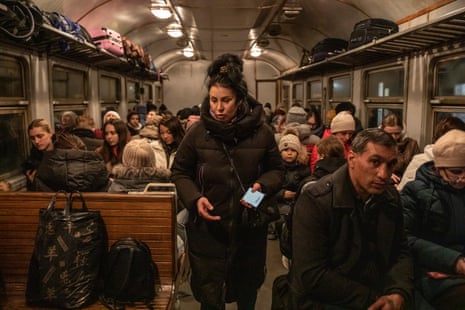
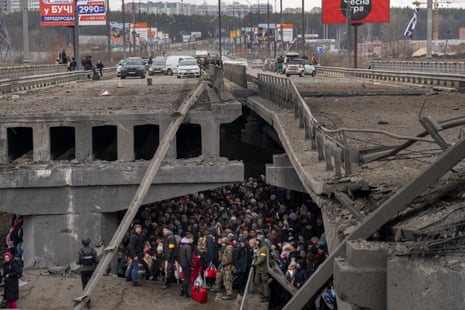
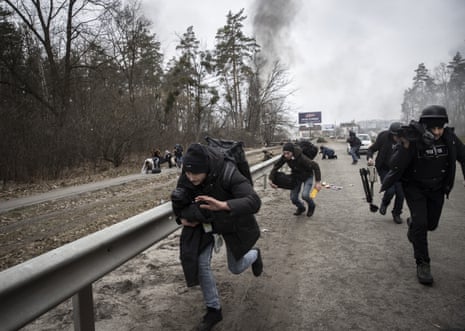
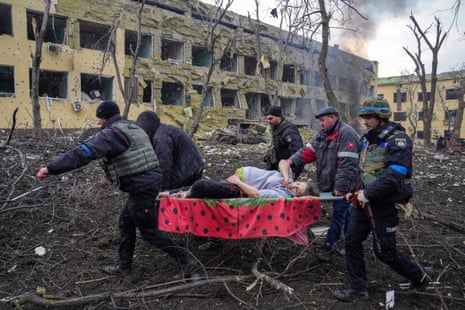
Four years of war in Ukraine – in pictures
Matt Fidler
Picture Editor, News
On the fourth anniversary of Russia’s invasion, we look back on some of the powerful photojournalism documenting the conflict.
More:
Four years into Ukraine invasion, Russia’s gains are small, while Kyiv remains resilient
Dan Sabbagh
Defence and security editor
Russia’s invasion of Ukraine, now entering its fifth grim year, has already gone on longer than the entire fight on the eastern front in the second world war.
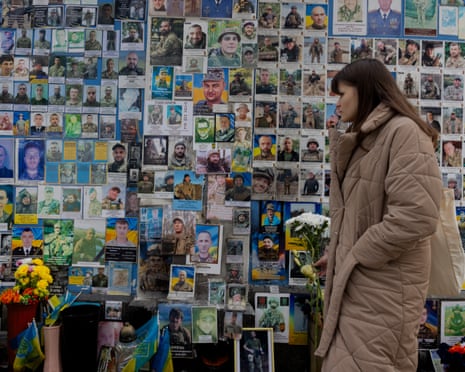
The Soviets marched from the gates of Leningrad to Berlin in a little over 15 months in 1944-45; today the Russian rate of gain in Pokrovsk in Ukraine is 70 metres a day, in Kupiansk, 23 metres, according to the Centre for Strategic and International Studies.
The gains are trivial, given Ukraine’s size, amounting to 1,865 sq miles during 2025 (about 0.8% of the country) – so the idea touted by the Russians, sometimes accepted by a credulous White House, that Ukraine is suffering a slow-motion defeat, is not accurate.
In reality, even allowing for the fact that hundreds of thousands of homes are without electricity, heating and water after Russian bombing, Ukraine is clarifying its strategy and pushing back with modest success.
…
Against this backdrop, it is not surprising that Russia continues to demand that Ukraine withdraw its military from Kramatorsk, Sloviansk and the remainder of the Donetsk (the latest suggestion seems to be the creation of a demilitarised zone, though Russia wants to patrol it).
Earlier this month, a Nato intelligence official estimated that they did not believe Russia could capture the region “anytime within the next 18 months” – though it is so urbanised that it could take far longer, at a cost of 600,000 Russian casualties or more.
The diplomatic misdirection demonstrates how poorly Russia’s military is performing. Last week, Sergei Lavrov, Russia’s foreign minister, became the latest Kremlin official to refer to understandings agreed in Anchorage, a claim that at the August summit in Alaska US president Donald Trump had agreed with Vladimir Putin that Ukraine should be made to hand over the rest of Donetsk without a fight.
But if Trump has flirted with the idea at times, it is not a position the US has sought to enforce amid Ukrainian and European objections.
Read in full:
Reminder: Q&A with Shaun Walker on Ukraine at 2pm UK, 3pm Europe
Jakub Krupa
Just a reminder that we will have our correspondent Shaun Walker join me here at 2pm UK (3pm Europe) to answer your questions on Ukraine.
Make sure you post yours in the comments section at the bottom of the page, which we are actively monitoring to pick the most interesting questions.
No Time to Heal - Guardian documentary on psychological rehabilitation of Ukrainian soldier after Russian captivity
Ukrainian soldiers suffering from PTSD, depression and anxiety are sent to the Forest Glade – Ukraine’s first center for the treatment of psychological trauma – before returning to the frontline.
After three years in Russian captivity following the battle for Mariupol, 25-year-old Kyrylo Chuvak spends three weeks at the centre outside Kyiv, a brief opportunity for rehabilitation.
Hidden in the pines near the capital city, this modest building offers soldiers psychological therapy as well as tango, archery, guided breathing, medieval games, and quiet conversations over tea.
After four years of war, and waning international attention, the battle is not only on the frontline but in the psyche.
Watch the documentary:
Kyiv marks fourth anniversary of full-scale aggression - in pictures
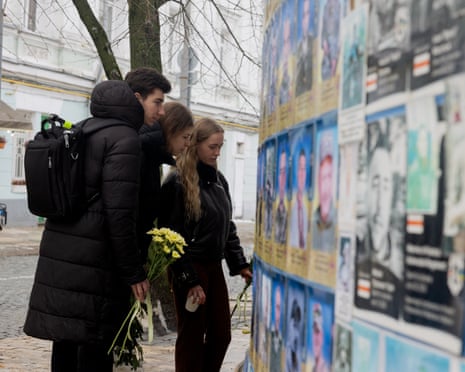
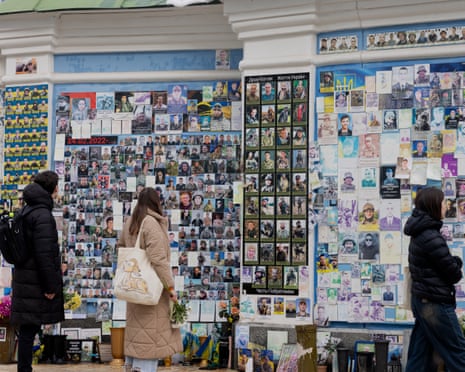
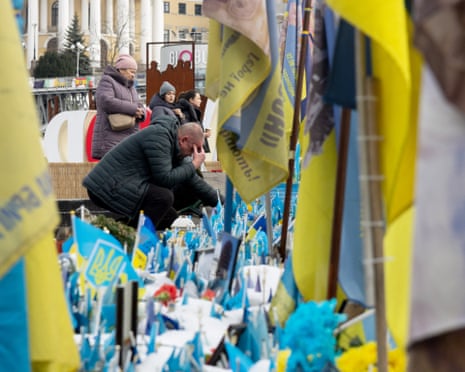
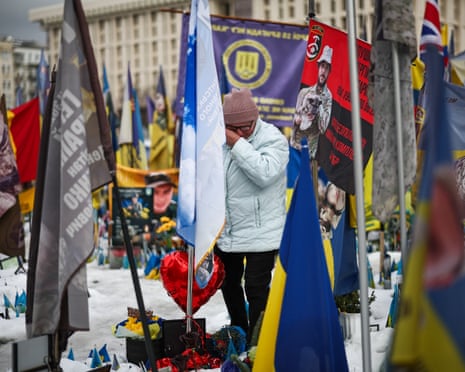
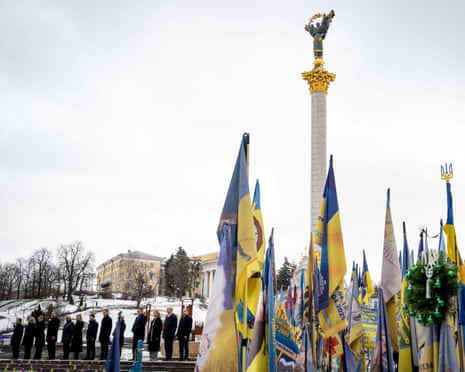
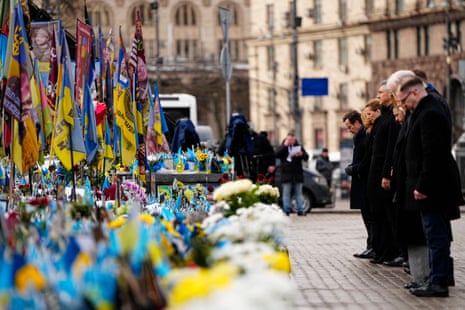
'Russia is not winning,' Germany's Merz says, as he calls for more pressure on Moscow
Germany’s Friedrich Merz is speaking next, with pre-recorded remarks, as he is attending a state ceremony in Berlin honouring the former Bundestag president, Rita Süssmuth.
He says Germany’s support remains “iron clad” and says:
“So we must be very clear this war will only end when Putin realises that he cannot win.”
He says “we must increase pressure on Russia” and “dry up Moscow’s war funding.”
He states:
“Moscow is not as strong as it would like the world to think. Russia is not winning.”
The leaders will hear from Nato’s Mark Rutte next, but it seems that’s where the public part of the event ends and they will continue behind the closed doors.
Macron 'very sceptical' about short-term peace as 'no willingness' on Russia's side
France’s Macron is speaking next.
He doesn’t mince his words as he says he is “very sceptical” about the prospect of short-term peace, as “there is no willingness on the Russian side to have peace.”
He calls for more support for Ukraine, and also puts pressure on the EU leadership to make sure the €90bn loan gets paid out soon. “We will deliver that, no choice,” he says. (Tell that to Hungary’s Orbán.)
He then also mentions the need for further sanctions on Russia, including on its shadow fleet to “kill its business model.”
On security guarantees, he says these are “being finalised,” and they need to be “agreed on in concrete terms.”
He ends with his words of admiration and solidarity with the Ukrainians.
'We need peace, but have to prepare' for other scenarios, Zelenskyy says, hinting at further talks with Russia in 7-10 days
After brief opening remarks from Britain’s Starmer, Zelenskyy says he remains “thankful” for all the support.
He says there are “no secrets” as Russia continues to attack its civilians and energy system as “a terrible winter” continues, and asks for help to renovate the grid.
He also thanks for all the military aid Ukraine is getting through the Prioritized Ukraine Requirements List, or PURL, list of weapons bought through Nato.
He expresses gratitude for the latest deliveries on air defence, “half of the package is already here,” which he says is very important.
He briefly mentions the awkward issue of further EU sanctions on Russia and the EU’s €90bn loan, as they continue to be blocked by Hungary.
Zelenskyy says he will update other leaders on the talks later when the press is out of the room, but stresses “we need Europe in negotiations.”
He says there will be further talks in the trilateral format with the US and Russia “during this week or 10 days.”
“We need peace, but we have to prepare to any other kind of challenges from Russian side,” he says.
Coalition of the Willing's meeting on fourth anniversary gets under way
The meeting of the Coalition of the Willing is now under way, co-chaired by Britain’s Keir Starmer and France’s Emmanuel Macron.
They are dialling in from London and Paris, joining Volodymyr Zelenskyy and a big group of European leaders who are in Kyiv.
I will bring you all the key lines here, and you can watch it here:
Over 200,000 Russian soldiers killed in Ukraine identified

Pjotr Sauer
Russian affairs reporter
Russian independent journalists said they had identified 200,000 Russian soldiers killed in Ukraine as the war reached its fourth anniversary.
Using official reports, online obituaries, images of tombstones and government leaks, Mediazona and the BBC’s Russian service have tracked confirmed military deaths since the first day of the invasion, building a key database that has become one of the clearest public indicators of Russia’s mounting losses.
The outlets also mapped the geography of the casualties, documenting deaths across more than 27,000 cities, towns and villages, from the “Arctic to Dagestan and from Kaliningrad to Chukotka.”
Western intelligence agencies believe the true toll is significantly higher, estimating that as many as 325,000 Russian troops may have been killed, as many deaths cannot be independently verified by journalists.
By historical comparison, the losses are striking.
In a recent report, the Washington-based Center for Strategic and International Studies (CSIS) wrote that the “Russian battlefield fatalities in Ukraine were more than 17 times greater than Soviet losses in Afghanistan in the 1980s, 11 times higher than during Russia’s first and second Chechen wars, and more than five times greater than all Russian and Soviet conflicts combined since the second world war.”
On the eve of the anniversary, Vladimir Putin met the widows of soldiers killed in the war in a carefully choreographed event aimed at projecting public support for the invasion.
Russia will press ahead with its war aims in Ukraine, Kremlin says
Pjotr Sauer
Russian affairs reporter
The Kremlin said it was engaged in a broad confrontation with the west but insisted Moscow would press ahead with its war aims in Ukraine.
Speaking on the fourth anniversary of Russia’s full-scale invasion, the Kremlin spokesperson Dmitry Peskov claimed the west sought to “crush” Russia but had instead helped unite the country.
“The past four years have been extremely significant in Russia’s life and will remain in people’s memory forever,” Peskov said, adding that the period had led to what he described as a “remarkable consolidation” of Russian society.
“The goals haven’t been fully achieved yet, which is why the military operation continues,” he said.
Peskov also echoed unsubstantiated claims by Russia’s foreign intelligence service, the SVR, which has accused Britain and France of preparing to arm Kyiv with a nuclear device, calling it a “flagrant violation of international law”, despite offering no evidence to support the allegation (10:00).
Ask your questions about Ukraine war for our live Q&A at 2pm UK, 3pm CET
Jakub Krupa
In today’s blog, we are covering all the key events as Ukraine and Europe mark the fourth anniversary of the full-scale Russian aggression in 2022.
At 2pm UK (3pm CET) I will be joined by our correspondent Shaun Walker, the author of our brilliant long read on the build up to the war, how the CIA and MI6 got hold of Putin’s Ukraine plans and why nobody believed them – to answer your questions about the war.
You can post your questions below the line, at the bottom of the blog.
Putin is standing in way of peace, Starmer says, as he says Ukraine is 'frontline of our freedom' and marks its resilience
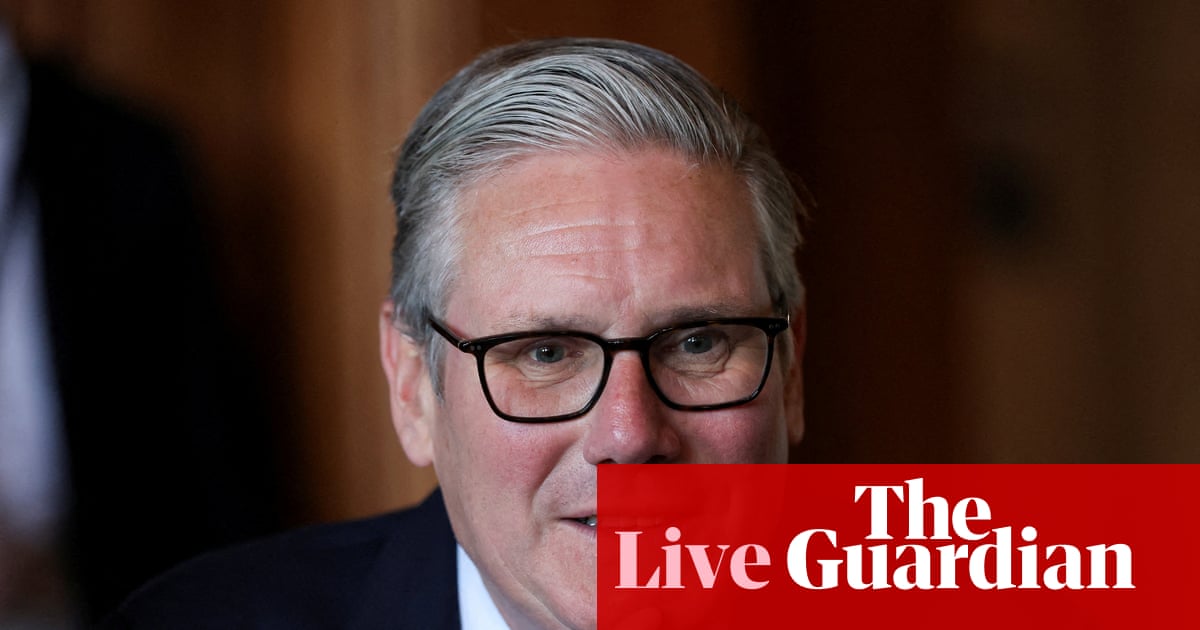
UK prime minister Keir Starmer has also delivered brief remarks on the fourth anniversary of the war at today’s cabinet meeting, praising Ukraine’s resilience.
Starmer said “we must defeat the falsehood that Russia is winning,” saying it took only 0.8% of the Ukrainian territory in the last year “at a terrible cost … of half a million losses.”
He says that “we all want a just and lasting peace” in Ukraine, and says “in terms of getting to that just and lasting peace, it is Putin who is standing in the way.”
He says that’s why “we must always double down on our support for Ukraine” with capabilities, resources and more sanctions, with the UK announcing the latest round of targeted measures today.
The prime minister also says:
“This is not a remote conflict a long way away from the United Kingdom.
It’s about us in so many levels. It’s about our values of freedom, democracy and the right of a country to decide for itself. …
It has already impacted us over and above the work we’ve done on capability, resource sanctions, etc, because it has hit every family with the cost of living. …
How and when this conflict ends is going to affect everybody in the United Kingdom for a very long time, which is why it’s so important that we make sure that it’s a just and lasting peace.
Ukraine is very much the frontline of our freedom, and we need to bear that in mind as we mark this four years since the outbreak of this.”
You can watch his remarks here:
Ukraine needs 'ammunition today and every day' in its fight against 'Russian terror,' Nato's Rutte says
Ukraine needs to get “ammunition today and every day until the bloodshop stops” along with the “essential” military, financial and humanitarian aid needed to fight against “Russian terror from the skies,” Nato’s secretary general Mark Rutte said this morning.
In a speech in Brussels, he said that “Ukraine continues to blunt Russia’s aggression and despite Putin’s posturing, Russia has failed to meet their ambitions on the battlefield.”
“Their security is our security. There cannot be true peace in Europe without real peace in Ukraine.”
He added that Russia’s Vladimir Putin must also show “if he is serious about peace.”
Referencing Winston Churchill’s speech from the second world war, saying that “our qualities and deeds must burn and glow through the gloom of Europe,” Rutte declared that “the flame of freedom is alive in Ukraine, and that flame continues to burn and glow.”
Jakub Krupa
In the meantime, we got the text of Rutte’s speech at the Nato ceremony earlier, so let me bring you his lines now.
Russia shows contempt for Europe, Zelenskyy warns
Zelenskyy continues with a very strong line urging Europe to act against Russian interests in Europe as he says:
“In many ways, we can see how Russia shows contempt for Europe, but Russians should learn that Europe is not just a land for the villas of Russian oligarchs.
It’s not a museum for the lovers of Russian officials to admire beauty, another place of leisure for Russian killers.
Russians must learn that Europe is a union of independent nations and millions of people who do not tolerate humiliation and will not accept violence.”
He urges them to “continue to defend the European way of life”.
He gets a long, standing ovation in response to his speech.