2 months ago
83
2 months ago
83
Morning opening: G7 commits to 'unwavering support for Ukraine'

Jakub Krupa
Despite some early concerns about Donald Trump’s position, the G7 leaders meeting in France have agreed on a statement declaring their “unwavering support for Ukraine in defending its freedom, sovereignty, and territorial integrity.”

The statement, published overnight, says:
“We commend Ukraine for its resilience and progress on the battlefield in recent months and emphasise there is now a new momentum.
To support and accelerate this new momentum, we agree to increase the delivery of air defence capacities, additional systems and interceptors, and long-range capabilities.
We are also ready to consider extending to Ukraine the benefit of licenses to allow for an increase in Ukraine’s military production.”
In a classic Trump-era move, the statement on Ukraine also includes some pointed praise of the US president in a pointed attempt to keep him on side:
“We commit to increase the pressure on the Russian war economy. In this context, we will strengthen our sanctions, including those on the oil and gas sectors. We consider this the right moment to proceed with additional measures, as president Trump has delivered a deal that we support in reopening the strait of Hormuz.”
I guess, whatever works, right?
The leaders will continue their talks today discussing economic growth and AI, with the latter session likely to get some attention as they will meet with the bosses of OpenAI and Anthropic.
Later tonight, France’s Emmanuel Macron will host the US president at the Palace of Versailles to mark the 250th anniversary of the US independence. Unusually enthused Trump said last night that it was “a real deal,” and that he was looking forward to it.

Separately, we will hear from Nato’s secretary general Mark Rutte this morning ahead of tomorrow’s meeting of the alliance’s defence ministers – and less than a month before the much-dreaded Ankara summit, which once again will be all about keeping Trump on side.
Lots to cover today.
It’s Wednesday, 17 June 2026, it’s Jakub Krupa here, and this is Europe Live.
Good morning.
Key events
Rutte says that the G7 statement on Ukraine today shows that all Nato allies are “completely commited to making sure that Ukraine maintains its position in the fight against Russia, and is able to defend itself.”
He says the US also continues its support in areas that only they can provide, including the air defence Patriot systems, which is paid for by European and Canadian allies.
He says he wants the summit to deliver “an absolute ironclad commitment” to Nato spending pledges from last year, and to Ukraine.
'We are not naive,' Rutte says on reports China helps Russia with military training
Rutte also gets asked about China’s apparent help to Russia through training, as recently disclosed by the EU’s foreign policy chief, Kaja Kallas.
He says Nato is “constantly trying to follow exactly what China is doing.”
“We are not naive. We follow everything exactly. I cannot tell you more at this moment, or at least in this open press conference, but you can be assured that we follow every [bit].”
Rutte gets asked about the Czech Republic’s troubles with getting to 2% defence spending under Andrej Babiš.
He says:
“We know each other for many years, and I know that the Czech Republic is as committed as everyone to what we decided in The Hague.
Czechia did not reach the 2% last year, but I know that the Czech government is working very hard to make sure that when it comes to a credible trajectory, it will be there.”
Rutte says he expects Zelenskyy to have a full programme of meetings at Nato’s summit in Ankara next month, but notably “no sit down with all the 32 leaders.”
Rutte gets asked about what Ukraine is likely to get from the Nato summit next month.
He says there were already some positive statement coming out of the G7 in France.
He says Nato will “focus particularly, of course, on what Ukraine needs to maintain the fight,” including the flow of military equipment, including the US interceptors for the Patriot system.
He says the focus will be on “making sure the money is there.”
“I’m pretty confident that collectively we’ll make sure you have what you need as far as Europeans and Americans can help to defend yourself,” he says.
Rutte gets pushed further about the question on timeline, which he completely avoided answering at the first time of asking.
He gives a muddled answer, saying it’s impossible to answer this question.
“It’s not that you can answer that question with a yes or no. It’s clear that US has adjusted its commitment to the Nato force model, but it’s in technical terms, it is not a yes or no.”
Rutte gets asked about spending commitments, and some countries that appear to be dragging their feet.
He says that overall, the increases are “really staggering,” with many countries “really ramping up” their spending.
Rutte also gets asked about the potential Nato/European assistance in the strait of Hormuz.
He says it comes outside the Nato framework, but it is clear that France and the UK are coordinating on this, and it was discussed at the G7 summit in France.
“Whether Nato will play a role there, yes or no… if helpful, of course we will play a role, but if they can do it without us, also okay; we are always ready to help if so wanted.”
Let’s say journalists are somewhat suspicious of the positive spin Rutte is putting on the changes to the Nato Force Model.
He gets asked about them further.
He stays on message:
“We have already seen that, as the United States has adjusted its pledge contributions, other allies have stepped up to contribute more, in some cases completely, in some cases nearly, but there are also areas that require more work, but the overall picture is looking good.”
Rutte says the adjustment in the US pledge to the Nato Force Model is “not primarily about where forces and assets are currently, but about who would do what if our defence plans were activated.”
He says historically the model was “overly reliant” on the US.
“Now the US has adjusted its pledged contributions, and other allies have stepped up to contribute more, and this is fair. This makes us stronger,” he argues.
Rutte also chooses to address the speculations about the US military presence in Europe.
He says:
“You will likely have seen news adjusting its contributions to the Nato force model. In some cases, this has been cast as a problem, as the US pulling away from its allies, but that is not the reality. The US has made clear that it is committed to Nato.
That commitment comes with an expectation that allies will more fairly share the responsibility for our security here in Europe.”
He says that European allies and Canada are capable of shouldering more responsibility for Nato’s activities.
Nato faces 'dynamic security environment,' secretary general Rutte says
Rutte is speaking now.
He says tomorrow’s meeting of Nato’s defence ministers will be the last before next month’s Ankara summit.
“We have a lot to talk about,” he says.
Rutte says Nato continues to “face a dynamic security environment,” which is presumably an euphemism for, erm, “the world is on fire.”
But, as he does so often, he then swiftly moves to praising Trump, this time for his Iran deal. He says Nato allies, such as France and the UK, are ready to support operations in the strait of Hormuz.
More broadly, he says Nato needs “more forces, more resources, and a much stronger industrial base.”
He says allies will be expected to give an update on how they are meeting the 5% GDP target by 2035.
“So I expect nations to present clear, concrete, credible plans to reach that goal, ideally well ahead of the agreed timeline.”
Nato's Rutte briefing media ahead of defence ministers's meeting, summit next month
Meanwhile, let’s cross to Brussels, where Nato secretary general Mark Rutte is about to give his press conference ahead of tomorrow’s meeting of defence ministers – and less than a month before the alliance’s annual summit in Ankara.
You can watch along below, and I will bring you all the key lines here.
There he is!
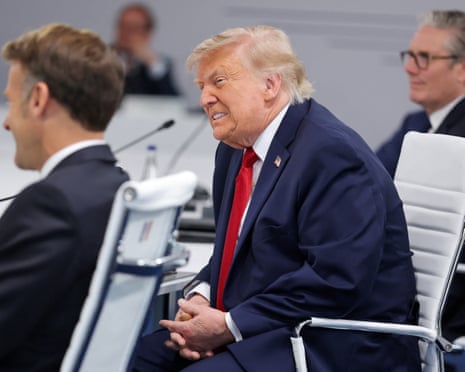
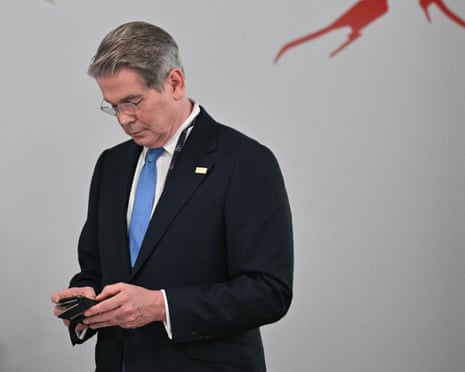
As day 2 of the summit gets under way, it briefly looked like we would have a prominent absence with the US secretary of commerce, Scott Bessent taking the seat between Emmanuel Macron and Keir Starmer.
But just as Macron was instructing leaders how to use their microphones, the US president, Donald Trump, arrived slightly late and took the US seat.
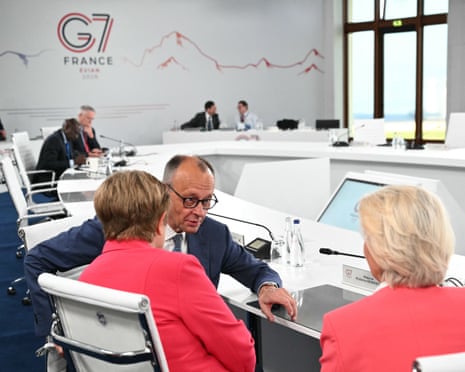
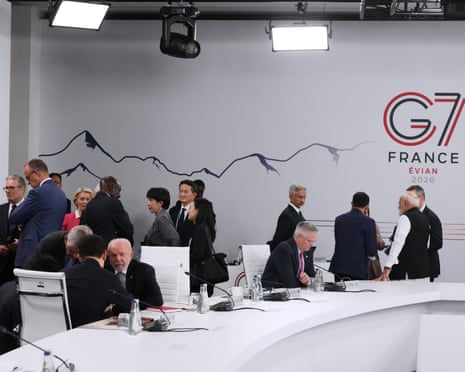
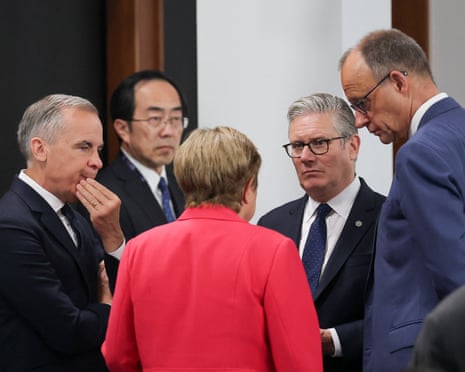
G7 summit continues with talks on economic growth, AI - in pictures
Day 2 of the G7 summit is about to formally get under way, with the focus today on economic growth and AI.
Let’s show you some pictures from inside the room as the invited leaders are gathering for their opening session.
Can Trump be convinced to back Ukraine? - The Latest podcast
Donald Trump has urged Russia to “make a deal” with Ukraine as the leaders of G7 countries meet on Tuesday and try to put the conflict back at the top of the agenda.
European leaders are hoping to capture Trump’s attention for long enough to speak to him about Ukraine, with the US president’s focus more on the US-Israeli war against Iran.
Nosheen Iqbal speaks to the Guardian’s Europe correspondent, Jon Henley.
Starmer’s waning influence is apparent at awkward G7 summit

Alexandra Topping
in Évian les-Bains
The wait for Keir Starmer’s first session of the G7 gathering in Évian-les-Bains was undoubtedly awkward.
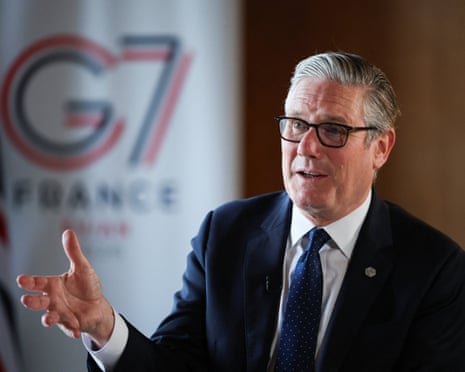
A meeting about the future of Ukraine had been due to start at 9am but more than half an hour later, Donald Trump, Volodymyr Zelenskyy and Emmanuel Macron were nowhere to be seen.
On a live Reuters feed, Starmer could be seen standing next to the leaders of Canada and Japan as they milled about making small talk. “Are they, are they having a meeting?” the British prime minister could be heard asking.
If he was referring to the missing attenders, and they were indeed having a meeting, it was clear he hadn’t been invited.
It was a moment that epitomised Starmer’s fragility during what could be one of his final outings on the world stage.
Arriving on the red carpet at the Hotel Royal, the luxurious G7 venue on the shores of Lake Geneva, he smiled and shook hands, seemingly untroubled by the prospect of a leadership challenge that could come within days if Andy Burnham is elected in the Makerfield byelection on Thursday.
Morning opening: G7 commits to 'unwavering support for Ukraine'
Jakub Krupa
Despite some early concerns about Donald Trump’s position, the G7 leaders meeting in France have agreed on a statement declaring their “unwavering support for Ukraine in defending its freedom, sovereignty, and territorial integrity.”
The statement, published overnight, says:
“We commend Ukraine for its resilience and progress on the battlefield in recent months and emphasise there is now a new momentum.
To support and accelerate this new momentum, we agree to increase the delivery of air defence capacities, additional systems and interceptors, and long-range capabilities.
We are also ready to consider extending to Ukraine the benefit of licenses to allow for an increase in Ukraine’s military production.”
In a classic Trump-era move, the statement on Ukraine also includes some pointed praise of the US president in a pointed attempt to keep him on side:
“We commit to increase the pressure on the Russian war economy. In this context, we will strengthen our sanctions, including those on the oil and gas sectors. We consider this the right moment to proceed with additional measures, as president Trump has delivered a deal that we support in reopening the strait of Hormuz.”
I guess, whatever works, right?
The leaders will continue their talks today discussing economic growth and AI, with the latter session likely to get some attention as they will meet with the bosses of OpenAI and Anthropic.
Later tonight, France’s Emmanuel Macron will host the US president at the Palace of Versailles to mark the 250th anniversary of the US independence. Unusually enthused Trump said last night that it was “a real deal,” and that he was looking forward to it.
Separately, we will hear from Nato’s secretary general Mark Rutte this morning ahead of tomorrow’s meeting of the alliance’s defence ministers – and less than a month before the much-dreaded Ankara summit, which once again will be all about keeping Trump on side.
Lots to cover today.
It’s Wednesday, 17 June 2026, it’s Jakub Krupa here, and this is Europe Live.
Good morning.