3 months ago
155
3 months ago
155
Today so far
Here is a summary of today’s events so far:
-
World leaders have been reacting to Donald Trump’s earlier declaration that the US Navy would start blockading the Hormuz strait and also prohibit every vessel in international waters that had paid a toll to Iran. UK prime minister Keir Starmer was adamant that the UK does not support the blockade and that “we are not getting dragged into the war”. Meanwhile, Ursula von der Leyen, president of the European Commission, said that restoration of freedom of navigation in the strait of Hormuz is of “paramount” importance.
-
US Central Command said it would begin a blockade of all Iranian Gulf ports and coastal areas on Monday at 10am ET (5.30pm in Iran and 1400 GMT), effectively seizing control of maritime traffic in the strait of Hormuz. Reuters reports that the US military has sent a note to seafarers warning that the blockade will apply to all vessel traffic, regardless of flag.
-
Trump lashed out on social media at Pope Leo XIV, who, over the weekend, had called for an end to war without directly mentioning the conflict in Iran. The US president posted a more than 300-word diatribe on Truth Social accusing the pope of catering to the “Radical Left” and being “terrible” for foreign policy.
-
The pope on Monday told reporters that he has “no intention to debate” with Trump over Iran – but when on to say that he will “continue to speak out loudly against war, looking to promote peace, promoting dialogue and multilateral relationships among the states to look for just solutions to problems.”
-
Oil prices rose in early market trading after Trump’s blockade announcement. The price of US crude oil rose 8% to $104.24 a barrel and Brent crude oil – the international standard – rose 7% to $102.29. Australia’s share market dropped sharply on Monday morning.
-
Iran’s parliamentary speaker Mohammad Bagher Ghalibaf taunted Trump on X, saying in a post: “Enjoy the current pump figures. With the so-called ‘blockade’, Soon you’ll be nostalgic for $4–$5 gas.” Earlier he said Trump’s new threats would have no effect on the Iranian nation: “If you fight, we will fight … We will not bow to any threats.”
Key events Show key events only Please turn on JavaScript to use this feature
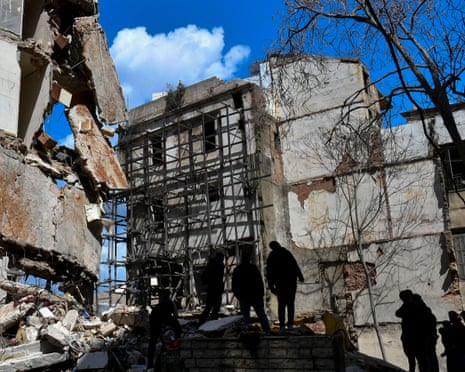
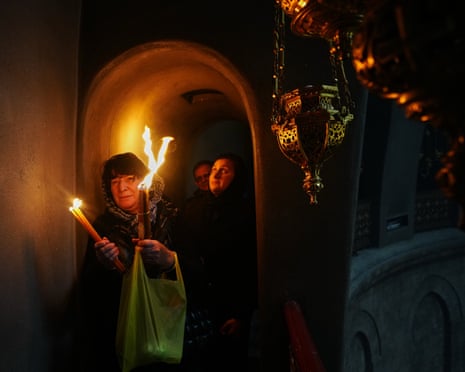
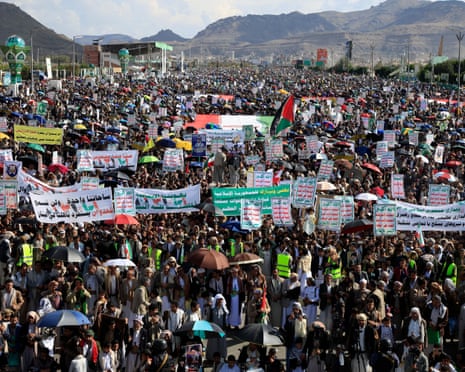
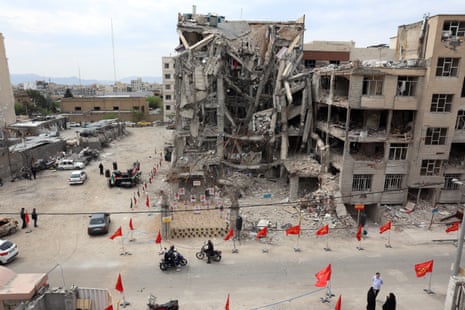
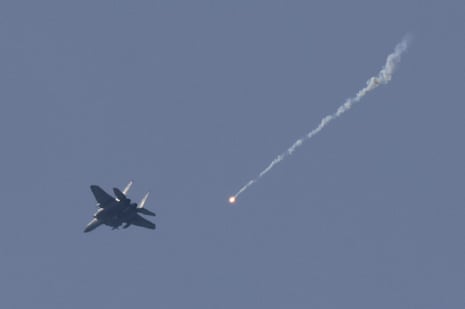
Here are some images coming out of the Middle East today:
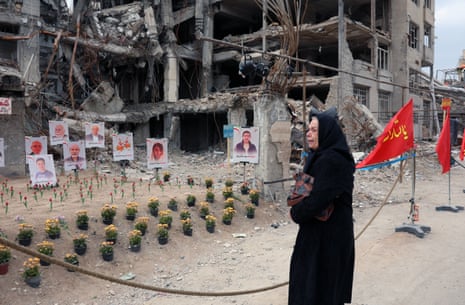
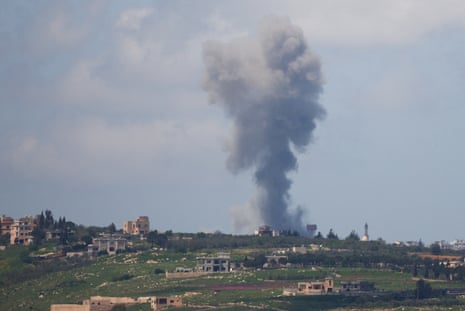
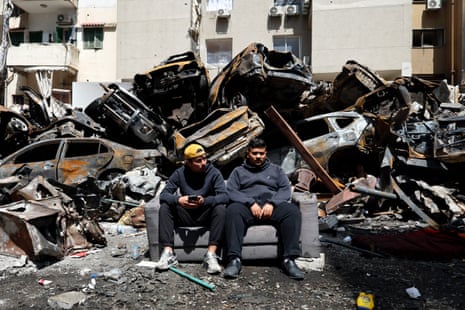
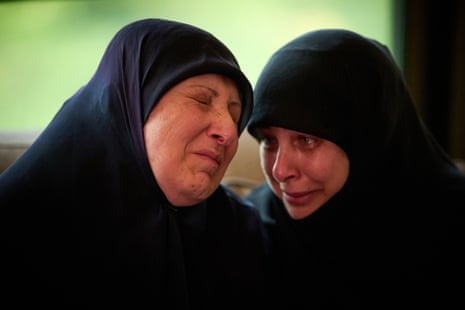
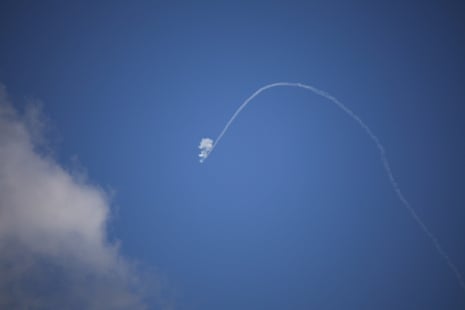
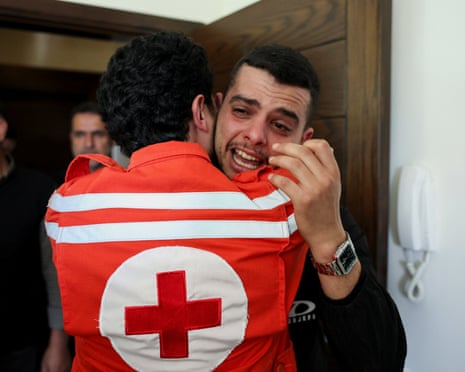
The International Committee of the Red Cross (ICRC) has said it is deeply concerned about attacks on medical workers in Lebanon after a Red Cross centre was struck by Israel on Monday, and the killing of a health worker on Sunday.
“The loss of those who dedicate their lives to saving others is gravely concerning, given the impact on the civilians who depend on their help,” said Agnes Dhur, head of delegation of the ICRC in Lebanon.
“Saving lives must never cost a life. Humanitarian and medical personnel must be protected. They must be allowed to reach and help the wounded and return unharmed.”
The ICRC called on all parties to the fighting to “uphold their obligations under international humanitarian law”.
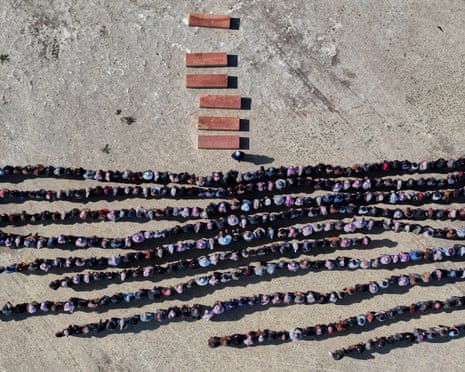
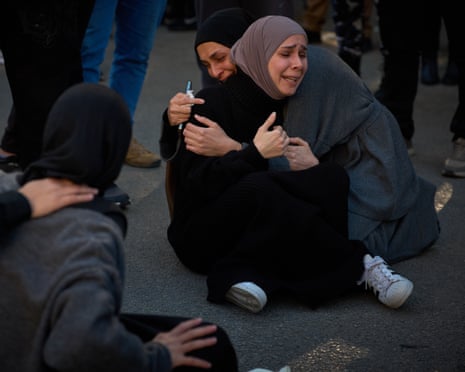
Red Cross paramedic Hassan Badawi was killed in an Israeli strike on Sunday. His funeral has taken place, and his colleagues are mourning.
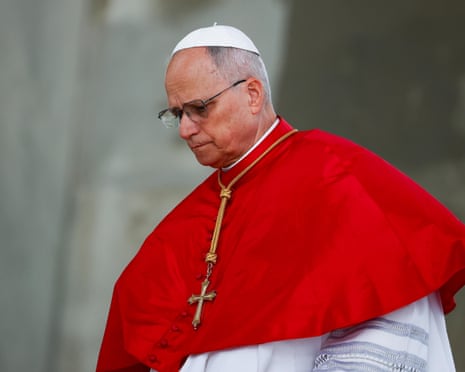
Pope Leo XIV has further defended his position of seeking peace, after US president Donald Trump criticised him for “catering to the Radical Left”.
“I have no fear of the Trump administration or speaking out loudly of the message of the Gospel, which is what I believe I am here to do, what the church is here to do,” the pontiff said.
“We are not politicians, we don’t deal with foreign policy with the same perspective (as) he might understand it,” he continued. “But I do believe in the message of the Gospel, as a peacemaker.”
This comes after Leo suggested over the weekend that “delusion of omnipotence” was fuelling the US-Israel war in Iran. In response, Trump said he doesn’t think the pontiff is not “doing a very good job”.
Both Trump and Pete Hegseth, his defence secretary, have invoked God and religious language in public messaging during the conflict. Hegseth has even framed the war effort as divinely supported, a sentiment that the pope has repeatedly refuted.
“Jesus is the king of peace, who rejects war, whom no one can use to justify war,” he said on Palm Sunday. “He does not listen to the prayers of those who wage war but rejects them.”
EU must scale up 'homegrown' renewable energy as war in Iran continues, European Commission president says

Jennifer Rankin
The EU needs to intensify the shift to “homegrown” and “reliable” renewable and nuclear energy, after the war in the Middle East added €22bn to its energy-import bill, the head of the European Commission said Monday.
Speaking to reporters in Brussels, Ursula von der Leyen promised a strategy next Wednesday outlining how the EU could contain the economic fallout from 44 days of turmoil in the Middle East, which began when the US and Israel launched strikes on Iran in late February.
Reflecting the uncertainty after the weekend’s inconclusive talks between the US and Iran – and Donald Trump’s subsequent social media posts – von der Leyen observed that “negotiations have been stalled now and we have to say how things go”.
Any agreement, she said, would have to address concerns raised by Iran’s nuclear and ballistic missile programme and the strait of Hormuz, as she said “the restoration of the freedom of navigation is of paramount importance for us”.
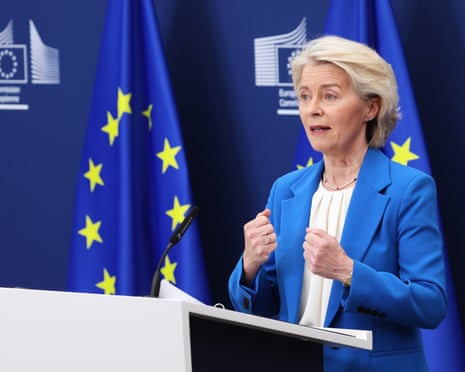
EU leaders remain concerned about Israel’s attacks on Lebanon and she called on “all parties” to respect Lebanon’s sovereignty and to implement a complete cessation of hostilities. “You cannot have stability in the Middle East or the Gulf while Lebanon is in flames.”
Most of her remarks were focused on the EU’s internal agenda in response to soaring energy prices. Von der Leyen said that during 44 days the EU’s import bill for fossil fuels had increased by more than €22bn, with “not a single molecule of energy in addition”.
She said the EU was paying “a high price for our over-dependency on fossil fuels” but went on to say that Europe had assets.
“We have the electricity that is produced in Europe, from renewables and from nuclear. And therefore our strategy to decarbonise has not only been confirmed in the last years, but is growing in importance day by day. And our objective is very clear. We need to scale up the homegrown, affordable, reliable energy,” von der Leyen said.
She said the EU’s 27 member states need to coordinate on gas storage filling and releasing oil stocks. The European Commission would consult countries on greater flexibility in state aid, rules governing subsidies and other support. She urged faster progress to agree on an EU draft law on grids that would help the shift to renewable energy, while also promising an electrification strategy and calling for governments to implement more energy-saving measures.
Today so far
Here is a summary of today’s events so far:
-
World leaders have been reacting to Donald Trump’s earlier declaration that the US Navy would start blockading the Hormuz strait and also prohibit every vessel in international waters that had paid a toll to Iran. UK prime minister Keir Starmer was adamant that the UK does not support the blockade and that “we are not getting dragged into the war”. Meanwhile, Ursula von der Leyen, president of the European Commission, said that restoration of freedom of navigation in the strait of Hormuz is of “paramount” importance.
-
US Central Command said it would begin a blockade of all Iranian Gulf ports and coastal areas on Monday at 10am ET (5.30pm in Iran and 1400 GMT), effectively seizing control of maritime traffic in the strait of Hormuz. Reuters reports that the US military has sent a note to seafarers warning that the blockade will apply to all vessel traffic, regardless of flag.
-
Trump lashed out on social media at Pope Leo XIV, who, over the weekend, had called for an end to war without directly mentioning the conflict in Iran. The US president posted a more than 300-word diatribe on Truth Social accusing the pope of catering to the “Radical Left” and being “terrible” for foreign policy.
-
The pope on Monday told reporters that he has “no intention to debate” with Trump over Iran – but when on to say that he will “continue to speak out loudly against war, looking to promote peace, promoting dialogue and multilateral relationships among the states to look for just solutions to problems.”
-
Oil prices rose in early market trading after Trump’s blockade announcement. The price of US crude oil rose 8% to $104.24 a barrel and Brent crude oil – the international standard – rose 7% to $102.29. Australia’s share market dropped sharply on Monday morning.
-
Iran’s parliamentary speaker Mohammad Bagher Ghalibaf taunted Trump on X, saying in a post: “Enjoy the current pump figures. With the so-called ‘blockade’, Soon you’ll be nostalgic for $4–$5 gas.” Earlier he said Trump’s new threats would have no effect on the Iranian nation: “If you fight, we will fight … We will not bow to any threats.”
US naval blockade will apply to all vessel traffic east of Hormuz strait
The US military has sent a note to seafarers warning that the blockade east of the strait of Hormuz will apply to all vessel traffic, regardless of flag, Reuters reports.
The blockade is scheduled to go into effect on Monday at 10am ET (5.30pm in Iran and 1400 GMT).
“Any vessel entering or departing the blockaded area without authorization is subject to interception, diversion, and capture,” the note said. “The blockade will not impede neutral transit passage through the strait of Hormuz to or from non-Iranian destinations.”
Netanyahu: Israel supports Trump's naval blockade of Iran
Benjamin Netanyahu, Israel’s prime minister, said on Monday that Israel supports Donald Trump’s decision to impose a naval blockade on Iran and Tel Aviv is coordinating with Washington on the situation, AFP reports.
“Iran violated the rules (of the peace talks in Pakistan), President Trump decided to impose a naval blockade,” Netanyahu said at a cabinet meeting, according to a video statement released by his office.
“We, of course, support this firm position, and we are in constant coordination with the United States.”
US Central Command said it would begin a blockade of all Iranian Gulf ports and coastal areas on Monday at 10am ET (5.30pm in Iran and 1400 GMT), effectively seizing control of maritime traffic in the strait of Hormuz.
A poll from the Hebrew University of Jerusalem has found that nearly two-thirds of Israelis oppose the Iran ceasefire, Reuters reports.
This poll was the first national survey of Israelis conducted after the US and Iran agreed last week to a two-week ceasefire brokered by Pakistan. According to the poll, more than 61 percent of Israelis believe that the ceasefire should not extend to the fighting with Hezbollah. Although Iran and Pakistan have asserted that the ceasefire includes Lebanon, Israel’s prime minister, Benjamin Netanyahu, has said there was “no ceasefire in Lebanon”.
The poll found the public to be divided on whether Israel should respect the two-week truce or resume attacks on Iran – 39 percent said Israel should continue attacks, 41 percent said their country should respect the ceasefire and 19 percent said they weren’t sure.
Though Pope Leo said he has “no intention to debate” Donald Trump on Iran, he also said he plans on continuing to “speak out loudly against war”, Reuters reports.
“I will continue to speak out loudly against war, looking to promote peace, promoting dialogue and multilateral relationships among the states to look for just solutions to problems,” Leo told Reuters aboard a papal flight to Algiers for the pontiff’s first official trip to Africa.
“Too many people are suffering in the world today,” he said. “Too many innocent people are being killed. And I think someone has to stand up and say there’s a better way.“
Ursula von der Leyen, president of the European Commission, is speaking about Iran, the strait of Hormuz and the impact the conflict is having on Europe’s energy prices.
We’ll have more details here in a bit. Watch her remarks here:
The Israeli military said on Monday that it has begun targeted ground operations in the Bint Jbeil area in southern Lebanon.
While Iran and Pakistan have asserted that the temporary Pakistani-brokered ceasefire that began last week included Lebanon, Israel’s prime minister, Benjamin Netanyahu, has said there was “no ceasefire in Lebanon” and Israel would continue “to strike Hezbollah with full force”.
Pope Leo says he has 'no intention to debate' with Trump over Iran
Pope Leo XIV on Monday told reporters that he has “no intention to debate” with Donald Trump after the US president posted a more than 300-word diatribe on social media accusing the pope of catering to the “Radical Left” and being “terrible” for foreign policy, AFP reports.
Over the weekend, Leo, the first US-born pope, entered the international political arena when he said prayer for peace is “a bulwark against that delusion of omnipotence that surrounds us and is becoming increasingly unpredictable and aggressive.”
On Monday, the pope had a simple message for reporters aboard the papal plane as they headed to Algeria for the pontiff’s first visit to Africa: “I am not a politician.”
“I have no intention to debate with (Trump),” Leo said. “The message is the same: to promote peace.”
On Sunday night, Trump posted on Truth Social that Leo was “Weak on Crime, Weak on Nuclear Weapons”.
“I don’t want a Pope who thinks it’s OK for Iran to have a Nuclear Weapon. I don’t want a Pope who thinks it’s terrible that America attacked Venezuela…And I don’t want a Pope who criticizes the President of the United States because I’m doing exactly what I was elected, IN A LANDSLIDE, to do,” Trump said.
In the same post, Trump added: “If I wasn’t in the White House, Leo wouldn’t be in the Vatican.” An hour after the intial statement, Trump posted an AI-generated image portraying him as Jesus, blessing an elderly man on a bed while a nurse and soldier gaze up at him in awe.
'We are not getting dragged into the war', says British PM
When pushed on Monday, UK prime minister Keir Starmer refused to take a harder stance on the conflict and speak out against Donald Trump.
When asked by BBC’s 5Live Breakfast on whether he held Trump responsible for the rising energy costs caused by the closure of the strait of Hormuz, Starmer said he blamed Iran, which began preventing ships and tankers from traversing the waterway in response to the US and Israel striking thousands of targets and killing dozens of the country’s most senior leaders.
“Where the blame lies, it’s Iran that has caused the restriction on traffic and vessels through the Gulf and they’re doing that in breach of international law,” Starmer said.
On Sunday Trump once again lashed out at the UK’s actions during the conflict and repeated a jibe that appeared to compare Starmer to Neville Chamberlain, who has long been criticised for following a policy of appeasement toward Adolf Hitler.
But Starmer refrained on Monday from responding to Trump’s jibes and instead reiterated his position that any UK action in the conflict will remain purely defensive and in protection of British lives and interest.
“My decision has been very clear that whatever the pressure – and there has been some considerable pressure – we are not getting dragged into the war. The UK is not getting dragged into the war,” Starmer said. “That is not in our national interest because I’m not going to act unless there’s a clear lawful basis and a clear thought-through plan.”
UK's Starmer: 'We're not supporting the blockade'
UK prime minister Keir Starmer on Monday reiterated his government’s position that the UK will not be involved in a blockade of the strait of Hormuz.
In an interview with BBC’s 5Live Breakfast, Starmer said all British efforts at the moment are focused on getting the strait fully open.
“All the time the strait is shut or not free for navigation in the way it should be, that means oil and gas is not getting to market, that means the price is going up and everybody listening to this is facing higher energy bills,” Starmer said. “I don’t want that to happen. I want their energy bills to be stablised and lower.”
Donald Trump had previously said on Fox News that “it won’t take long to clean out the strait” and that “numerous countries are going to be helping us”, adding that the UK and other nations were sending minesweepers.
Starmer confirmed that while the UK does have minesweeping capability in the region, “all of the marshalling diplomatically, politically…that’s all focused on geting the strait fully open.”
For more, follow here for live updates on UK politics.
Nine people were killed and 13 wounded in an Israeli attack on the town of Tefahta in southern Lebanon on Sunday, the state-run National News Agency said.
Since 2 March, at least 2,055 people have been killed and 6,588 wounded in the conflict, according to Lebanon’s Ministry of Public Health.
Donald Trump launches extraordinary attack on Pope Leo calling him ‘weak’ and ‘terrible’
President Donald Trump has delivered an extraordinary broadside against Pope Leo XIV, saying he didn’t think the US-born leader of the Catholic church was “doing a very good job” and that he was “a very liberal person”, while also suggesting the pontiff should “stop catering to the Radical Left”.
Flying back to Washington from Florida on Sunday night, Trump used a lengthy social media post to sharply criticise Leo, then kept it up in comments on the tarmac to reporters.
“I’m not a fan of Pope Leo,” he said.
Trump’s comments came after Leo suggested over the weekend that a “delusion of omnipotence” was fuelling the US-Israel war in Iran. While it’s not unusual for popes and presidents to be at cross-purposes, it’s exceedingly rare for the pope to criticise a US leader – and Trump’s stinging response is equally uncommon.
“Pope Leo is WEAK on Crime, and terrible for Foreign Policy,” the president wrote in his post, adding: “I don’t want a Pope who thinks it’s OK for Iran to have a Nuclear Weapon.”
You can read our full report here:
Oil price rises back over $100 a barrel after Trump announces naval blockade of strait of Hormuz
Donald Trump’s threat to impose a blockade on the Strait of Hormuz has driven the oil price back over $100 a barrel again, as hopes of an end to the conflict soon take another knock.
My colleagues on the business desk are covering the impact over in our business live blog.
You can read their coverage here:
We also have this explainer here:
Interim summary
If you’re just tuning in to today’s live coverage of the US-Israel war on Iran, here’s the latest to bring you up to speed. It’s 9.30am in Tehran, 9am in Tel Aviv and Beirut and 2am in Washington DC.
-
Donald Trump has said he doesn’t care if Iran comes back to negotiations with the US after the weekend talks in Pakistan ended without a deal. “I don’t care if they come back or not,” Trump told reporters in Maryland on Sunday. “If they don’t come back, I’m fine.”
-
Trump said earlier that the US Navy would start blockading the Hormuz strait and also prohibit every vessel in international waters that had paid a toll to Iran. US Central Command said later it would begin a blockade of all Iranian Gulf ports and coastal areas on Monday at 10am ET (5.30pm in Iran and 1400 GMT), effectively seizing control of maritime traffic in the strait of Hormuz.
-
Iran’s Revolutionary Guards warned that “approaching military vessels to the strait of Hormuz is considered a violation of the ceasefire”.
-
Oil prices rose in early market trading after Trump’s blockade announcement. The price of US crude oil rose 8% to $104.24 a barrel and Brent crude oil – the international standard – rose 7% to $102.29. Australia’s share market dropped sharply on Monday morning.
-
Iran’s parliamentary speaker Mohammad Bagher Ghalibaf taunted Trump on X, saying in a post: “Enjoy the current pump figures. With the so-called ‘blockade’, Soon you’ll be nostalgic for $4–$5 gas.” Earlier he said Trump’s new threats would have no effect on the Iranian nation: “If you fight, we will fight … We will not bow to any threats.”
-
Trump and his advisers are looking at resuming limited military strikes in Iran in addition to the US blockade of the Hormuz strait, the Wall Street Journal reported, citing officials and people familiar with the situation.
-
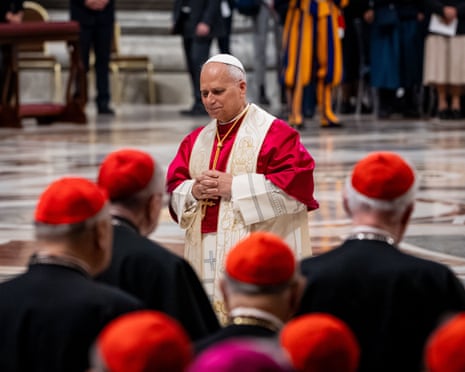
Trump launched a scathing attack on Pope Leo XIV, saying he was “weak on crime and terrible for foreign policy”, was catering to the left and was “hurting the Catholic church”. Leo should “focus on being a Great Pope, not a Politician”, the president said on Truth Social. The attack came after Leo denounced a “delusion of omnipotence” as fuelling the US-Israel war in Iran and urged political leaders to stop and negotiate peace.
-
Lloyd’s List Intelligence said “all traffic” through the strait of Hormuz stopped after Trump announced the US naval blockade. It said two vessels that were leaving the strait turned around after the post.
-
Trump’s threatened blockade could boost oil prices by $5 to $10 a barrel, estimates Michael Lynch, a distinguished fellow at the Energy Policy Research Foundation.
-
More than 32 million people worldwide could be plunged into poverty by the economic fallout from the Iran war, with developing countries expected to be hit hardest. The UN Development Programme said in a report that the world was facing a “triple shock” involving energy, food and weaker economic growth, reports Richard Partington.
-
Trump reiterated his threat to destroy Iran’s power plants and other civilian energy infrastructure if no deal was reached to end the war.
-
Australian prime minister Anthony Albanese said negotiations to stop the war should resume quickly, as the country called for the full reopening of the Hormuz strait and free navigation for all nations.
Here are some of the latest images coming in from the Middle East amid the countdown to the US naval blockade on Monday.