1 month ago
112
1 month ago
112
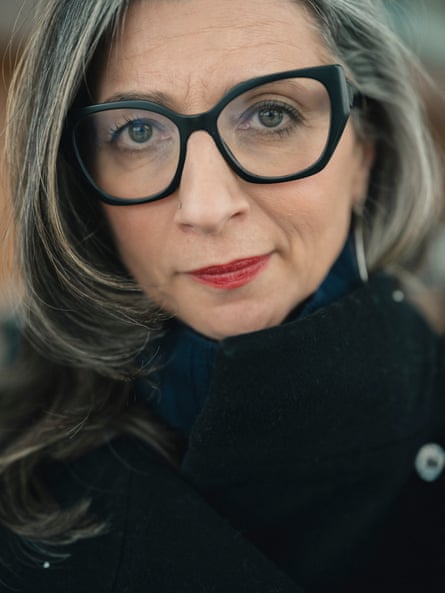
In retrospect, arranging to interview Francesca Albanese in a cafe was not the best plan. Before we could start, the waitress wanted a photo with the Italian human rights lawyer. So did the cashier. Then the cook came out of the kitchen in his whites for a group photo. Some of the customers wanted their turn. Albanese was gracious with all comers and chatty in three languages, so the process took some time.
Albanese, 49, has been getting similar rock star welcomes everywhere she goes lately, which is not the norm for unpaid UN legal experts. In other times, her job title – UN special rapporteur on the situation of human rights in the Palestinian territories occupied since 1967 – would sound like a recipe for obscurity. She is one of more than 40 special rapporteurs, human rights experts appointed to do pro bono investigations and reports on areas of concern.
These are no ordinary times, however. The untreated wound of Israel-Palestine has shown its capacity every generation to give the rest of the world a fever. The Hamas attack on 7 October 2023, which killed about 1,200 people, provoked a ferocious Israeli response that has killed more than 75,000 Palestinians in Gaza, displaced more than 90% of its population and reduced the overwhelming bulk of the territory to ruins.
Albanese was not the first person to describe the Israeli military campaign as a genocide, but she was the first person with the initials UN in her title to do so. She has used her megaphone consistently over the past two years not just to condemn the Israeli government and its military, but also the constellation of western states and corporations that have abetted them. Her message, delivered emphatically in person and in a series of UN reports, is that we are living in an interlocking system that has shown itself capable of mass killing.
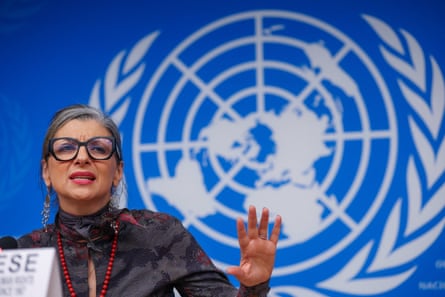
For her public stance, Albanese’s life has been threatened and her family put in danger. She has faced the prospect of arrest in Germany for her choice of words. Donald Trump’s administration has named her a “specially designated national”, a term usually reserved for terrorists, drug traffickers and the occasional murderous dictator. She is the first UN official to have received the designation.
“It was bad. That sort of puts you together with mass murderers and drug dealers of international proportions,” Albanese says. “It was a paradox of facing one of the harshest forms of punishment without due process, because I’ve not even been afforded the possibility to defend myself. I’ve just been sanctioned without trial.”
Trump’s executive order sanctioning Albanese prohibited any American person or entity from providing her with “funds, goods or services” – a description so broad it has been compared to a “civil death”. Her apartment in Washington, bought when she and her family were living in the US capital, has been seized. She can no longer use a credit card anywhere in the world, as almost all such transactions are processed by US-based services. “I go around with cash or I have to borrow from friends or from family members,” she says.
She accuses pro-Israel activists based in Geneva of hounding her husband, Massimiliano Calì, a senior economist at the World Bank, in a campaign that led to him being removed from his lead position running its Syria file. “The World Bank was completely craven,” Albanese says. “He has stellar records of performance in all his positions.”
Calì and the couple’s 13-year-old daughter, a US citizen, are suing Trump and top administration officials in federal district court in Washington for the breach of their constitutional rights under the first, fourth and fifth amendments and seizure of property without due process. Under UN policy, Albanese is not able to bring the case in person; a group of US law professors filed an amicus brief on the family’s behalf, warning of the “chilling effect” the personalised sanctions had on free speech.
Albanese’s demonisation by the Trump administration has only enhanced her status as a popular hero to some. She is part of a small but striking resurgence of the left spurred by Gaza outrage in the west that also includes Zohran Mamdani’s mayoral win in New York and the rise of Zack Polanski and the Green party in the UK.
“The genocides in Rwanda and Bosnia did not bring this mass reaction,” Albanese says. “So it means that human rights are better understood now. This is a test for universality of rights and for humanity.” The difference in the public response is due partly to western complicity. The slaughter in Rwanda was carried out with machetes, the mass executions in Srebrenica by machine guns and assault rifles. Many Palestinians in Gaza were killed by precision bombs supplied by the US, guided by AI-assisted, target-selecting algorithms. It is very much a genocide of the 21st century.
Alongside her human rights advocacy, Albanese is bringing out a book, When the World Sleeps: Stories, Words and Wounds of Palestine, which is part memoir and part elegy to the Palestinians for what she sees as their dignity under oppression and their “rage without hate”. The book is built around the stories of 10 characters, beginning with Hind Rajab, a five-year-old girl who was killed in January 2024 in Gaza, curled up on the back seat of a family car, alongside four cousins, after hours appealing for help on a telephone call to the Palestinian Red Crescent.
Also among the characters is Alon Confino, an Italian Israeli university professor who died in 2024; he came to Albanese’s defence when she was first accused of antisemitism. He was among the hundreds of Jewish progressives with whom she has campaigned against definitions of antisemitism that include criticism of the Israeli state, a blurring of lines that is, they argue, as dangerous for Jews as it is for Palestinians.
When the World Sleeps traces the roots of Albanese’s professed “intolerance for injustice” to growing up in a small town in southern Italy, in a world suffused with organised crime and clientelist governance, in which a citizen is only as successful as their political connections. “I was horrified when I was young by this mentality where you can be good at what you do, but you never trust yourself, so you always ask the powerful: ‘Can you please help?’” she says.
Her disdain for this pervasive corruption was inspired by her parents, who refused to succumb to it. Her role models were Italy’s martyrs to justice: Paolo Borsellino, an anti-mafia magistrate assassinated by a car bomb in 1992, and his colleague Giovanni Falcone, killed the same year with his wife and three bodyguards when the mafia blew up a whole section of motorway as their car was passing over it. “I went through the pain of a nation for the loss of these two precious figures of justice,” she says. “That planted an important seed in me.”
She thought of them especially when she began to receive death threats after she presented her March 2024 report on the Gaza conflict, which she called Anatomy of a Genocide. One anonymous caller said her daughter would be raped, giving the name of the school she attended in Tunis, Tunisia, where the family lives. Albanese went to the police for protection. While she doesn’t give details of the arrangements, she says: “I have what I need.”
She describes the period after Anatomy of a Genocide as “brutal”. “That is when I started wondering: is it worth it? I have two kids. What if they harm them? I cannot take this responsibility,” she says. She describes the dilemma as an “unresolved question”, although what she says next suggests she has resolved it for the time being: “There is a lot that I’m putting on the line, but, at the same time, I don’t have any alternative. I still need to continue to throw water on the fire and I have a bigger bucket right now … and strong arms.”
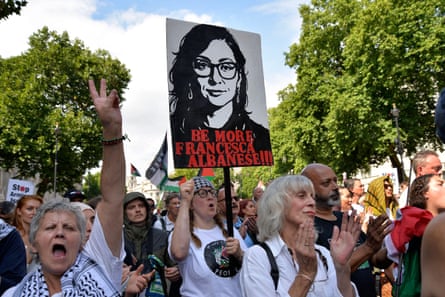
Her big bucket is the UN mandate her team has to investigate and report at the highest level internationally – and she intends to continue throwing water for the remaining two years of her second three-year term. She believes she is up against not just Trump’s and Benjamin Netanyahu’s governments, but also “predatory elites” around the world who are prepared to defend the accumulation of unprecedented riches with violence. Israel’s war against Palestinian resistance is one of many battlefields, she says.
Last year, Germany tried to ban her and sent riot police to a venue where she was due to speak. The police even threatened to arrest her for having referred to two genocides Germany carried out in the first half of the 20th century: that of the Herero and Nama peoples in Namibia and then the Holocaust. By putting the two in the same category, she was told she had trivialised the Holocaust, potentially a criminal offence. She had also referred to the area under Israeli control as “from the river to the sea”, a phrase banned in Germany because of its use by Hamas.
She describes the UK as more outwardly polite, although she adds: “[Keir] Starmer probably hates me as much as [Giorgia] Meloni and [Emmanuel] Macron.” She describes the UK government’s suppression of Palestine Action as “brutal” and the prime minister as a “monster” for arguing in 2023 that Israel “has the right” to cut off electricity and gas to Gaza: “You’re not a human rights person at all if you say such a monstrosity. And the university who gave you your law degree should take it away from you.”
In June 2025, Albanese published a report titled From Economy of Occupation to Economy of Genocide, which showed how many of the world’s corporations, including household names, had investments linked to Israel’s occupation of Palestinian territories.
When I canvassed others in the international human rights field on their views of Albanese before our interview, I found great admiration for her commitment and impact, caveated in a few cases by regret that she has mixed the language of the dispassionate lawyer with the passionate rhetoric of a political campaigner. This makes her an easier target for those defending war crimes, the doubters argued.
Albanese has been cheerful and amicable throughout our conversation, but my mention of these criticisms draws a flash of anger. “So don’t ask me political questions,” she says. “This is such a paternalistic approach. It always comes from men.”
When I counter, sheepishly but truthfully, that the comments had come from women, Albanese was unfazed. “There are alpha people among women as well,” she says. “Excuse me, why can’t I express a political view? Everything that is being done is political. The way human rights are not respected is political. But we are used to thinking in silos, so I need to stay in my silo?”
At this strained moment, another of the cafe’s customers, a young woman, approaches. “Can I just interrupt you to say that I admire you. Thank you. You’re doing a great job,” she tells Albanese. The admirer is Greek, and Albanese is delighted, telling her she will soon be presenting the Greek translation of her book in Athens and that they should meet again then.
It’s another reminder of the special rapporteur’s extraordinary visibility and clout. When the woman has gone, an assuaged Albanese addresses the possibility of a future in politics. “In Italy, some people are scared and some hopeful that I’m going to get into a political party. And, frankly, if there was a party that really looked like a home big enough for me to continue to be who I am, I would do it,” she says, before quickly adding: “There is not.”
She is too much a creature of the last century, she says, with all the biases that come with that vintage. Instead, she sees it as her role to “make space” for members of a younger generation who are “wise enough and humble enough to get into politics and take good care of what remains of our world”.
That evening, a long line of students from around the world, many with Palestinian keffiyehs around their necks, forms outside the University of Geneva to hear Albanese speak. It is the second event she has been invited to on the campus and the hall is packed well beyond its 400 capacity.
She speaks the same way to the crowd as she does in private – chatty, humorous, anecdotal and sweeping. She offers a narrative of hope that the world is in the throes of transformation. “Justice will bloom for you and your children,” she tells the hall. “We have it in our power to undo this. We will change it. Collectively, we are doing better. This is the first genocide that has caused an upheaval. Palestine has become a wound, but it has become our wound.”
The students applaud virtually every second sentence and almost all of them stay to ask questions. A young Georgian woman gets up to say that Albanese has inspired everyone in her circle. Another woman asks about how to find political courage, hinting that she has lost a job for speaking out about Gaza. Albanese’s counsel is never to concede: “My life has become a rollercoaster,” she says in reference to the death threats and sanctions. “I never imagined living without a bank card, but I do. People help me. My freedom is stronger than my fear. You are defeated the moment you stop fighting.”
When the World Sleeps: Stories, Words and Wounds of Palestine is published in Australia (Hardie Grant, A$24.99) and the US on 28 April (Other Books, US$28.99) and in the UK on 30 April (Hardie Grant, £16.99)