2 months ago
112
2 months ago
112
At first, it seemed like a natural progression. I have long been a surf fan, I regularly write about the World Surf League (WSL) Championship Tour, and once even tried my hand in a local surf competition. And so in recent years, during breaks between top-tier WSL events, I found myself glued to live streams for the second tier, the Challenger Series.
Only this year, the WSL wrapped up in September, and the Challenger Series had major gaps in its schedule. And that was how I found myself addicted to third-tier surfing, the WSL Qualifying Series (QS). What started with watching the best surfers in the world on the best waves in the world ended with the Taiwan Open of Surfing. Jinzun Harbor is not Teahupo’o or Pipeline, but, for the surf-starved, it is better than nothing.
The QS is the lowest rung on the ladder that is competitive surfing. The competition is divided into a regional format, with Australian surfers competing across the country and throughout Asia, for a precious few spots on the Challenger Series. Youthful surf prodigies vie with local stalwarts and nomadic veterans clinging on to the dream of WSL glory. Some events feature more than 100 surfers. Short, four-surfer heats in variable conditions make for frenetic action.
The competitive pyramid has a democratising effect on the sport. While there are of course many barriers to the elite level, and an athlete from the surfing heartlands – Australia, Hawaii, the US, and more recently Brazil – has institutional advantages, in theory at least it is a level playing field. Any young surf talent, anywhere in the world, can follow the pathway to the dream tour.
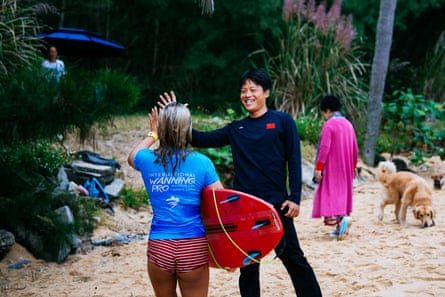
Thanks to the magic of technology, that pathway is also live streamed. Surfing has been a pioneer of streaming. The variable nature of waves necessitate an event window and the uncertainty about when exactly competition will run makes the sport less desirable for television networks. That reality, according to Will Hayden-Smith, who oversees the QS, has been a “blessing in disguise”. It has forced the WSL to develop to a position where it can “roll up to a jungle in Indonesia, with five suitcases of equipment and a commentary team, and we can be streaming on YouTube around the world,” he says.
These logistical challenges are no exaggeration. One popular QS event, the Krui Pro in Sumatra, Indonesia, requires surfers and the WSL’s broadcast team to fly to Jakarta, then to Lampung in southern Sumatra, and then embark on an eight-hour drive to the event site. There is barely internet at the contest site, but somehow the WSL beams a high-definition broadcast to the world – for free.


The broadcast is important, for at least three reasons. First, selfishly, it provides surf addicts like myself something to while away the time. Hayden-Smith compares it to Test cricket: “That’s one of the beauties of surfing – it’s a perfect sport to have on in the background.” (If any of my bosses are reading this, please be assured that watching third-tier surfing has no impact on my productivity).
Second, it provides an economic model for the events – which are often funded by local tourism authorities. The live streams are effectively advertorials for lesser-known waves, eager to attract surf tourism dollars (the WSL says it has data which shows major surf tourism growth off the back of QS events).
Hayden-Smith is in China, at the latest QS event, when I speak with him. It is a case in point: China is hardly a global surf hub, he says, but there are beautiful white sandy beaches, palm trees and a long left-hand point break in front of him. “Surfers love to travel – if you’re watching this event in China, you might have never thought about travelling to China, but maybe it gets added to your bucket list,” he says. “Surfers are curious about new waves.”
Third, because everyone starts at QS level, it is a great opportunity for fans to get to know the stars of the future. It is the Drive to Survive effect (at the top-tier level, the WSL had an equivalent, Make or Break, on Apple TV). If fans can follow someone from the QS to the CS to the CT, there is deeper emotional investment in the surfer and their career.
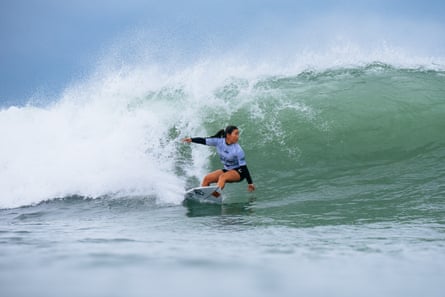
Some of the most exciting young Australians, including 19-year-old duo Dane Henry and Harley Walters, have impressed on the QS this year – they are tipped to be future WSL surfers. The Australia/Oceania regional rankings for women are topped by 15-year-old Lucy Darragh, after she won the Nias Pro and the Taiwan Open.
That, for me, was a surprise finding of my deep, months-long “investigation” into the QS – the kids are really, really good. The difference in quality between the best surfers in the world, and their semi-professional or even amateur third-tier counterparts, is not vast. Where once the top pros where on another planet, today the gap is marginal. That means good fortune can often be the difference between a Championship career and years slugging it out on the QS.
A few decades ago, a major surf brand had a hit campaign with a simple tagline: “Only a surfer knows the feeling.” As I was writing this column a surfer friend messaged me: “[I’m] so pro surfing starved I’m currently watching under-16s at [the International Surfing Association] juniors.” Perhaps only a true surf addict knows that feeling.