5 hours ago
10
5 hours ago
10
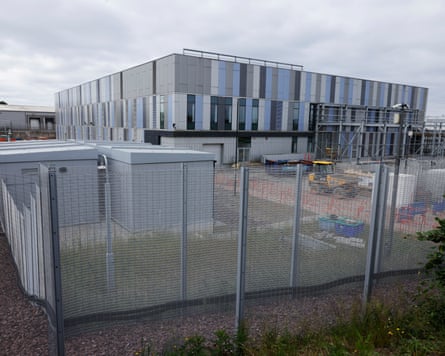
In a village 21 miles north of Edinburgh, a real estate consultancy plans to build a datacentre larger than the village itself – 35 metres high, with an area larger than 100 football pitches.
Billed as the second-biggest datacentre in the world, the development in Auchertool, Fife, has attracted 1,600 objections.
“The public pressure is huge,” said David Torrance, a member of the Scottish parliament representing the village. “I’ve never seen this level of objection to a local plan, and I have been in politics for 25 years.”
Similar concerns are being echoed across Scotland, next to gargantuan planned developments in towns such as Airdrie and Larbert. In a matter of weeks, as the Scottish parliament comes back into session, the growing opposition could pose a challenge to Britain’s AI strategy.
government is inching towards a moratorium,” said Kat Jones, director of the Edinburgh-based charity Action to Protect Rural Scotland. “MSPs return to parliament next week, after a summer in their constituencies where they have been hearing the concerns of local people about proposed hyperscale datacentres. They will be expecting action.”
For months, UK officials have been encouraging would-be datacentre developers to consider Scotland. In April, Fintan Slye, the chief executive of the UK’s National Energy System Operator (Neso), told a London audience to look north: “If in the audience you have a big datacentre and you want to go to Scotland, please come talk to me, we will help you,” he said.
“They are coming up here because we are energy-rich, and we are water-rich, and England is in drought and the grid is struggling,” said Torrance.
But Scotland, it turns out, isn’t having it. The proposal for Auchtertool is a behemoth: drawings show the 600MW datacentre towering over the village, dwarfing old stone houses and blocking the view of fields and forests.
“How can you possibly ask people to accept that?” Torrance said. “You can see why the public is objecting.”
Scotland has already started to take steps that could mean the Auchtertool datacentre – and dozens of others – may never be built.
This week, Scotland’s minister for public finance issued a new set of directions to regulate datacentres in the country. The first of these requires planning authorities to notify the government when they receive an application for a datacentre larger than 50MW – in other words, anything more than a twelfth of the size of Auchtertool.
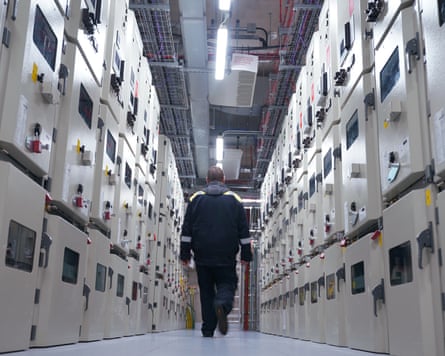
The minister has also required that certain datacentres, including Auchtertool, submit an environmental impact assessment. Their developers had previously argued that they were exempt.
In some senses, these are “obvious, bare-minimum” rules, said Jones. They mean that Scotland is starting to closely follow developments that stand to drastically reshape the landscape and resource consumption of the entire country.
The fact that giant datacentres can currently be built across Britain with little strategy and without government knowledge is a feature of an old and idiosyncratic planning regime; no one foresaw that giant tech companies would wish to litter the world with buildings the size of large monuments.
But these restrictions are just the start. The Scottish parliament will return at the end of this month. Three days after the session commences, in early September, campaigners plan a massive demonstration against datacentres in Edinburgh.
after newsletter promotion
That demonstration will aim higher. Campaigners have been calling for Scotland to put in place a full moratorium on datacentre development, to give the public and authorities time to examine the plans that are in the pipeline. This summer, the national council of the Scottish National party passed a motion to freeze all new datacentre projects that have not received planning permission.
Several weeks ago, Police Scotland warned another datacentre developer that public anger over datacentres could lead to incursions and posed a security risk, in what appeared to be the first-ever such warning in the UK.
A moratorium on datacentres could soon become policy. At the least, “you’ll see a lot more restrictions – and stronger guidance,” said Torrance.
Datacentre developers have other plans. Data Vita, the company building the UK’s AI growth zone in Lanarkshire, has recently been awarded an investment package which includes a £202m guarantee from the National Wealth Fund – although the Guardian’s investigations have revealed that its plans to power itself do not stand up.
Meanwhile, Mark Wilson, chief executive of ILI Group, the company building the datacentre in Auchtertool, spoke to the BBC’s Scotcast this week and defended its plans, suggesting that Torrance’s angry constituents were perhaps ill-informed.
“I understand how people can think in a rural area,” he said. “There’s a lot of misinformation out there, it’s mainly coming from overseas, from America.”
His company was part of a “once-in-a-lifetime opportunity” for Scotland to “create long-term economic benefit”, he said, through the jobs created by building datacentres. He conceded that most of the datacentre developments currently in the planning pipeline in Scotland were unlikely to be built.
“Scotland can be No1,” he said. “We can become a global hub for datacentres in Scotland.”