3 months ago
146
3 months ago
146
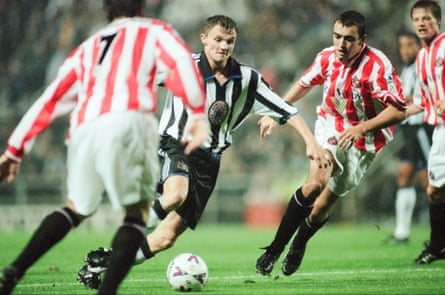
It was the final shot in a brutal civil war that left Newcastle reeling for a year. For Paul Robinson, though, Ruud Gullit’s decision to start him over Alan Shearer in the Tyne-Wear derby felt like a natural progression.
Tensions between Gullit and Shearer had been brewing since the Dutchman replaced Kenny Dalglish on 27 August 1998. Two days short of the first anniversary, everything came to a head when Newcastle’s talisman was not selected to start against Sunderland for the biggest game in the club’s calendar.
Four matches into the Premier League season, Newcastle were winless and in the bottom three. Robinson was a 20-year-old striker, born and raised in Sunderland, who had joined Newcastle from the fourth-tier side Darlington in March 1998. Looking back, as Newcastle prepare to host Sunderland again on Sunday, he wonders whether he was a pawn in a bigger story, but at the time there was no fear.
Shearer had been sent off in the season’s opening fixture, against Aston Villa, in which Robinson made his debut, and the derby was the first after his ban. “I started the game before, against Wimbledon, and got man of the match,” Robinson says. “I thought: ‘Well, yeah, why shouldn’t I start?’ In hindsight you don’t think you should be taking the place of the England captain, but I was young and full of myself.”
Failing to recall Shearer felt like Gullit was gambling everything for the ultimate jackpot. Win the game and with it he would win the power struggle. It was a huge story at the time.
“I wasn’t told I was starting,” Robinson says of the buildup. “It was a day or two before and I was in one team in training, Alan and Dunc [Duncan Ferguson] were in the other. It didn’t even click. When the team was announced, there were no nerves. It was a derby and I was playing in it. I was ready.”
Supporters were furious about Shearer’s absence and Robinson’s Sunderland allegiance created more anger. There were no split loyalties for Robinson on the night, but he admits his story fuelled the raw emotion for both camps before kick-off, and says Shearer remained the epitome of professionalism.
“I had done an interview for the matchday programme talking about being a Sunderland fan. I was asked if I would celebrate if I scored and I said no because of my family and friends. It got put in. My name got read out and people say some Newcastle fans booed me. The Sunderland fans booed me, my mates were giving me the finger.
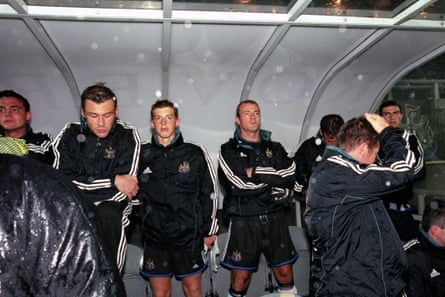
“Alan came into the dressing room before the game and said: ‘Robbo, we need to beat these.’ Not once did he look down at me or have a go at me. He was psyching me up to go out there and do a job.”
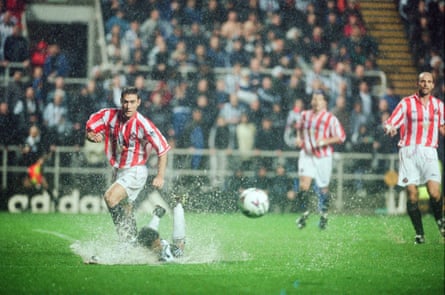
The rain felt apocalyptic, which was fitting, and the game started well for Gullit: Robinson fed Kieron Dyer for the opener. Second-half goals from Niall Quinn and Kevin Phillips turned the match around.
“The ball wasn’t rolling,” Robinson says. “I think the game would be called off now, but the ref might’ve been murdered. When Kieron scored, I went nuts. I didn’t keep my promise about not celebrating. A few people didn’t speak to me for a bit.
“Leading up to the game I rang up a couple of friends and told them I was starting and they put the phone down. I got a couple of messages, not very nice ones. It was the first time in my life I realised football is more to fans than players understand.”
Gullit’s post-match interview was the final note of a dramatic, damaging saga. He resigned three days later. “Ruud basically said when he brought me off and put Alan and Dunc on, he should have kept me on. Basically, he was digging them out. That was the first time I went: ‘Woah, that isn’t clever.’
“Obviously, he bigged me up. But was that my downfall? Was I a scapegoat? It was easy to put a young kid in and, if he got sacked or if he’d won and Alan would have left, say: ‘It was all Paul Robinson’s fault.’”
Sir Bobby Robson took over and Robinson departed the following summer for second-tier Wimbledon. The move did not work out and Robinson played for several lower-league teams, including Hartlepool and Torquay, and a string of non-league clubs until 2016. He had been declared bankrupt in January 2007 and spent time working as a delivery driver.
In 2020, he set up a coaching company, Strikes Coaching, with the idea of helping children in the Durham area find joy in the game.
“The ethos is every kid should be allowed to play,” Robinson says. “I’ll coach the way I want to. I’ve had my bit, but if I can give something back and make children love football, then great.”
Robinson has no regrets over his career. He still gets recognised and his story is a famous chapter in one of English football’s greatest rivalries.
“I was doing a delivery and this guy was staring at me. He said: ‘Excuse me, didn’t you used to be Paul Robinson?’ I said: ‘No mate, I still am. I haven’t changed my name!’ I wanted to play for England and to play in the Premier League. One out of two isn’t bad. I can say I kept Alan Shearer on the bench. Not many people can say that.”